

energy. Therefore, a chemical composition of antimony-germanate glasses (SGS) ,
consisting of glass-forming elements Sb 2 O 3 –GeO 2 –SiO 2 , as well as modifiers
Al 2 O 3 and Na 2 O, were proposed. In order to generate emission through energy
transfer, glasses were doped with lanthanide ion in following systems: Yb
3+ /Tm
3+ ,
Yb
3+ /Ho
3+ and Yb
3+ /Tm
3+ /Ho
3+ [39–42]. In each analyzed system, the ytterbium
ions functioned as a donor, which by transferring excitation energy to the remaining
acceptor ions (Tm
3+ , Ho
3+ ) in energy transfer processes (donor ! acceptor) led to
the energy levels of thulium and holmium ions. Co-doping has many benefits, one
being that we can use commercially available high-energy laser diodes that generate
radiation in the near-infrared (976 nm) range to achieve the conversion of excitation, which simplifies the future use of the fabricated glasses in photonic structures.
Also, the upconversion process enables radiative transitions to be obtained with
energy higher than the excitation energy, which is only observed in materials with
low-phonon energy, where the adverse impact of non-radiation transitions is minimized. In addition, by co-locating more than two rare-earth ions, it is possible to
obtain the emission of radiation simultaneously in several luminescence bands in
the visible range (multicolor emission).
The mentioned phenomena became the starting point for the research on new
antimony-germanate glasses, which combine high thermal stability, low phonon
energy, and optical properties necessary to carry out the emission of radiation in the
processes of converting excitation energy to higher energy levels. As cores of
optical fibers glass from the set of (25 − 30)Sb 2 O 3 –(25 − 30)GeO 2 –24SiO 2 –
10Al 2 O 3 –5Na 2 O, co-doped with oxides 1Yb 2 O 3 –xTm 2 O 3 , yHo 2 O 3 (x = 0, 0.1; 0.2;
0.5; 0.75, y = 0, 0.1; 0.2; 0.5; 0.75; mol%) were used [39, 41, 43]. In the first stage,
optimization of the concentrations of rare-earth ions was accomplished, to obtain a
maximum of luminescence intensity in the visible range. The analysis of the
intensity of luminescence in the band of 478 nm (
1 G 4 !
3 H 6 ) and 650 nm
(
1 G 4 !
3 F 4 ) as a function of Tm 2 O 3 content indicated that the maximum intensity
of luminescence obtained as a result of the Yb
3+ ! Tm
3+ energy transfer and
three-photon upconversion (k exc = 976 nm) was obtained in glass co-doped with
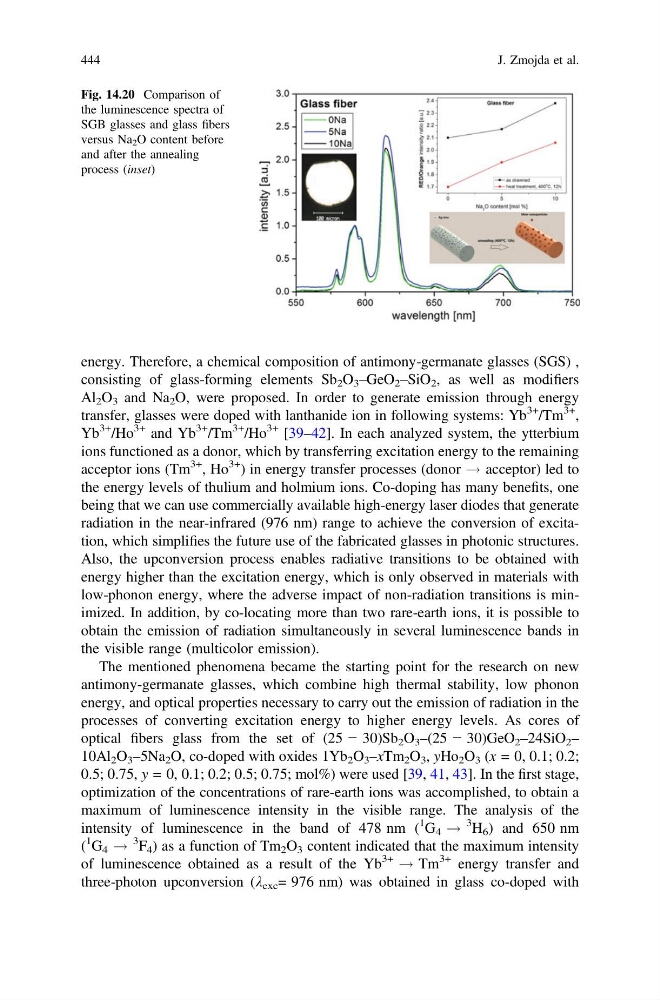
Fig. 14.20 Comparison of
the luminescence spectra of
SGB glasses and glass fibers
versus Na 2 O content before
and after the annealing
process (inset)
444
J. Zmojda et al.
consisting of glass-forming elements Sb 2 O 3 –GeO 2 –SiO 2 , as well as modifiers
Al 2 O 3 and Na 2 O, were proposed. In order to generate emission through energy
transfer, glasses were doped with lanthanide ion in following systems: Yb
3+ /Tm
3+ ,
Yb
3+ /Ho
3+ and Yb
3+ /Tm
3+ /Ho
3+ [39–42]. In each analyzed system, the ytterbium
ions functioned as a donor, which by transferring excitation energy to the remaining
acceptor ions (Tm
3+ , Ho
3+ ) in energy transfer processes (donor ! acceptor) led to
the energy levels of thulium and holmium ions. Co-doping has many benefits, one
being that we can use commercially available high-energy laser diodes that generate
radiation in the near-infrared (976 nm) range to achieve the conversion of excitation, which simplifies the future use of the fabricated glasses in photonic structures.
Also, the upconversion process enables radiative transitions to be obtained with
energy higher than the excitation energy, which is only observed in materials with
low-phonon energy, where the adverse impact of non-radiation transitions is minimized. In addition, by co-locating more than two rare-earth ions, it is possible to
obtain the emission of radiation simultaneously in several luminescence bands in
the visible range (multicolor emission).
The mentioned phenomena became the starting point for the research on new
antimony-germanate glasses, which combine high thermal stability, low phonon
energy, and optical properties necessary to carry out the emission of radiation in the
processes of converting excitation energy to higher energy levels. As cores of
optical fibers glass from the set of (25 − 30)Sb 2 O 3 –(25 − 30)GeO 2 –24SiO 2 –
10Al 2 O 3 –5Na 2 O, co-doped with oxides 1Yb 2 O 3 –xTm 2 O 3 , yHo 2 O 3 (x = 0, 0.1; 0.2;
0.5; 0.75, y = 0, 0.1; 0.2; 0.5; 0.75; mol%) were used [39, 41, 43]. In the first stage,
optimization of the concentrations of rare-earth ions was accomplished, to obtain a
maximum of luminescence intensity in the visible range. The analysis of the
intensity of luminescence in the band of 478 nm (
1 G 4 !
3 H 6 ) and 650 nm
(
1 G 4 !
3 F 4 ) as a function of Tm 2 O 3 content indicated that the maximum intensity
of luminescence obtained as a result of the Yb
3+ ! Tm
3+ energy transfer and
three-photon upconversion (k exc = 976 nm) was obtained in glass co-doped with
Fig. 14.20 Comparison of
the luminescence spectra of
SGB glasses and glass fibers
versus Na 2 O content before
and after the annealing
process (inset)
444
J. Zmojda et al.