

with the highest concentration of Ag
+ ions. A specific addition to research is the
extensive characterization of the structural and spectroscopic properties of the
fabricated antimony-germanate-borate SGB glass co-doped with ions of 0.2 mol%
Eu 2 O 3 and 0.6 mol% AgNO 3 [35]. In this case, the effect of modification of glass
structure with composition 25Sb 2 O 3 –25Ge 2 O 3 –5Al 2 O 3 –(40 − x)B 2 O 3 by Na 2 O
compounds on thermal stability and correlation of glass structural features with the
thermochemical reduction of silver ions due to the annealing process at 400 °C. The
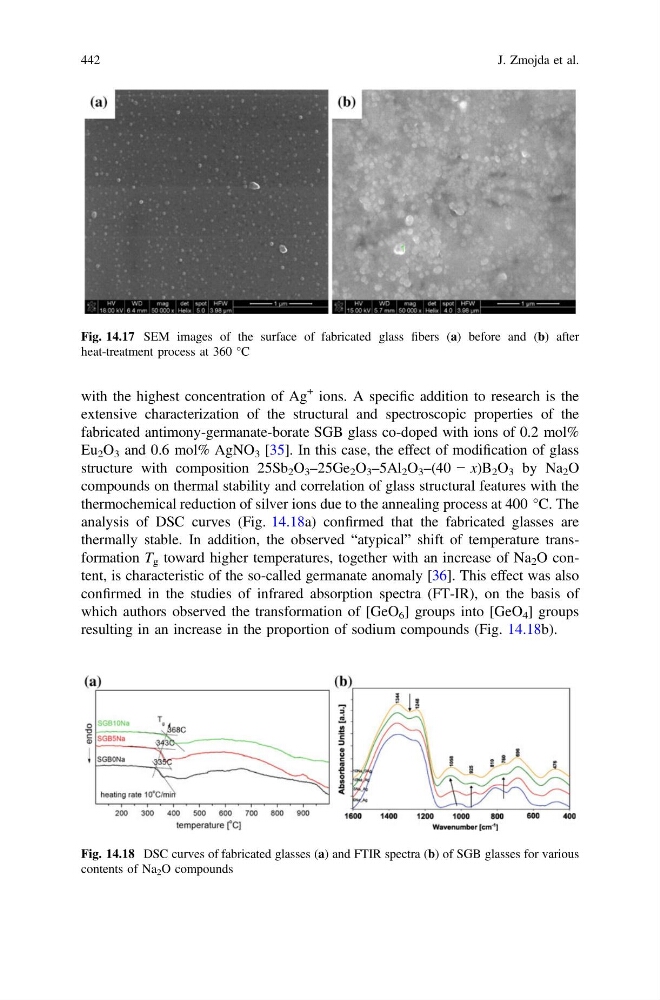
analysis of DSC curves (Fig. 14.18a) confirmed that the fabricated glasses are
thermally stable. In addition, the observed “atypical” shift of temperature transformation T g toward higher temperatures, together with an increase of Na 2 O content, is characteristic of the so-called germanate anomaly [36]. This effect was also
confirmed in the studies of infrared absorption spectra (FT-IR), on the basis of
which authors observed the transformation of [GeO 6 ] groups into [GeO 4 ] groups
resulting in an increase in the proportion of sodium compounds (Fig. 14.18b).
Fig. 14.17 SEM images of the surface of fabricated glass fibers (a) before and (b) after
heat-treatment process at 360 °C
Fig. 14.18 DSC curves of fabricated glasses (a) and FTIR spectra (b) of SGB glasses for various
contents of Na 2 O compounds
442
J. Zmojda et al.
+ ions. A specific addition to research is the
extensive characterization of the structural and spectroscopic properties of the
fabricated antimony-germanate-borate SGB glass co-doped with ions of 0.2 mol%
Eu 2 O 3 and 0.6 mol% AgNO 3 [35]. In this case, the effect of modification of glass
structure with composition 25Sb 2 O 3 –25Ge 2 O 3 –5Al 2 O 3 –(40 − x)B 2 O 3 by Na 2 O
compounds on thermal stability and correlation of glass structural features with the
thermochemical reduction of silver ions due to the annealing process at 400 °C. The
analysis of DSC curves (Fig. 14.18a) confirmed that the fabricated glasses are
thermally stable. In addition, the observed “atypical” shift of temperature transformation T g toward higher temperatures, together with an increase of Na 2 O content, is characteristic of the so-called germanate anomaly [36]. This effect was also
confirmed in the studies of infrared absorption spectra (FT-IR), on the basis of
which authors observed the transformation of [GeO 6 ] groups into [GeO 4 ] groups
resulting in an increase in the proportion of sodium compounds (Fig. 14.18b).
Fig. 14.17 SEM images of the surface of fabricated glass fibers (a) before and (b) after
heat-treatment process at 360 °C
Fig. 14.18 DSC curves of fabricated glasses (a) and FTIR spectra (b) of SGB glasses for various
contents of Na 2 O compounds
442
J. Zmojda et al.