

optical fiber was different from the spectrum obtained when the core material is
antimony-germanate glass modified with 0.5 mol% P 2 O 5 (Fig. 14.7). Changes
resulting from the additional thermal treatment of the core glass in the process of
fiber drawing are related to the partial ordering of the glass structure surrounding
the europium ions.
As a result, a decrease in the luminescent FIR asymmetry ratio, a narrowing of
the emission band at 616 nm (
5 D 0 !
7 F 2 ) and significant splitting of the emission
bandwidth corresponding to the
5 D 0 !
7 F 1 transition were observed. The obtained
results clearly indicate that in optical fiber produced with a core made of
antimony-germanate glass, the nanocrystallization of EuPO 4 takes place during the
fiber drawing process.
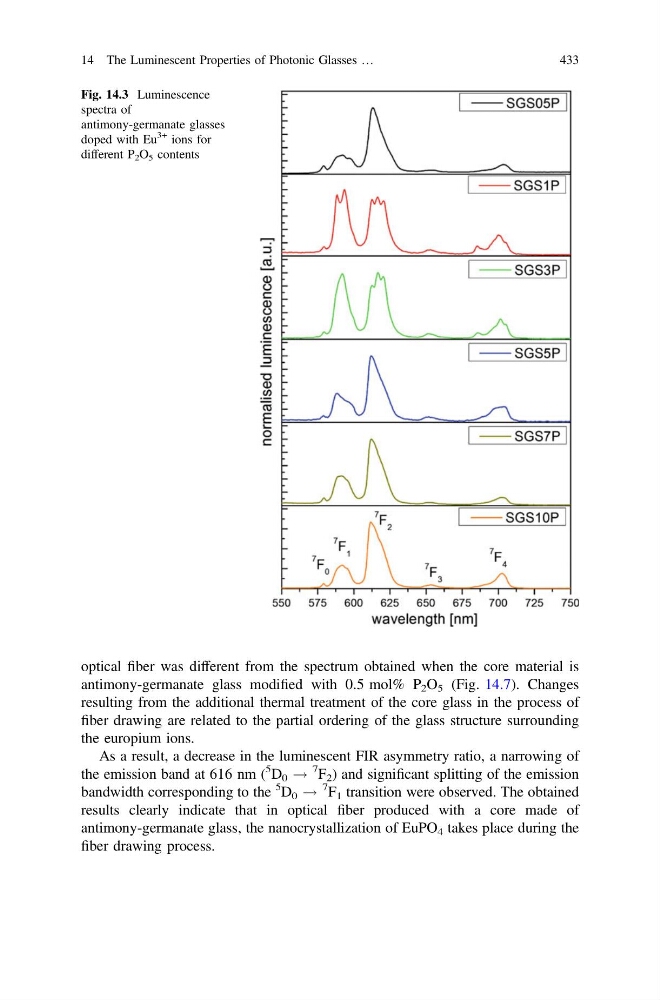
Fig. 14.3 Luminescence
spectra of
antimony-germanate glasses
doped with Eu
3+ ions for
different P 2 O 5 contents
14 The Luminescent Properties of Photonic Glasses …
433
antimony-germanate glass modified with 0.5 mol% P 2 O 5 (Fig. 14.7). Changes
resulting from the additional thermal treatment of the core glass in the process of
fiber drawing are related to the partial ordering of the glass structure surrounding
the europium ions.
As a result, a decrease in the luminescent FIR asymmetry ratio, a narrowing of
the emission band at 616 nm (
5 D 0 !
7 F 2 ) and significant splitting of the emission
bandwidth corresponding to the
5 D 0 !
7 F 1 transition were observed. The obtained
results clearly indicate that in optical fiber produced with a core made of
antimony-germanate glass, the nanocrystallization of EuPO 4 takes place during the
fiber drawing process.
Fig. 14.3 Luminescence
spectra of
antimony-germanate glasses
doped with Eu
3+ ions for
different P 2 O 5 contents
14 The Luminescent Properties of Photonic Glasses …
433