

for the modified glass of 5 mol% P 2 O 5, the local asymmetry field of the dopant,
defined by the ratio of (
5 D 0 !
7 F 2 )/(
5 D 0 !
7 F 1 ) transitions, was 0.92. The
obtained result confirms unequivocally that for the analyzed SGS5P sample, the
europium ions surroundings are characterized by a high degree of order, characteristic for crystals.
Also, the formation of EuPO 4 nanocrystals in the XRD pattern was observed
(Fig. 14.4). After the reference analysis of peak positions calculated reflections are
in good accordance with monoclinic EuPO 4 crystalline phase (ICSD:01-083-0656).
A visual confirmation of the glass-ceramic material are measurements of the
morphology of the samples made using SEM microscope where EuPO 4 micro- and
nanocrystals on the amorphous SGS glass structure were observed (Fig. 14.5).
Changes in the local environment were also confirmed based on the analysis of
luminescence decay time from the level of
5 D 0 . The double-exponential nature of
the decay curves indicates the presence of two glass structures: amorphous and
crystalline (Fig. 14.6).
By retaining the ability to reproduce the technological process and controlling
the content of P 2 O 5 compounds, authors determined that it is possible to create a
double-shell optical fiber with a glass-ceramic core made of EuPO 4 nanoparticles
[31]. On the basis of luminescence research, the shape of the spectrum obtained for
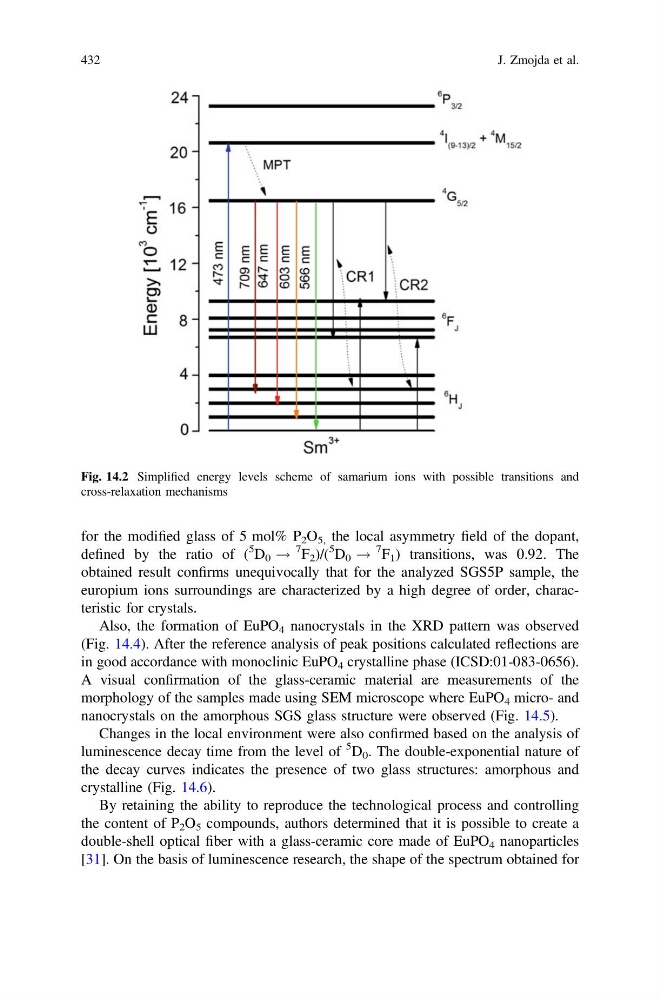
Fig. 14.2 Simplified energy levels scheme of samarium ions with possible transitions and
cross-relaxation mechanisms
432
J. Zmojda et al.
defined by the ratio of (
5 D 0 !
7 F 2 )/(
5 D 0 !
7 F 1 ) transitions, was 0.92. The
obtained result confirms unequivocally that for the analyzed SGS5P sample, the
europium ions surroundings are characterized by a high degree of order, characteristic for crystals.
Also, the formation of EuPO 4 nanocrystals in the XRD pattern was observed
(Fig. 14.4). After the reference analysis of peak positions calculated reflections are
in good accordance with monoclinic EuPO 4 crystalline phase (ICSD:01-083-0656).
A visual confirmation of the glass-ceramic material are measurements of the
morphology of the samples made using SEM microscope where EuPO 4 micro- and
nanocrystals on the amorphous SGS glass structure were observed (Fig. 14.5).
Changes in the local environment were also confirmed based on the analysis of
luminescence decay time from the level of
5 D 0 . The double-exponential nature of
the decay curves indicates the presence of two glass structures: amorphous and
crystalline (Fig. 14.6).
By retaining the ability to reproduce the technological process and controlling
the content of P 2 O 5 compounds, authors determined that it is possible to create a
double-shell optical fiber with a glass-ceramic core made of EuPO 4 nanoparticles
[31]. On the basis of luminescence research, the shape of the spectrum obtained for
Fig. 14.2 Simplified energy levels scheme of samarium ions with possible transitions and
cross-relaxation mechanisms
432
J. Zmojda et al.