

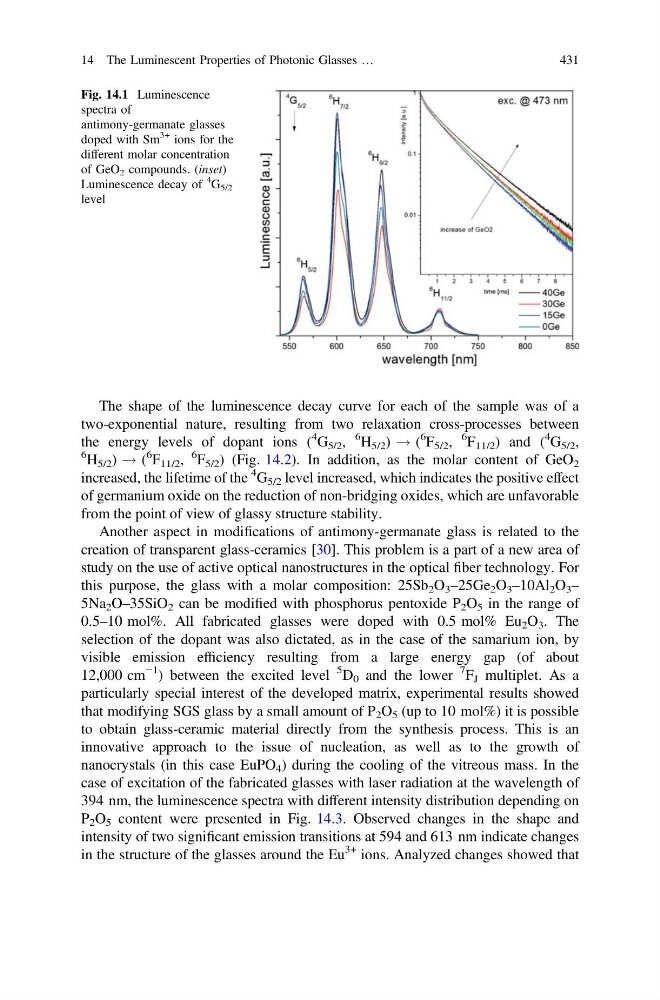
The shape of the luminescence decay curve for each of the sample was of a
two-exponential nature, resulting from two relaxation cross-processes between
the energy levels of dopant ions (
4 G 5/2 ,
6 H 5/2 ) ! (
6 F 5/2 ,
6 F 11/2 ) and (
4 G 5/2 ,
6 H 5/2 ) ! (
6 F 11/2 ,
6 F 5/2 ) (Fig. 14.2). In addition, as the molar content of GeO 2
increased, the lifetime of the
4 G 5/2 level increased, which indicates the positive effect
of germanium oxide on the reduction of non-bridging oxides, which are unfavorable
from the point of view of glassy structure stability.
Another aspect in modifications of antimony-germanate glass is related to the
creation of transparent glass-ceramics [30]. This problem is a part of a new area of
study on the use of active optical nanostructures in the optical fiber technology. For
this purpose, the glass with a molar composition: 25Sb 2 O 3 –25Ge 2 O 3 –10Al 2 O 3 –
5Na 2 O–35SiO 2 can be modified with phosphorus pentoxide P 2 O 5 in the range of
0.5–10 mol%. All fabricated glasses were doped with 0.5 mol% Eu 2 O 3 . The
selection of the dopant was also dictated, as in the case of the samarium ion, by
visible emission efficiency resulting from a large energy gap (of about
12,000 cm
−1 ) between the excited level
5 D 0 and the lower
7 F J multiplet. As a
particularly special interest of the developed matrix, experimental results showed
that modifying SGS glass by a small amount of P 2 O 5 (up to 10 mol%) it is possible
to obtain glass-ceramic material directly from the synthesis process. This is an
innovative approach to the issue of nucleation, as well as to the growth of
nanocrystals (in this case EuPO 4 ) during the cooling of the vitreous mass. In the
case of excitation of the fabricated glasses with laser radiation at the wavelength of
394 nm, the luminescence spectra with different intensity distribution depending on
P 2 O 5 content were presented in Fig. 14.3. Observed changes in the shape and
intensity of two significant emission transitions at 594 and 613 nm indicate changes
in the structure of the glasses around the Eu
3+ ions. Analyzed changes showed that
Fig. 14.1 Luminescence
spectra of
antimony-germanate glasses
doped with Sm
3+ ions for the
different molar concentration
of GeO 2 compounds. (inset)
Luminescence decay of
4
G 5/2
level
14 The Luminescent Properties of Photonic Glasses …
431
two-exponential nature, resulting from two relaxation cross-processes between
the energy levels of dopant ions (
4 G 5/2 ,
6 H 5/2 ) ! (
6 F 5/2 ,
6 F 11/2 ) and (
4 G 5/2 ,
6 H 5/2 ) ! (
6 F 11/2 ,
6 F 5/2 ) (Fig. 14.2). In addition, as the molar content of GeO 2
increased, the lifetime of the
4 G 5/2 level increased, which indicates the positive effect
of germanium oxide on the reduction of non-bridging oxides, which are unfavorable
from the point of view of glassy structure stability.
Another aspect in modifications of antimony-germanate glass is related to the
creation of transparent glass-ceramics [30]. This problem is a part of a new area of
study on the use of active optical nanostructures in the optical fiber technology. For
this purpose, the glass with a molar composition: 25Sb 2 O 3 –25Ge 2 O 3 –10Al 2 O 3 –
5Na 2 O–35SiO 2 can be modified with phosphorus pentoxide P 2 O 5 in the range of
0.5–10 mol%. All fabricated glasses were doped with 0.5 mol% Eu 2 O 3 . The
selection of the dopant was also dictated, as in the case of the samarium ion, by
visible emission efficiency resulting from a large energy gap (of about
12,000 cm
−1 ) between the excited level
5 D 0 and the lower
7 F J multiplet. As a
particularly special interest of the developed matrix, experimental results showed
that modifying SGS glass by a small amount of P 2 O 5 (up to 10 mol%) it is possible
to obtain glass-ceramic material directly from the synthesis process. This is an
innovative approach to the issue of nucleation, as well as to the growth of
nanocrystals (in this case EuPO 4 ) during the cooling of the vitreous mass. In the
case of excitation of the fabricated glasses with laser radiation at the wavelength of
394 nm, the luminescence spectra with different intensity distribution depending on
P 2 O 5 content were presented in Fig. 14.3. Observed changes in the shape and
intensity of two significant emission transitions at 594 and 613 nm indicate changes
in the structure of the glasses around the Eu
3+ ions. Analyzed changes showed that
Fig. 14.1 Luminescence
spectra of
antimony-germanate glasses
doped with Sm
3+ ions for the
different molar concentration
of GeO 2 compounds. (inset)
Luminescence decay of
4
G 5/2
level
14 The Luminescent Properties of Photonic Glasses …
431