

should be also controlled to obtain a higher optical transparency, especially optimizing Pt catalyst concentration and curing conditions and others. After knowing
the optical loss limit, it is very important and helpful for the optical material
formulation to decrease the loss by appropriate hydrogen substitution, but even
amplification (which can be accomplished by doping the PDMS material with some
rare-earth metal materials showing luminescence at the requested signal wavelength) may still be necessary.
13.3.2.6 Intrinsic Scattering Loss
A significant loss factor is due to Rayleigh scattering, caused by fluctuations of the
density and the refractive index in such polymer materials. Extrinsic loss arising
from scattering in polymers can also result from unfiltered particles, dust, dissolved
bubbles and non-reacting monomers. To eliminate this source of extrinsic scattering, it is necessary to follow rigorously ultimate procedures in the preparation of
polymer formulations, e.g. by filtering and deaeration, and to perform all preparations in a clean room environment.
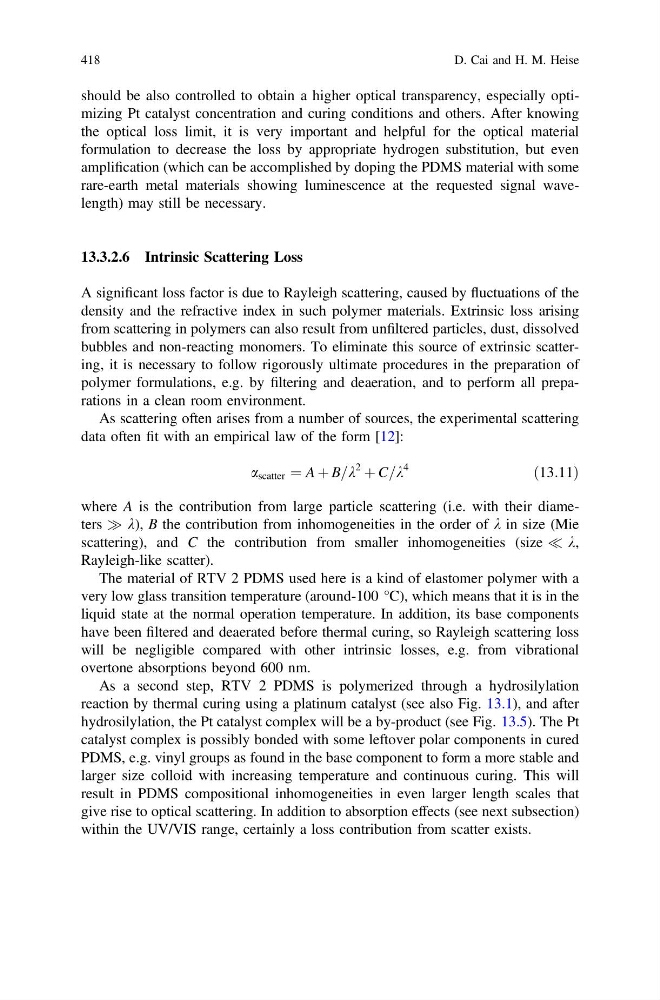
As scattering often arises from a number of sources, the experimental scattering
data often fit with an empirical law of the form [12]:
a scatter ¼ A þ B=k
2
þ C=k
4
ð13:11Þ
where A is the contribution from large particle scattering (i.e. with their diameters ) k), B the contribution from inhomogeneities in the order of k in size (Mie
scattering), and C the contribution from smaller inhomogeneities (size ( k,
Rayleigh-like scatter).
The material of RTV 2 PDMS used here is a kind of elastomer polymer with a
very low glass transition temperature (around-100 °C), which means that it is in the
liquid state at the normal operation temperature. In addition, its base components
have been filtered and deaerated before thermal curing, so Rayleigh scattering loss
will be negligible compared with other intrinsic losses, e.g. from vibrational
overtone absorptions beyond 600 nm.
As a second step, RTV 2 PDMS is polymerized through a hydrosilylation
reaction by thermal curing using a platinum catalyst (see also Fig. 13.1), and after
hydrosilylation, the Pt catalyst complex will be a by-product (see Fig. 13.5). The Pt
catalyst complex is possibly bonded with some leftover polar components in cured
PDMS, e.g. vinyl groups as found in the base component to form a more stable and
larger size colloid with increasing temperature and continuous curing. This will
result in PDMS compositional inhomogeneities in even larger length scales that
give rise to optical scattering. In addition to absorption effects (see next subsection)
within the UV/VIS range, certainly a loss contribution from scatter exists.
418
D. Cai and H. M. Heise
the optical loss limit, it is very important and helpful for the optical material
formulation to decrease the loss by appropriate hydrogen substitution, but even
amplification (which can be accomplished by doping the PDMS material with some
rare-earth metal materials showing luminescence at the requested signal wavelength) may still be necessary.
13.3.2.6 Intrinsic Scattering Loss
A significant loss factor is due to Rayleigh scattering, caused by fluctuations of the
density and the refractive index in such polymer materials. Extrinsic loss arising
from scattering in polymers can also result from unfiltered particles, dust, dissolved
bubbles and non-reacting monomers. To eliminate this source of extrinsic scattering, it is necessary to follow rigorously ultimate procedures in the preparation of
polymer formulations, e.g. by filtering and deaeration, and to perform all preparations in a clean room environment.
As scattering often arises from a number of sources, the experimental scattering
data often fit with an empirical law of the form [12]:
a scatter ¼ A þ B=k
2
þ C=k
4
ð13:11Þ
where A is the contribution from large particle scattering (i.e. with their diameters ) k), B the contribution from inhomogeneities in the order of k in size (Mie
scattering), and C the contribution from smaller inhomogeneities (size ( k,
Rayleigh-like scatter).
The material of RTV 2 PDMS used here is a kind of elastomer polymer with a
very low glass transition temperature (around-100 °C), which means that it is in the
liquid state at the normal operation temperature. In addition, its base components
have been filtered and deaerated before thermal curing, so Rayleigh scattering loss
will be negligible compared with other intrinsic losses, e.g. from vibrational
overtone absorptions beyond 600 nm.
As a second step, RTV 2 PDMS is polymerized through a hydrosilylation
reaction by thermal curing using a platinum catalyst (see also Fig. 13.1), and after
hydrosilylation, the Pt catalyst complex will be a by-product (see Fig. 13.5). The Pt
catalyst complex is possibly bonded with some leftover polar components in cured
PDMS, e.g. vinyl groups as found in the base component to form a more stable and
larger size colloid with increasing temperature and continuous curing. This will
result in PDMS compositional inhomogeneities in even larger length scales that
give rise to optical scattering. In addition to absorption effects (see next subsection)
within the UV/VIS range, certainly a loss contribution from scatter exists.
418
D. Cai and H. M. Heise