

main two options to decrease the optical loss, since the CD and CX (halogen
elements, e.g. F, Cl) fundamental absorption bands (in particular, the stretching
vibrations) in the mid-infrared region are shifted to longer wavelengths (m(CD):
2230 cm
−1 , m(CF): 1250 cm
−1 and m(CCl): 770 cm
−1 ). Notably, also smaller
anharmonicity constants exist compared with CH bond vibrations, so that finally a
much lower optical loss will result for the VIS-NIR region.
After obtaining the correlation equation above and in combination with the
detailed calculation results, as previously published for the ratios of E v
CX /E 1
CH
, we
can roughly estimate also the optical loss in deuterated or halogenated core PDMS
within the VIS-NIR region. For example, 4m 1 of the CD stretching vibration is
located at 1160 nm and the E 4
CD
/E 1
CH ratio is 1.3 Â 10
−4 , and assuming its band
half-width of 150 cm
−1 being similar to that of 4m 1 of the C–H bond vibration, we
can find the corresponding CD stretch overtone loss value to be only 0.109 dB/cm.
This must be compared with the 3m 1 of the CH stretching vibration located at
1183 nm, as discussed above for the normal isotopic material with its optical loss
found about 60–70 times larger than for the 4m 1 CD stretching overtone loss. Whilst
from a theoretical view deuteration and halogenation in siloxane-based materials
are proving their applicability to render even more transparent materials, practical
aspects about the use of such materials must still be investigated.
In addition, in terms of core PDMS material and with respect to the siloxane
polymer design, assuming a ratio of q/M G = 0.01 mol/cm
−3 based on possible
deuteration or halogenation and n c = 6, an absorption loss of 0.001 dB/cm could be
achieved when referring to a quotient of E v
CX /(E 1
CH
ÁD v) of 1.09 Â 10
−8 .
Furthermore, specifically to 850 nm, the optical loss at 850 nm of polysiloxanes
will then be mainly from Rayleigh scattering, e.g. 0.005 dB/cm as found for PDMS
SLM core material, if the absorption peaks near 850 nm are shifted due to
deuteration or halogenation. Therefore, the inhomogeneities in polysiloxanes
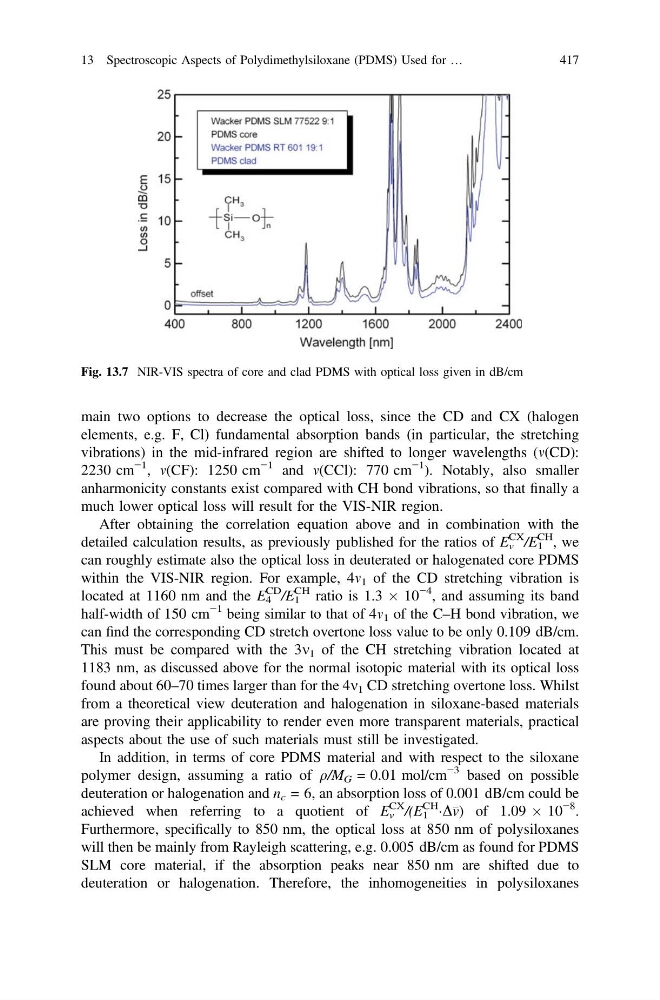
Fig. 13.7 NIR-VIS spectra of core and clad PDMS with optical loss given in dB/cm
13 Spectroscopic Aspects of Polydimethylsiloxane (PDMS) Used for …
417
elements, e.g. F, Cl) fundamental absorption bands (in particular, the stretching
vibrations) in the mid-infrared region are shifted to longer wavelengths (m(CD):
2230 cm
−1 , m(CF): 1250 cm
−1 and m(CCl): 770 cm
−1 ). Notably, also smaller
anharmonicity constants exist compared with CH bond vibrations, so that finally a
much lower optical loss will result for the VIS-NIR region.
After obtaining the correlation equation above and in combination with the
detailed calculation results, as previously published for the ratios of E v
CX /E 1
CH
, we
can roughly estimate also the optical loss in deuterated or halogenated core PDMS
within the VIS-NIR region. For example, 4m 1 of the CD stretching vibration is
located at 1160 nm and the E 4
CD
/E 1
CH ratio is 1.3 Â 10
−4 , and assuming its band
half-width of 150 cm
−1 being similar to that of 4m 1 of the C–H bond vibration, we
can find the corresponding CD stretch overtone loss value to be only 0.109 dB/cm.
This must be compared with the 3m 1 of the CH stretching vibration located at
1183 nm, as discussed above for the normal isotopic material with its optical loss
found about 60–70 times larger than for the 4m 1 CD stretching overtone loss. Whilst
from a theoretical view deuteration and halogenation in siloxane-based materials
are proving their applicability to render even more transparent materials, practical
aspects about the use of such materials must still be investigated.
In addition, in terms of core PDMS material and with respect to the siloxane
polymer design, assuming a ratio of q/M G = 0.01 mol/cm
−3 based on possible
deuteration or halogenation and n c = 6, an absorption loss of 0.001 dB/cm could be
achieved when referring to a quotient of E v
CX /(E 1
CH
ÁD v) of 1.09 Â 10
−8 .
Furthermore, specifically to 850 nm, the optical loss at 850 nm of polysiloxanes
will then be mainly from Rayleigh scattering, e.g. 0.005 dB/cm as found for PDMS
SLM core material, if the absorption peaks near 850 nm are shifted due to
deuteration or halogenation. Therefore, the inhomogeneities in polysiloxanes
Fig. 13.7 NIR-VIS spectra of core and clad PDMS with optical loss given in dB/cm
13 Spectroscopic Aspects of Polydimethylsiloxane (PDMS) Used for …
417