

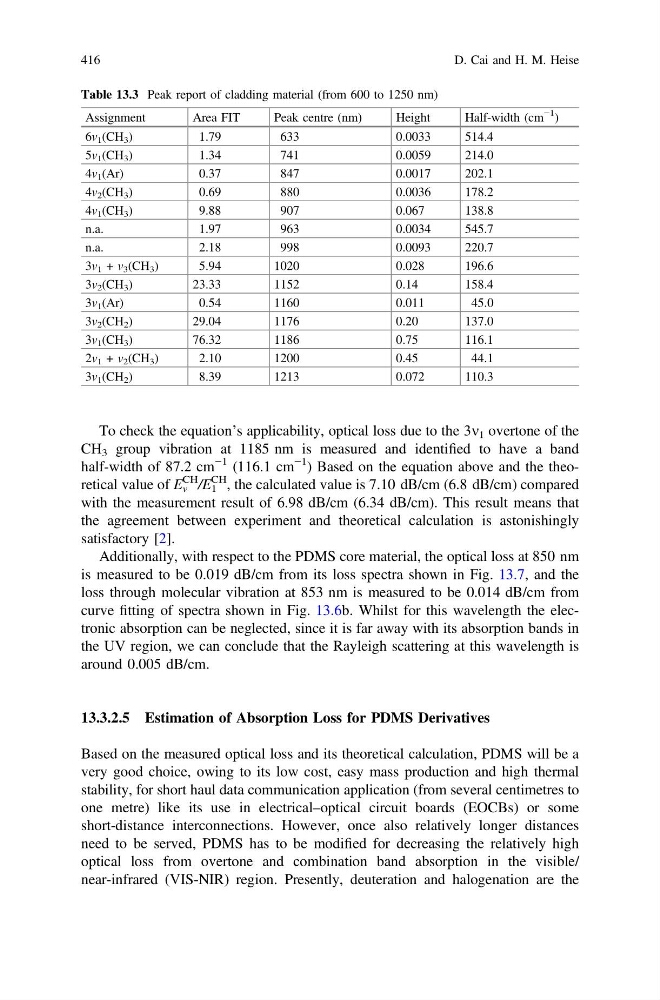
To check the equation’s applicability, optical loss due to the 3m 1 overtone of the
CH 3 group vibration at 1185 nm is measured and identified to have a band
half-width of 87.2 cm
−1 (116.1 cm
−1 ) Based on the equation above and the theoretical value of E v
CH /E 1
CH , the calculated value is 7.10 dB/cm (6.8 dB/cm) compared
with the measurement result of 6.98 dB/cm (6.34 dB/cm). This result means that
the agreement between experiment and theoretical calculation is astonishingly
satisfactory [2].
Additionally, with respect to the PDMS core material, the optical loss at 850 nm
is measured to be 0.019 dB/cm from its loss spectra shown in Fig. 13.7, and the
loss through molecular vibration at 853 nm is measured to be 0.014 dB/cm from
curve fitting of spectra shown in Fig. 13.6b. Whilst for this wavelength the electronic absorption can be neglected, since it is far away with its absorption bands in
the UV region, we can conclude that the Rayleigh scattering at this wavelength is
around 0.005 dB/cm.
13.3.2.5 Estimation of Absorption Loss for PDMS Derivatives
Based on the measured optical loss and its theoretical calculation, PDMS will be a
very good choice, owing to its low cost, easy mass production and high thermal
stability, for short haul data communication application (from several centimetres to
one metre) like its use in electrical–optical circuit boards (EOCBs) or some
short-distance interconnections. However, once also relatively longer distances
need to be served, PDMS has to be modified for decreasing the relatively high
optical loss from overtone and combination band absorption in the visible/
near-infrared (VIS-NIR) region. Presently, deuteration and halogenation are the
Table 13.3 Peak report of cladding material (from 600 to 1250 nm)
Assignment
Area FIT
Peak centre (nm)
Height
Half-width (cm
−1
)
6v 1 (CH 3 )
1.79
633
0.0033
514.4
5v 1 (CH 3 )
1.34
741
0.0059
214.0
4v 1 (Ar)
0.37
847
0.0017
202.1
4v 2 (CH 3 )
0.69
880
0.0036
178.2
4v 1 (CH 3 )
9.88
907
0.067
138.8
n.a.
1.97
963
0.0034
545.7
n.a.
2.18
998
0.0093
220.7
3v 1 + v 3 (CH 3 )
5.94
1020
0.028
196.6
3v 2 (CH 3 )
23.33
1152
0.14
158.4
3v 1 (Ar)
0.54
1160
0.011
45.0
3v 2 (CH 2 )
29.04
1176
0.20
137.0
3v 1 (CH 3 )
76.32
1186
0.75
116.1
2v 1 + v 2 (CH 3 )
2.10
1200
0.45
44.1
3v 1 (CH 2 )
8.39
1213
0.072
110.3
416
D. Cai and H. M. Heise
CH 3 group vibration at 1185 nm is measured and identified to have a band
half-width of 87.2 cm
−1 (116.1 cm
−1 ) Based on the equation above and the theoretical value of E v
CH /E 1
CH , the calculated value is 7.10 dB/cm (6.8 dB/cm) compared
with the measurement result of 6.98 dB/cm (6.34 dB/cm). This result means that
the agreement between experiment and theoretical calculation is astonishingly
satisfactory [2].
Additionally, with respect to the PDMS core material, the optical loss at 850 nm
is measured to be 0.019 dB/cm from its loss spectra shown in Fig. 13.7, and the
loss through molecular vibration at 853 nm is measured to be 0.014 dB/cm from
curve fitting of spectra shown in Fig. 13.6b. Whilst for this wavelength the electronic absorption can be neglected, since it is far away with its absorption bands in
the UV region, we can conclude that the Rayleigh scattering at this wavelength is
around 0.005 dB/cm.
13.3.2.5 Estimation of Absorption Loss for PDMS Derivatives
Based on the measured optical loss and its theoretical calculation, PDMS will be a
very good choice, owing to its low cost, easy mass production and high thermal
stability, for short haul data communication application (from several centimetres to
one metre) like its use in electrical–optical circuit boards (EOCBs) or some
short-distance interconnections. However, once also relatively longer distances
need to be served, PDMS has to be modified for decreasing the relatively high
optical loss from overtone and combination band absorption in the visible/
near-infrared (VIS-NIR) region. Presently, deuteration and halogenation are the
Table 13.3 Peak report of cladding material (from 600 to 1250 nm)
Assignment
Area FIT
Peak centre (nm)
Height
Half-width (cm
−1
)
6v 1 (CH 3 )
1.79
633
0.0033
514.4
5v 1 (CH 3 )
1.34
741
0.0059
214.0
4v 1 (Ar)
0.37
847
0.0017
202.1
4v 2 (CH 3 )
0.69
880
0.0036
178.2
4v 1 (CH 3 )
9.88
907
0.067
138.8
n.a.
1.97
963
0.0034
545.7
n.a.
2.18
998
0.0093
220.7
3v 1 + v 3 (CH 3 )
5.94
1020
0.028
196.6
3v 2 (CH 3 )
23.33
1152
0.14
158.4
3v 1 (Ar)
0.54
1160
0.011
45.0
3v 2 (CH 2 )
29.04
1176
0.20
137.0
3v 1 (CH 3 )
76.32
1186
0.75
116.1
2v 1 + v 2 (CH 3 )
2.10
1200
0.45
44.1
3v 1 (CH 2 )
8.39
1213
0.072
110.3
416
D. Cai and H. M. Heise