

(also called normal vibrations), measured in units of cm
−1 , and the X ik are their
anharmonicity constants.
In this chapter, the methyl groups were selected for our study, although the
approach for the determination of anharmonicity constants is also valid for other
molecular group vibrations. The NIR spectrum and a band assignment for methyl
group vibrations in RT 601 cladding PDMS have been recently reported by us [18].
However, the anharmonicity constants reported there were reassessed with slightly
different values now for some constants. In normal waveguide systems, especially
for multimode operation, most of the radiation will travel through the core material
attenuated by the optical absorption losses. Therefore, the results from calculations
for the NIR overtone and combination bands of methyl group vibrations are
especially important with PDMS SLM 77522 as core material, but also results for
the cladding material will be listed.
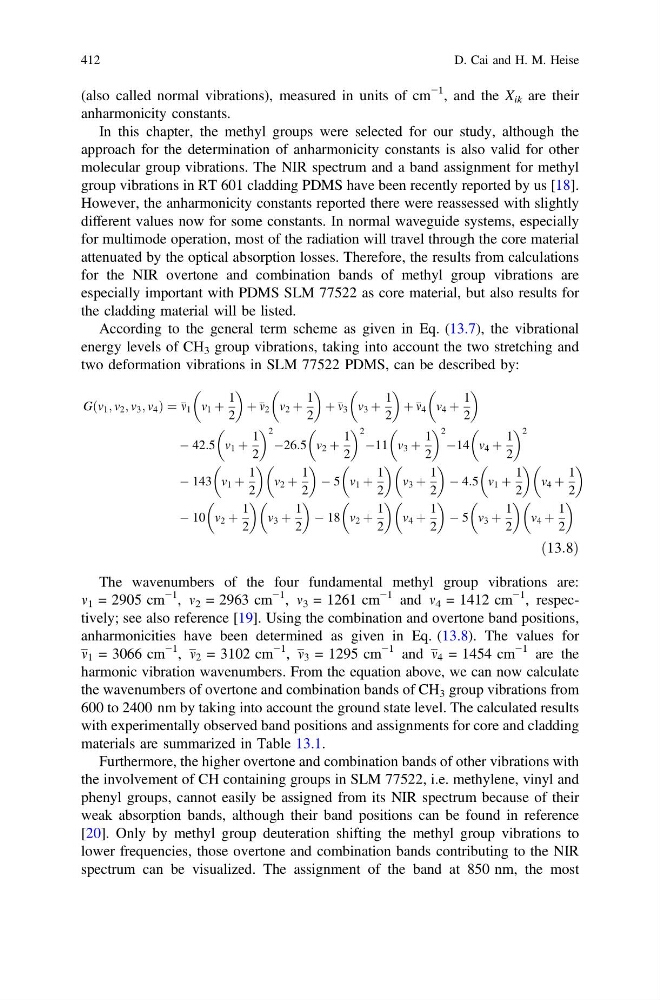
According to the general term scheme as given in Eq. (13.7), the vibrational
energy levels of CH 3 group vibrations, taking into account the two stretching and
two deformation vibrations in SLM 77522 PDMS, can be described by:
G v 1 ; v 2 ; v 3 ; v 4
ð
Þ¼ m 1 v 1 þ
1
2
þ m 2 v 2 þ
1
2
þ m 3 v 3 þ
1
2
þ m 4 v 4 þ
1
2
À 42:5 v 1 þ
1
2
2
À26:5 v 2 þ
1
2
2
À11 v 3 þ
1
2
2
À14 v 4 þ
1
2
2
À 143 v 1 þ
1
2
v 2 þ
1
2
À 5 v 1 þ
1
2
v 3 þ
1
2
À 4:5 v 1 þ
1
2
v 4 þ
1
2
À 10 v 2 þ
1
2
v 3 þ
1
2
À 18 v 2 þ
1
2
v 4 þ
1
2
À 5 v 3 þ
1
2
v 4 þ
1
2
ð13:8Þ
The wavenumbers of the four fundamental methyl group vibrations are:
m 1 = 2905 cm
−1 , m 2 = 2963 cm
−1 , m 3 = 1261 cm
−1 and m 4 = 1412 cm
−1 , respectively; see also reference [19]. Using the combination and overtone band positions,
anharmonicities have been determined as given in Eq. (13.8). The values for
m 1 = 3066 cm
−1 , m 2 = 3102 cm
−1 , m 3 = 1295 cm
−1 and m 4 = 1454 cm
−1 are the
harmonic vibration wavenumbers. From the equation above, we can now calculate
the wavenumbers of overtone and combination bands of CH 3 group vibrations from
600 to 2400 nm by taking into account the ground state level. The calculated results
with experimentally observed band positions and assignments for core and cladding
materials are summarized in Table 13.1.
Furthermore, the higher overtone and combination bands of other vibrations with
the involvement of CH containing groups in SLM 77522, i.e. methylene, vinyl and
phenyl groups, cannot easily be assigned from its NIR spectrum because of their
weak absorption bands, although their band positions can be found in reference
[20]. Only by methyl group deuteration shifting the methyl group vibrations to
lower frequencies, those overtone and combination bands contributing to the NIR
spectrum can be visualized. The assignment of the band at 850 nm, the most
412
D. Cai and H. M. Heise
−1 , and the X ik are their
anharmonicity constants.
In this chapter, the methyl groups were selected for our study, although the
approach for the determination of anharmonicity constants is also valid for other
molecular group vibrations. The NIR spectrum and a band assignment for methyl
group vibrations in RT 601 cladding PDMS have been recently reported by us [18].
However, the anharmonicity constants reported there were reassessed with slightly
different values now for some constants. In normal waveguide systems, especially
for multimode operation, most of the radiation will travel through the core material
attenuated by the optical absorption losses. Therefore, the results from calculations
for the NIR overtone and combination bands of methyl group vibrations are
especially important with PDMS SLM 77522 as core material, but also results for
the cladding material will be listed.
According to the general term scheme as given in Eq. (13.7), the vibrational
energy levels of CH 3 group vibrations, taking into account the two stretching and
two deformation vibrations in SLM 77522 PDMS, can be described by:
G v 1 ; v 2 ; v 3 ; v 4
ð
Þ¼ m 1 v 1 þ
1
2
þ m 2 v 2 þ
1
2
þ m 3 v 3 þ
1
2
þ m 4 v 4 þ
1
2
À 42:5 v 1 þ
1
2
2
À26:5 v 2 þ
1
2
2
À11 v 3 þ
1
2
2
À14 v 4 þ
1
2
2
À 143 v 1 þ
1
2
v 2 þ
1
2
À 5 v 1 þ
1
2
v 3 þ
1
2
À 4:5 v 1 þ
1
2
v 4 þ
1
2
À 10 v 2 þ
1
2
v 3 þ
1
2
À 18 v 2 þ
1
2
v 4 þ
1
2
À 5 v 3 þ
1
2
v 4 þ
1
2
ð13:8Þ
The wavenumbers of the four fundamental methyl group vibrations are:
m 1 = 2905 cm
−1 , m 2 = 2963 cm
−1 , m 3 = 1261 cm
−1 and m 4 = 1412 cm
−1 , respectively; see also reference [19]. Using the combination and overtone band positions,
anharmonicities have been determined as given in Eq. (13.8). The values for
m 1 = 3066 cm
−1 , m 2 = 3102 cm
−1 , m 3 = 1295 cm
−1 and m 4 = 1454 cm
−1 are the
harmonic vibration wavenumbers. From the equation above, we can now calculate
the wavenumbers of overtone and combination bands of CH 3 group vibrations from
600 to 2400 nm by taking into account the ground state level. The calculated results
with experimentally observed band positions and assignments for core and cladding
materials are summarized in Table 13.1.
Furthermore, the higher overtone and combination bands of other vibrations with
the involvement of CH containing groups in SLM 77522, i.e. methylene, vinyl and
phenyl groups, cannot easily be assigned from its NIR spectrum because of their
weak absorption bands, although their band positions can be found in reference
[20]. Only by methyl group deuteration shifting the methyl group vibrations to
lower frequencies, those overtone and combination bands contributing to the NIR
spectrum can be visualized. The assignment of the band at 850 nm, the most
412
D. Cai and H. M. Heise