

versus the spectrum of the pure PDMS RT 601 compound under the same reaction
conditions, which indicates that the addition of the catalyst without reaction
changed the optical characteristics only marginally. Adding a larger amount of Pt
catalyst (1 wt%) to the PDMS RT 601 changes the absorption spectrum after curing
significantly (see top trace in Fig. 13.5) including scattering loss. The PDMS
sample with the increased addition of Pt catalyst shows yellowness and brownness
with time. In order to improve the PDMS optical stability and decrease absorption
and scattering losses, the Pt concentration should be controlled in a preliminary step
before reaching its final applications.
13.3.2.2 Intrinsic Absorption Loss by Molecular Vibrations
Molecular vibration absorption exists due to the higher harmonics (overtones) of
fundamental stretching vibrations and combination bands with corresponding
bending vibrations, which are main contributors to the intrinsic absorption losses as
found in amorphous polymers at longer wavelengths beyond 600 nm, as the
influence due to scattering is not too strong except after further thermal material
treatment. In the following part, the wavelengths with the most significant vibrational absorption and the loss limits in PDMS polymers will be determined.
13.3.2.3 Assignment and Wavenumber Calculation of Vibrational
PDMS Bands
Mid-infrared spectra of PDMS materials have been studied already 50 years ago
[15]. In addition, Bokobza et al. investigated also NIR spectra of such polymers
[16]. Previously, fundamental bands of Si–O and Si–C bond vibrations of
PDMS RT 601 and SLM 77522 (core material), respectively, have been recorded
and partly assigned [17–19]. Overtone absorption bands due to these chemical
substructures can be neglected in the VIS-NIR wavelength region when compared
with vibrations of the C–H group, e.g. as found in methyl, methylene, vinyl or
phenyl groups. NIR spectral assignments of those bands for cladding PDMS have
already been published [18, 19].
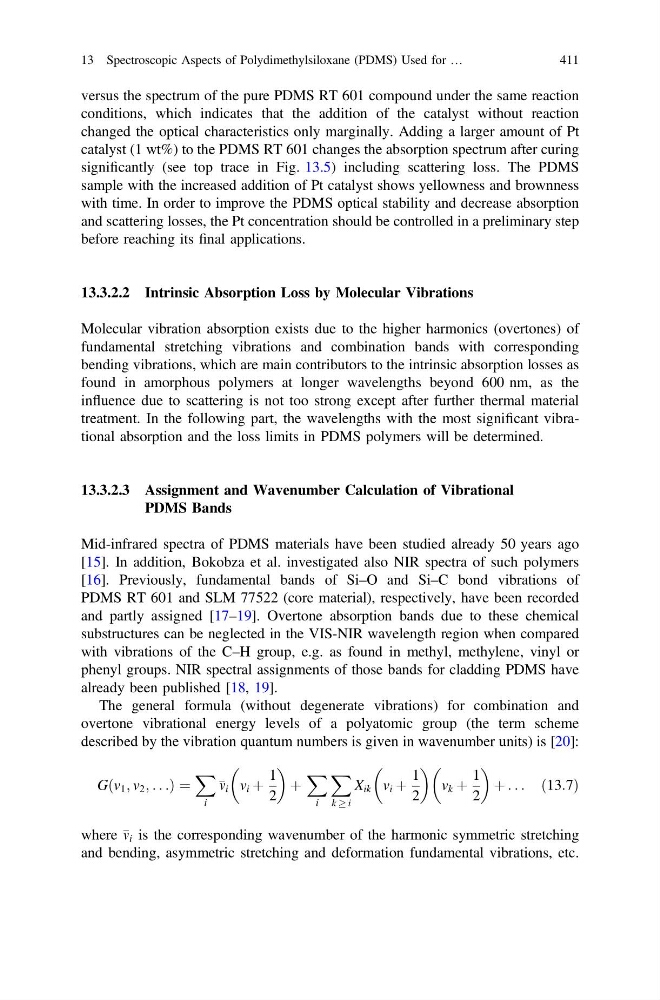
The general formula (without degenerate vibrations) for combination and
overtone vibrational energy levels of a polyatomic group (the term scheme
described by the vibration quantum numbers is given in wavenumber units) is [20]:
G v 1 ; v 2 ; . . .
ð
Þ¼
X
i
m i v i þ
1
2
þ
X
i
X
k ! i
X ik v i þ
1
2
v k þ
1
2
þ . . . ð13:7Þ
where m i is the corresponding wavenumber of the harmonic symmetric stretching
and bending, asymmetric stretching and deformation fundamental vibrations, etc.
13 Spectroscopic Aspects of Polydimethylsiloxane (PDMS) Used for …
411
conditions, which indicates that the addition of the catalyst without reaction
changed the optical characteristics only marginally. Adding a larger amount of Pt
catalyst (1 wt%) to the PDMS RT 601 changes the absorption spectrum after curing
significantly (see top trace in Fig. 13.5) including scattering loss. The PDMS
sample with the increased addition of Pt catalyst shows yellowness and brownness
with time. In order to improve the PDMS optical stability and decrease absorption
and scattering losses, the Pt concentration should be controlled in a preliminary step
before reaching its final applications.
13.3.2.2 Intrinsic Absorption Loss by Molecular Vibrations
Molecular vibration absorption exists due to the higher harmonics (overtones) of
fundamental stretching vibrations and combination bands with corresponding
bending vibrations, which are main contributors to the intrinsic absorption losses as
found in amorphous polymers at longer wavelengths beyond 600 nm, as the
influence due to scattering is not too strong except after further thermal material
treatment. In the following part, the wavelengths with the most significant vibrational absorption and the loss limits in PDMS polymers will be determined.
13.3.2.3 Assignment and Wavenumber Calculation of Vibrational
PDMS Bands
Mid-infrared spectra of PDMS materials have been studied already 50 years ago
[15]. In addition, Bokobza et al. investigated also NIR spectra of such polymers
[16]. Previously, fundamental bands of Si–O and Si–C bond vibrations of
PDMS RT 601 and SLM 77522 (core material), respectively, have been recorded
and partly assigned [17–19]. Overtone absorption bands due to these chemical
substructures can be neglected in the VIS-NIR wavelength region when compared
with vibrations of the C–H group, e.g. as found in methyl, methylene, vinyl or
phenyl groups. NIR spectral assignments of those bands for cladding PDMS have
already been published [18, 19].
The general formula (without degenerate vibrations) for combination and
overtone vibrational energy levels of a polyatomic group (the term scheme
described by the vibration quantum numbers is given in wavenumber units) is [20]:
G v 1 ; v 2 ; . . .
ð
Þ¼
X
i
m i v i þ
1
2
þ
X
i
X
k ! i
X ik v i þ
1
2
v k þ
1
2
þ . . . ð13:7Þ
where m i is the corresponding wavenumber of the harmonic symmetric stretching
and bending, asymmetric stretching and deformation fundamental vibrations, etc.
13 Spectroscopic Aspects of Polydimethylsiloxane (PDMS) Used for …
411