

13.3.2.1 Intrinsic Absorption Loss by Electronic Transitions
In the far ultraviolet region with a wavelength of less than 200 nm, the molecules
with single bonds (predominantly molecular groups with aliphatic hydrogen atoms)
can undergo r ! r* transitions, but this is not of interest to us. In addition, there
are absorptions arising from p ! p* or n ! p* electronic transitions caused by
double-bond structural units, e.g. >C=C< or >C=O. These usually appear in the
ultraviolet wavelength region and influence the propagation loss of optical polymer
materials still in the visible wavelength region through their absorption tails
observed in the interval of 200–400 nm.
At longer optical path length, the influence of material electronic transitions can
have a significant influence on the optical absorption even at wavelengths in the
short-wave NIR. PDMS as studied in this paper belongs to the category of silicone
polymers obtained from two components as starting material with thermal addition
curing. Due to polymerization, the C = C double-bond concentrations have been
significantly decreased. To investigate the influence of the Pt compound on the
optical scatter and absorption loss, a commercial Pt catalyst complex (Catalyst EP
from Wacker Chemie) and a pure filtered PDMS polymer (RT 601, Wacker,
including 30–40 ppm of Pt in the base component), not containing other impurities
like silicone oil and inhibitors, were selected for studying its contribution to the loss
budget.
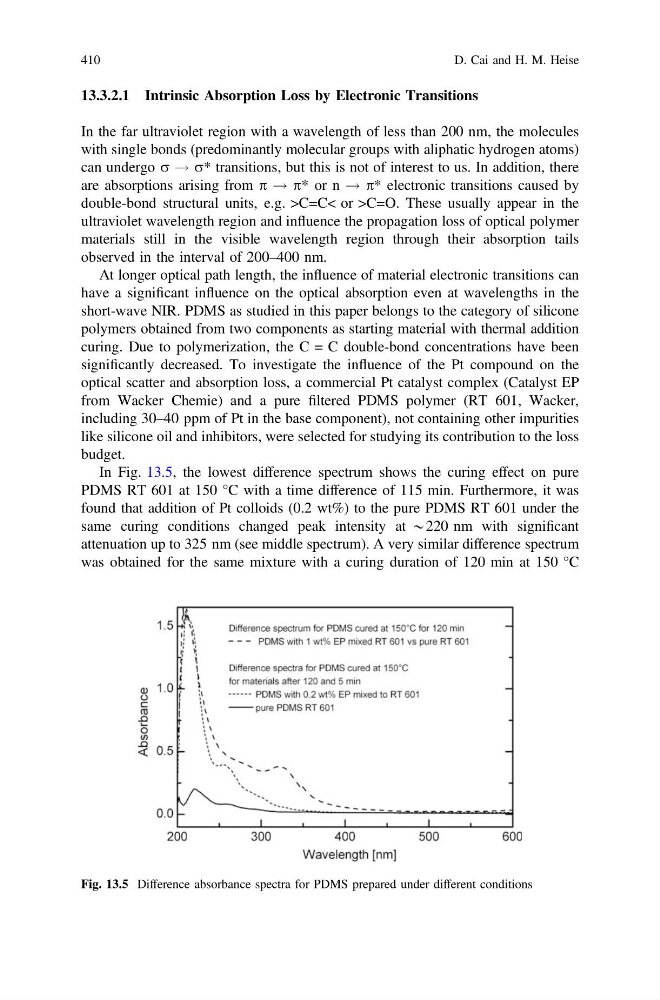
In Fig. 13.5, the lowest difference spectrum shows the curing effect on pure
PDMS RT 601 at 150 °C with a time difference of 115 min. Furthermore, it was
found that addition of Pt colloids (0.2 wt%) to the pure PDMS RT 601 under the
same curing conditions changed peak intensity at *220 nm with significant
attenuation up to 325 nm (see middle spectrum). A very similar difference spectrum
was obtained for the same mixture with a curing duration of 120 min at 150 °C
Fig. 13.5 Difference absorbance spectra for PDMS prepared under different conditions
410
D. Cai and H. M. Heise
In the far ultraviolet region with a wavelength of less than 200 nm, the molecules
with single bonds (predominantly molecular groups with aliphatic hydrogen atoms)
can undergo r ! r* transitions, but this is not of interest to us. In addition, there
are absorptions arising from p ! p* or n ! p* electronic transitions caused by
double-bond structural units, e.g. >C=C< or >C=O. These usually appear in the
ultraviolet wavelength region and influence the propagation loss of optical polymer
materials still in the visible wavelength region through their absorption tails
observed in the interval of 200–400 nm.
At longer optical path length, the influence of material electronic transitions can
have a significant influence on the optical absorption even at wavelengths in the
short-wave NIR. PDMS as studied in this paper belongs to the category of silicone
polymers obtained from two components as starting material with thermal addition
curing. Due to polymerization, the C = C double-bond concentrations have been
significantly decreased. To investigate the influence of the Pt compound on the
optical scatter and absorption loss, a commercial Pt catalyst complex (Catalyst EP
from Wacker Chemie) and a pure filtered PDMS polymer (RT 601, Wacker,
including 30–40 ppm of Pt in the base component), not containing other impurities
like silicone oil and inhibitors, were selected for studying its contribution to the loss
budget.
In Fig. 13.5, the lowest difference spectrum shows the curing effect on pure
PDMS RT 601 at 150 °C with a time difference of 115 min. Furthermore, it was
found that addition of Pt colloids (0.2 wt%) to the pure PDMS RT 601 under the
same curing conditions changed peak intensity at *220 nm with significant
attenuation up to 325 nm (see middle spectrum). A very similar difference spectrum
was obtained for the same mixture with a curing duration of 120 min at 150 °C
Fig. 13.5 Difference absorbance spectra for PDMS prepared under different conditions
410
D. Cai and H. M. Heise