

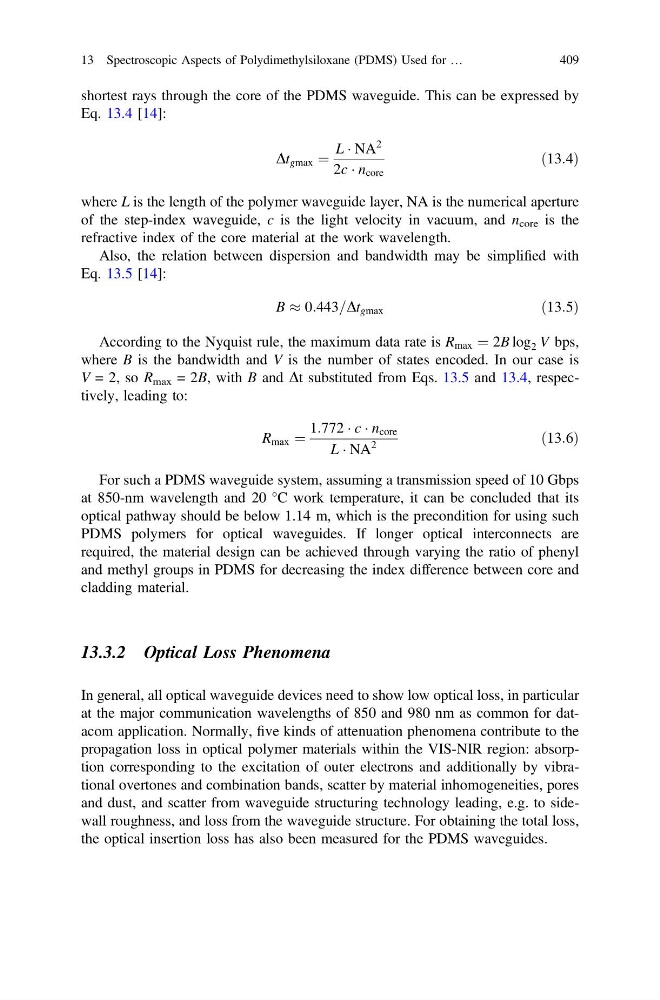
shortest rays through the core of the PDMS waveguide. This can be expressed by
Eq. 13.4 [14]:
Dt gmax ¼
L Á NA
2
2c Á n core
ð13:4Þ
where L is the length of the polymer waveguide layer, NA is the numerical aperture
of the step-index waveguide, c is the light velocity in vacuum, and n core is the
refractive index of the core material at the work wavelength.
Also, the relation between dispersion and bandwidth may be simplified with
Eq. 13.5 [14]:
B % 0:443=Dt gmax
ð13:5Þ
According to the Nyquist rule, the maximum data rate is R max ¼ 2B log 2 V bps,
where B is the bandwidth and V is the number of states encoded. In our case is
V = 2, so R max = 2B, with B and Dt substituted from Eqs. 13.5 and 13.4, respectively, leading to:
R max ¼
1:772 Á c Á n core
L Á NA
2
ð13:6Þ
For such a PDMS waveguide system, assuming a transmission speed of 10 Gbps
at 850-nm wavelength and 20 °C work temperature, it can be concluded that its
optical pathway should be below 1.14 m, which is the precondition for using such
PDMS polymers for optical waveguides. If longer optical interconnects are
required, the material design can be achieved through varying the ratio of phenyl
and methyl groups in PDMS for decreasing the index difference between core and
cladding material.
13.3.2 Optical Loss Phenomena
In general, all optical waveguide devices need to show low optical loss, in particular
at the major communication wavelengths of 850 and 980 nm as common for datacom application. Normally, five kinds of attenuation phenomena contribute to the
propagation loss in optical polymer materials within the VIS-NIR region: absorption corresponding to the excitation of outer electrons and additionally by vibrational overtones and combination bands, scatter by material inhomogeneities, pores
and dust, and scatter from waveguide structuring technology leading, e.g. to sidewall roughness, and loss from the waveguide structure. For obtaining the total loss,
the optical insertion loss has also been measured for the PDMS waveguides.
13 Spectroscopic Aspects of Polydimethylsiloxane (PDMS) Used for …
409
Eq. 13.4 [14]:
Dt gmax ¼
L Á NA
2
2c Á n core
ð13:4Þ
where L is the length of the polymer waveguide layer, NA is the numerical aperture
of the step-index waveguide, c is the light velocity in vacuum, and n core is the
refractive index of the core material at the work wavelength.
Also, the relation between dispersion and bandwidth may be simplified with
Eq. 13.5 [14]:
B % 0:443=Dt gmax
ð13:5Þ
According to the Nyquist rule, the maximum data rate is R max ¼ 2B log 2 V bps,
where B is the bandwidth and V is the number of states encoded. In our case is
V = 2, so R max = 2B, with B and Dt substituted from Eqs. 13.5 and 13.4, respectively, leading to:
R max ¼
1:772 Á c Á n core
L Á NA
2
ð13:6Þ
For such a PDMS waveguide system, assuming a transmission speed of 10 Gbps
at 850-nm wavelength and 20 °C work temperature, it can be concluded that its
optical pathway should be below 1.14 m, which is the precondition for using such
PDMS polymers for optical waveguides. If longer optical interconnects are
required, the material design can be achieved through varying the ratio of phenyl
and methyl groups in PDMS for decreasing the index difference between core and
cladding material.
13.3.2 Optical Loss Phenomena
In general, all optical waveguide devices need to show low optical loss, in particular
at the major communication wavelengths of 850 and 980 nm as common for datacom application. Normally, five kinds of attenuation phenomena contribute to the
propagation loss in optical polymer materials within the VIS-NIR region: absorption corresponding to the excitation of outer electrons and additionally by vibrational overtones and combination bands, scatter by material inhomogeneities, pores
and dust, and scatter from waveguide structuring technology leading, e.g. to sidewall roughness, and loss from the waveguide structure. For obtaining the total loss,
the optical insertion loss has also been measured for the PDMS waveguides.
13 Spectroscopic Aspects of Polydimethylsiloxane (PDMS) Used for …
409