

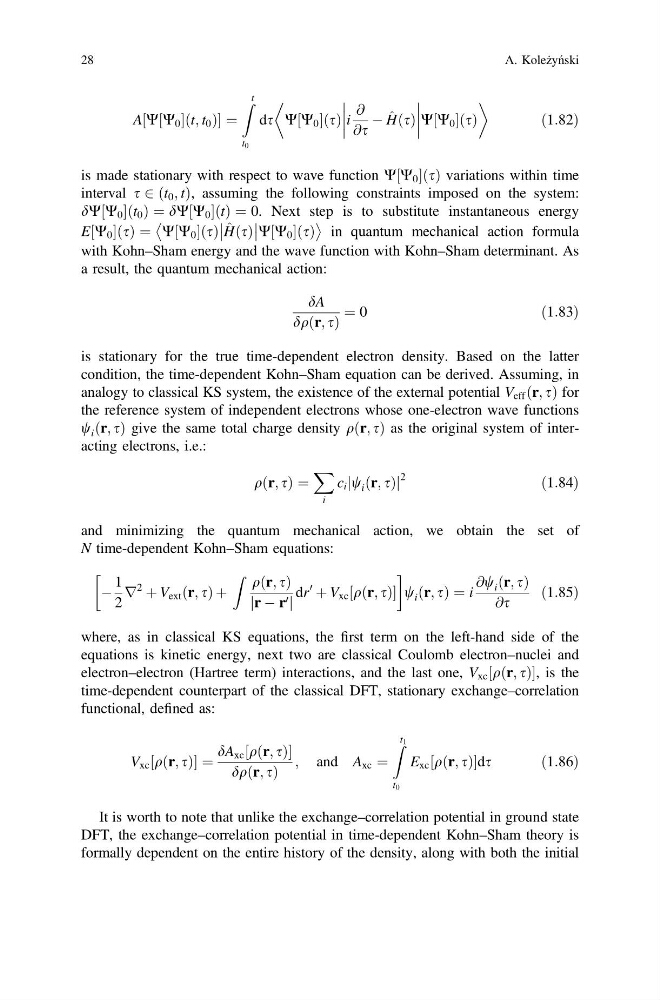
A½W½W 0 ðt; t 0 Þ ¼
Z t
t 0
ds W½W 0 ðsÞ i
@
@s
À ^
HðsÞ
W½W 0 ðsÞ
(
)
ð1:82Þ
is made stationary with respect to wave function W W 0
½ s
ð Þ variations within time
interval s 2 t 0 ; t
ð Þ, assuming the following constraints imposed on the system:
dW W 0
½ t 0
ð Þ ¼ dW W 0
½ t
ð Þ ¼ 0. Next step is to substitute instantaneous energy
E W 0
½ s
ð Þ ¼ W W 0
½ s
ð Þ ^
H s
ð Þ
W W 0
½ s
ð Þ
in quantum mechanical action formula
with Kohn–Sham energy and the wave function with Kohn–Sham determinant. As
a result, the quantum mechanical action:
dA
dqðr; sÞ
¼ 0
ð1:83Þ
is stationary for the true time-dependent electron density. Based on the latter
condition, the time-dependent Kohn–Sham equation can be derived. Assuming, in
analogy to classical KS system, the existence of the external potential V eff r; s
ð Þ for
the reference system of independent electrons whose one-electron wave functions
w i r; s
ð Þ give the same total charge density q r; s
ð Þ as the original system of interacting electrons, i.e.:
qðr; sÞ ¼
X
i
c i w i ðr; sÞ
j
j
2
ð1:84Þ
and minimizing the quantum mechanical action, we obtain the set of
N time-dependent Kohn–Sham equations:
À
1
2
r
2
þ V ext ðr; sÞ þ
Z qðr; sÞ
r À r 0
j
j
dr
0
þ V xc ½qðr; sÞ
!
w i ðr; sÞ ¼ i
@w i ðr; sÞ
@s
ð1:85Þ
where, as in classical KS equations, the first term on the left-hand side of the
equations is kinetic energy, next two are classical Coulomb electron–nuclei and
electron–electron (Hartree term) interactions, and the last one, V xc q r; s
ð Þ
½
, is the
time-dependent counterpart of the classical DFT, stationary exchange–correlation
functional, defined as:
V xc q r; s
ð Þ
½
¼
dA xc q r; s
ð Þ
½
dq r; s
ð Þ
; and A xc ¼
Z t 1
t 0
E xc q r; s
ð Þ
½
ds
ð1:86Þ
It is worth to note that unlike the exchange–correlation potential in ground state
DFT, the exchange–correlation potential in time-dependent Kohn–Sham theory is
formally dependent on the entire history of the density, along with both the initial
28
A. Koleżyński
Z t
t 0
ds W½W 0 ðsÞ i
@
@s
À ^
HðsÞ
W½W 0 ðsÞ
(
)
ð1:82Þ
is made stationary with respect to wave function W W 0
½ s
ð Þ variations within time
interval s 2 t 0 ; t
ð Þ, assuming the following constraints imposed on the system:
dW W 0
½ t 0
ð Þ ¼ dW W 0
½ t
ð Þ ¼ 0. Next step is to substitute instantaneous energy
E W 0
½ s
ð Þ ¼ W W 0
½ s
ð Þ ^
H s
ð Þ
W W 0
½ s
ð Þ
in quantum mechanical action formula
with Kohn–Sham energy and the wave function with Kohn–Sham determinant. As
a result, the quantum mechanical action:
dA
dqðr; sÞ
¼ 0
ð1:83Þ
is stationary for the true time-dependent electron density. Based on the latter
condition, the time-dependent Kohn–Sham equation can be derived. Assuming, in
analogy to classical KS system, the existence of the external potential V eff r; s
ð Þ for
the reference system of independent electrons whose one-electron wave functions
w i r; s
ð Þ give the same total charge density q r; s
ð Þ as the original system of interacting electrons, i.e.:
qðr; sÞ ¼
X
i
c i w i ðr; sÞ
j
j
2
ð1:84Þ
and minimizing the quantum mechanical action, we obtain the set of
N time-dependent Kohn–Sham equations:
À
1
2
r
2
þ V ext ðr; sÞ þ
Z qðr; sÞ
r À r 0
j
j
dr
0
þ V xc ½qðr; sÞ
!
w i ðr; sÞ ¼ i
@w i ðr; sÞ
@s
ð1:85Þ
where, as in classical KS equations, the first term on the left-hand side of the
equations is kinetic energy, next two are classical Coulomb electron–nuclei and
electron–electron (Hartree term) interactions, and the last one, V xc q r; s
ð Þ
½
, is the
time-dependent counterpart of the classical DFT, stationary exchange–correlation
functional, defined as:
V xc q r; s
ð Þ
½
¼
dA xc q r; s
ð Þ
½
dq r; s
ð Þ
; and A xc ¼
Z t 1
t 0
E xc q r; s
ð Þ
½
ds
ð1:86Þ
It is worth to note that unlike the exchange–correlation potential in ground state
DFT, the exchange–correlation potential in time-dependent Kohn–Sham theory is
formally dependent on the entire history of the density, along with both the initial
28
A. Koleżyński