

wave function W(0) of the real interacting system of N-electrons and the initial KS
wave function U(0) on reference system of N non-interacting particles.
Like in classical DFT, the time-dependent KS theory yields exact results,
assuming the knowledge of an exact form of the exchange–correlation potential.
Unfortunately, as in classical DFT counterpart, the exact formula for this potential
is unknown, so we are forced to use approximations. The simplest one is the
so-called adiabatic approximation, the local approximation in time, which assumes
instantaneous reaction of XC potential to any temporal changes in charge density
(and without memory of previous states, i.e., depending only on the density q s
ð Þ at
the same time) and therefore can be used reasonably for the systems with potential
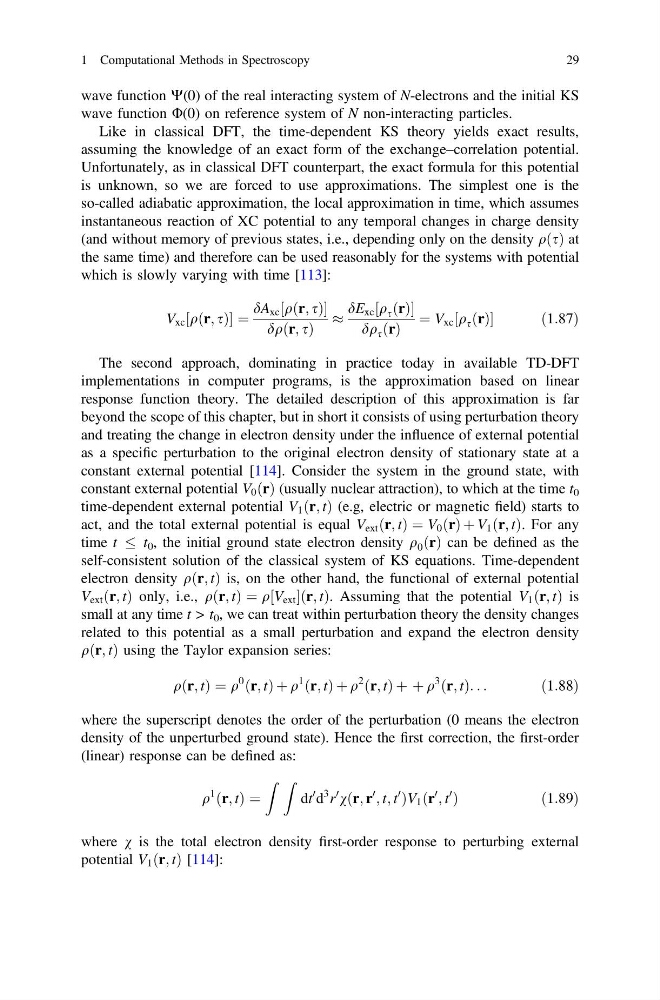
which is slowly varying with time [113]:
V xc ½qðr; sÞ ¼
dA xc ½qðr; sÞ
dqðr; sÞ
%
dE xc ½q s ðrÞ
dq s ðrÞ
¼ V xc ½q s ðrÞ
ð1:87Þ
The second approach, dominating in practice today in available TD-DFT
implementations in computer programs, is the approximation based on linear
response function theory. The detailed description of this approximation is far
beyond the scope of this chapter, but in short it consists of using perturbation theory
and treating the change in electron density under the influence of external potential
as a specific perturbation to the original electron density of stationary state at a
constant external potential [114]. Consider the system in the ground state, with
constant external potential V 0 r
ð Þ (usually nuclear attraction), to which at the time t 0
time-dependent external potential V 1 r; t
ð Þ (e.g, electric or magnetic field) starts to
act, and the total external potential is equal V ext r; t
ð Þ ¼ V 0 r
ð Þ þ V 1 r; t
ð Þ. For any
time t
t 0 , the initial ground state electron density q 0 r
ð Þ can be defined as the
self-consistent solution of the classical system of KS equations. Time-dependent
electron density q r; t
ð Þ is, on the other hand, the functional of external potential
V ext r; t
ð Þ only, i.e., q r; t
ð Þ ¼ q V ext
½ r; t
ð Þ. Assuming that the potential V 1 r; t
ð Þ is
small at any time t > t 0 , we can treat within perturbation theory the density changes
related to this potential as a small perturbation and expand the electron density
q r; t
ð Þ using the Taylor expansion series:
q r; t
ð Þ ¼ q
0 r; t
ð Þþq
1 r; t
ð Þþq
2 r; t
ð Þþ þq
3 r; t
ð Þ. . .
ð1:88Þ
where the superscript denotes the order of the perturbation (0 means the electron
density of the unperturbed ground state). Hence the first correction, the first-order
(linear) response can be defined as:
q
1 r; t
ð Þ ¼
Z Z
dt
0 d
3 r
0 v r; r
0
; t; t
0
ð
Þ V 1 r
0
; t
0
ð
Þ
ð1:89Þ
where v is the total electron density first-order response to perturbing external
potential V 1 r; t
ð Þ [114]:
1 Computational Methods in Spectroscopy
29
wave function U(0) on reference system of N non-interacting particles.
Like in classical DFT, the time-dependent KS theory yields exact results,
assuming the knowledge of an exact form of the exchange–correlation potential.
Unfortunately, as in classical DFT counterpart, the exact formula for this potential
is unknown, so we are forced to use approximations. The simplest one is the
so-called adiabatic approximation, the local approximation in time, which assumes
instantaneous reaction of XC potential to any temporal changes in charge density
(and without memory of previous states, i.e., depending only on the density q s
ð Þ at
the same time) and therefore can be used reasonably for the systems with potential
which is slowly varying with time [113]:
V xc ½qðr; sÞ ¼
dA xc ½qðr; sÞ
dqðr; sÞ
%
dE xc ½q s ðrÞ
dq s ðrÞ
¼ V xc ½q s ðrÞ
ð1:87Þ
The second approach, dominating in practice today in available TD-DFT
implementations in computer programs, is the approximation based on linear
response function theory. The detailed description of this approximation is far
beyond the scope of this chapter, but in short it consists of using perturbation theory
and treating the change in electron density under the influence of external potential
as a specific perturbation to the original electron density of stationary state at a
constant external potential [114]. Consider the system in the ground state, with
constant external potential V 0 r
ð Þ (usually nuclear attraction), to which at the time t 0
time-dependent external potential V 1 r; t
ð Þ (e.g, electric or magnetic field) starts to
act, and the total external potential is equal V ext r; t
ð Þ ¼ V 0 r
ð Þ þ V 1 r; t
ð Þ. For any
time t
t 0 , the initial ground state electron density q 0 r
ð Þ can be defined as the
self-consistent solution of the classical system of KS equations. Time-dependent
electron density q r; t
ð Þ is, on the other hand, the functional of external potential
V ext r; t
ð Þ only, i.e., q r; t
ð Þ ¼ q V ext
½ r; t
ð Þ. Assuming that the potential V 1 r; t
ð Þ is
small at any time t > t 0 , we can treat within perturbation theory the density changes
related to this potential as a small perturbation and expand the electron density
q r; t
ð Þ using the Taylor expansion series:
q r; t
ð Þ ¼ q
0 r; t
ð Þþq
1 r; t
ð Þþq
2 r; t
ð Þþ þq
3 r; t
ð Þ. . .
ð1:88Þ
where the superscript denotes the order of the perturbation (0 means the electron
density of the unperturbed ground state). Hence the first correction, the first-order
(linear) response can be defined as:
q
1 r; t
ð Þ ¼
Z Z
dt
0 d
3 r
0 v r; r
0
; t; t
0
ð
Þ V 1 r
0
; t
0
ð
Þ
ð1:89Þ
where v is the total electron density first-order response to perturbing external
potential V 1 r; t
ð Þ [114]:
1 Computational Methods in Spectroscopy
29