

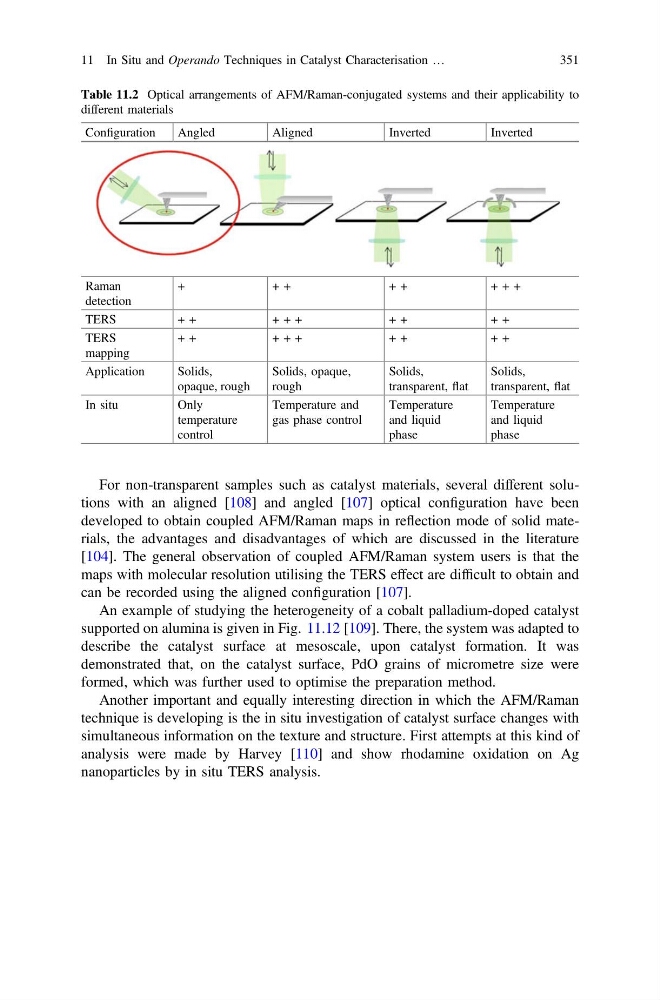
For non-transparent samples such as catalyst materials, several different solutions with an aligned [108] and angled [107] optical configuration have been
developed to obtain coupled AFM/Raman maps in reflection mode of solid materials, the advantages and disadvantages of which are discussed in the literature
[104]. The general observation of coupled AFM/Raman system users is that the
maps with molecular resolution utilising the TERS effect are difficult to obtain and
can be recorded using the aligned configuration [107].
An example of studying the heterogeneity of a cobalt palladium-doped catalyst
supported on alumina is given in Fig. 11.12 [109]. There, the system was adapted to
describe the catalyst surface at mesoscale, upon catalyst formation. It was
demonstrated that, on the catalyst surface, PdO grains of micrometre size were
formed, which was further used to optimise the preparation method.
Another important and equally interesting direction in which the AFM/Raman
technique is developing is the in situ investigation of catalyst surface changes with
simultaneous information on the texture and structure. First attempts at this kind of
analysis were made by Harvey [110] and show rhodamine oxidation on Ag
nanoparticles by in situ TERS analysis.
Table 11.2 Optical arrangements of AFM/Raman-conjugated systems and their applicability to
different materials
Configuration
Angled
Aligned
Inverted
Inverted
Raman
detection
+
+ +
+ +
+ + +
TERS
+ +
+ + +
+ +
+ +
TERS
mapping
+ +
+ + +
+ +
+ +
Application
Solids,
opaque, rough
Solids, opaque,
rough
Solids,
transparent, flat
Solids,
transparent, flat
In situ
Only
temperature
control
Temperature and
gas phase control
Temperature
and liquid
phase
Temperature
and liquid
phase
11 In Situ and Operando Techniques in Catalyst Characterisation …
351
developed to obtain coupled AFM/Raman maps in reflection mode of solid materials, the advantages and disadvantages of which are discussed in the literature
[104]. The general observation of coupled AFM/Raman system users is that the
maps with molecular resolution utilising the TERS effect are difficult to obtain and
can be recorded using the aligned configuration [107].
An example of studying the heterogeneity of a cobalt palladium-doped catalyst
supported on alumina is given in Fig. 11.12 [109]. There, the system was adapted to
describe the catalyst surface at mesoscale, upon catalyst formation. It was
demonstrated that, on the catalyst surface, PdO grains of micrometre size were
formed, which was further used to optimise the preparation method.
Another important and equally interesting direction in which the AFM/Raman
technique is developing is the in situ investigation of catalyst surface changes with
simultaneous information on the texture and structure. First attempts at this kind of
analysis were made by Harvey [110] and show rhodamine oxidation on Ag
nanoparticles by in situ TERS analysis.
Table 11.2 Optical arrangements of AFM/Raman-conjugated systems and their applicability to
different materials
Configuration
Angled
Aligned
Inverted
Inverted
Raman
detection
+
+ +
+ +
+ + +
TERS
+ +
+ + +
+ +
+ +
TERS
mapping
+ +
+ + +
+ +
+ +
Application
Solids,
opaque, rough
Solids, opaque,
rough
Solids,
transparent, flat
Solids,
transparent, flat
In situ
Only
temperature
control
Temperature and
gas phase control
Temperature
and liquid
phase
Temperature
and liquid
phase
11 In Situ and Operando Techniques in Catalyst Characterisation …
351