

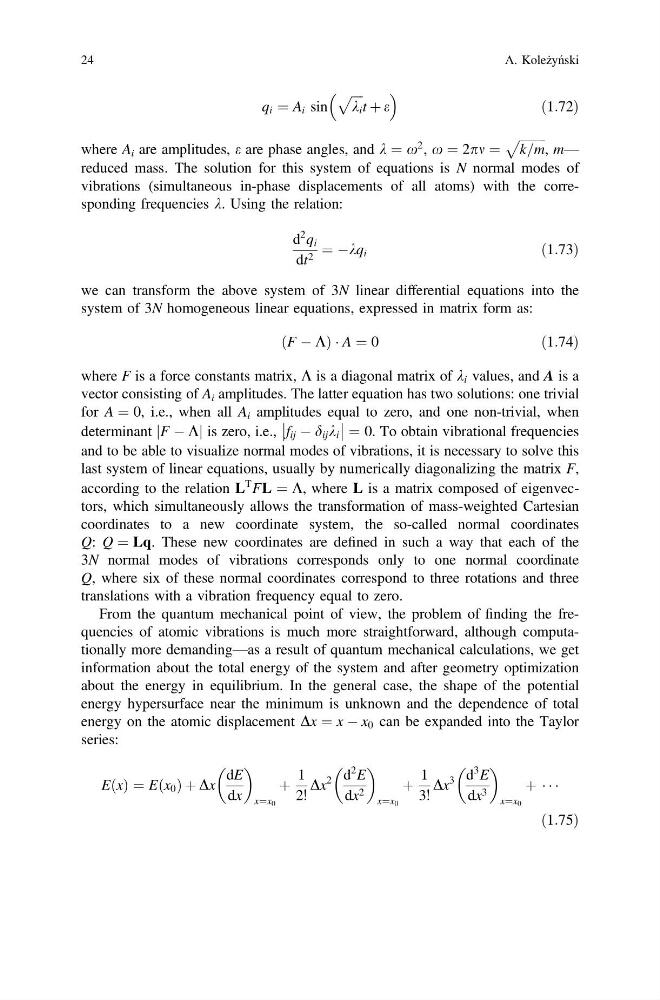
q i ¼ A i sin
ffiffiffiffi
k i
p
t þ e
ð1:72Þ
where A i are amplitudes, e are phase angles, and k ¼ x
2 , x ¼ 2pm ¼
ffiffiffiffiffiffiffiffi ffi
k=m
p
, m—
reduced mass. The solution for this system of equations is N normal modes of
vibrations (simultaneous in-phase displacements of all atoms) with the corresponding frequencies k. Using the relation:
d
2 q i
dt 2 ¼ Àkq i
ð1:73Þ
we can transform the above system of 3N linear differential equations into the
system of 3N homogeneous linear equations, expressed in matrix form as:
F À K
ð
ÞÁA ¼ 0
ð1:74Þ
where F is a force constants matrix, K is a diagonal matrix of k i values, and A is a
vector consisting of A i amplitudes. The latter equation has two solutions: one trivial
for A ¼ 0, i.e., when all A i amplitudes equal to zero, and one non-trivial, when
determinant F À K
j
jis zero, i.e., f ij À d ij k i
¼ 0. To obtain vibrational frequencies
and to be able to visualize normal modes of vibrations, it is necessary to solve this
last system of linear equations, usually by numerically diagonalizing the matrix F,
according to the relation L
T FL ¼ K, where L is a matrix composed of eigenvectors, which simultaneously allows the transformation of mass-weighted Cartesian
coordinates to a new coordinate system, the so-called normal coordinates
Q: Q ¼ Lq. These new coordinates are defined in such a way that each of the
3N normal modes of vibrations corresponds only to one normal coordinate
Q, where six of these normal coordinates correspond to three rotations and three
translations with a vibration frequency equal to zero.
From the quantum mechanical point of view, the problem of finding the frequencies of atomic vibrations is much more straightforward, although computationally more demanding—as a result of quantum mechanical calculations, we get
information about the total energy of the system and after geometry optimization
about the energy in equilibrium. In the general case, the shape of the potential
energy hypersurface near the minimum is unknown and the dependence of total
energy on the atomic displacement Dx ¼ x À x 0 can be expanded into the Taylor
series:
EðxÞ ¼ Eðx 0 Þ þ Dx
dE
dx
x¼x 0
þ
1
2!
Dx
2 d
2 E
dx 2
x¼x 0
þ
1
3!
Dx
3 d
3 E
dx 3
x¼x 0
þ Á Á Á
ð1:75Þ
24
A. Koleżyński
ffiffiffiffi
k i
p
t þ e
ð1:72Þ
where A i are amplitudes, e are phase angles, and k ¼ x
2 , x ¼ 2pm ¼
ffiffiffiffiffiffiffiffi ffi
k=m
p
, m—
reduced mass. The solution for this system of equations is N normal modes of
vibrations (simultaneous in-phase displacements of all atoms) with the corresponding frequencies k. Using the relation:
d
2 q i
dt 2 ¼ Àkq i
ð1:73Þ
we can transform the above system of 3N linear differential equations into the
system of 3N homogeneous linear equations, expressed in matrix form as:
F À K
ð
ÞÁA ¼ 0
ð1:74Þ
where F is a force constants matrix, K is a diagonal matrix of k i values, and A is a
vector consisting of A i amplitudes. The latter equation has two solutions: one trivial
for A ¼ 0, i.e., when all A i amplitudes equal to zero, and one non-trivial, when
determinant F À K
j
jis zero, i.e., f ij À d ij k i
¼ 0. To obtain vibrational frequencies
and to be able to visualize normal modes of vibrations, it is necessary to solve this
last system of linear equations, usually by numerically diagonalizing the matrix F,
according to the relation L
T FL ¼ K, where L is a matrix composed of eigenvectors, which simultaneously allows the transformation of mass-weighted Cartesian
coordinates to a new coordinate system, the so-called normal coordinates
Q: Q ¼ Lq. These new coordinates are defined in such a way that each of the
3N normal modes of vibrations corresponds only to one normal coordinate
Q, where six of these normal coordinates correspond to three rotations and three
translations with a vibration frequency equal to zero.
From the quantum mechanical point of view, the problem of finding the frequencies of atomic vibrations is much more straightforward, although computationally more demanding—as a result of quantum mechanical calculations, we get
information about the total energy of the system and after geometry optimization
about the energy in equilibrium. In the general case, the shape of the potential
energy hypersurface near the minimum is unknown and the dependence of total
energy on the atomic displacement Dx ¼ x À x 0 can be expanded into the Taylor
series:
EðxÞ ¼ Eðx 0 Þ þ Dx
dE
dx
x¼x 0
þ
1
2!
Dx
2 d
2 E
dx 2
x¼x 0
þ
1
3!
Dx
3 d
3 E
dx 3
x¼x 0
þ Á Á Á
ð1:75Þ
24
A. Koleżyński