

For x À x 0 , the first derivative is equal to zero and hence the expression,
neglecting the terms with derivatives of the order higher than the second (harmonic
approximation), simplifies to the form:
EðxÞ ¼ Eðx 0 Þ þ
1
2
Dx
2 d
2 E
dx 2
x¼x 0
ð1:76Þ
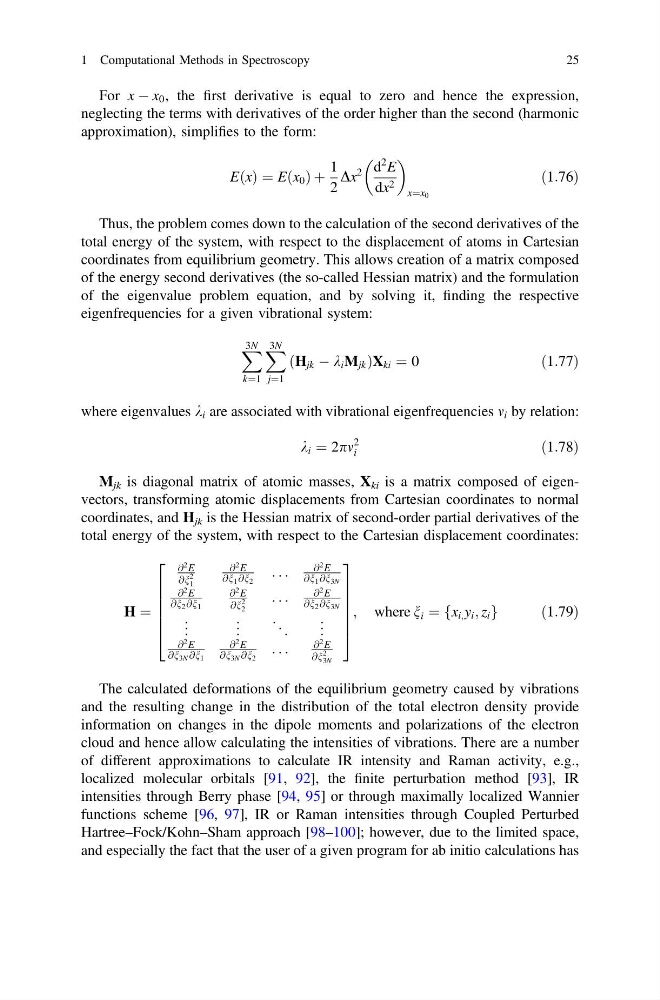
Thus, the problem comes down to the calculation of the second derivatives of the
total energy of the system, with respect to the displacement of atoms in Cartesian
coordinates from equilibrium geometry. This allows creation of a matrix composed
of the energy second derivatives (the so-called Hessian matrix) and the formulation
of the eigenvalue problem equation, and by solving it, finding the respective
eigenfrequencies for a given vibrational system:
X 3N
k¼1
X 3N
j¼1
ðH jk À k i M jk ÞX ki ¼ 0
ð1:77Þ
where eigenvalues k i are associated with vibrational eigenfrequencies m i by relation:
k i ¼ 2pm
2
i
ð1:78Þ
M jk is diagonal matrix of atomic masses, X ki is a matrix composed of eigenvectors, transforming atomic displacements from Cartesian coordinates to normal
coordinates, and H jk is the Hessian matrix of second-order partial derivatives of the
total energy of the system, with respect to the Cartesian displacement coordinates:
H ¼
@
2 E
@n
2
1
@
2 E
@n 1 @n 2
. . .
@
2 E
@n 1 @n 3N
@
2 E
@n 2 @n 1
@
2 E
@n
2
2
. . .
@
2 E
@n 2 @n 3N
. .
.
. .
.
. .
.
. .
.
@
2 E
@n 3N @n 1
@
2 E
@n 3N @n 2
. . .
@
2 E
@n
2
3N
2
6
6
6
6
6
4
3
7
7
7
7
7
5
; where n i ¼ fx i; y i ; z i g
ð1:79Þ
The calculated deformations of the equilibrium geometry caused by vibrations
and the resulting change in the distribution of the total electron density provide
information on changes in the dipole moments and polarizations of the electron
cloud and hence allow calculating the intensities of vibrations. There are a number
of different approximations to calculate IR intensity and Raman activity, e.g.,
localized molecular orbitals [91, 92], the finite perturbation method [93], IR
intensities through Berry phase [94, 95] or through maximally localized Wannier
functions scheme [96, 97], IR or Raman intensities through Coupled Perturbed
Hartree–Fock/Kohn–Sham approach [98–100]; however, due to the limited space,
and especially the fact that the user of a given program for ab initio calculations has
1 Computational Methods in Spectroscopy
25
neglecting the terms with derivatives of the order higher than the second (harmonic
approximation), simplifies to the form:
EðxÞ ¼ Eðx 0 Þ þ
1
2
Dx
2 d
2 E
dx 2
x¼x 0
ð1:76Þ
Thus, the problem comes down to the calculation of the second derivatives of the
total energy of the system, with respect to the displacement of atoms in Cartesian
coordinates from equilibrium geometry. This allows creation of a matrix composed
of the energy second derivatives (the so-called Hessian matrix) and the formulation
of the eigenvalue problem equation, and by solving it, finding the respective
eigenfrequencies for a given vibrational system:
X 3N
k¼1
X 3N
j¼1
ðH jk À k i M jk ÞX ki ¼ 0
ð1:77Þ
where eigenvalues k i are associated with vibrational eigenfrequencies m i by relation:
k i ¼ 2pm
2
i
ð1:78Þ
M jk is diagonal matrix of atomic masses, X ki is a matrix composed of eigenvectors, transforming atomic displacements from Cartesian coordinates to normal
coordinates, and H jk is the Hessian matrix of second-order partial derivatives of the
total energy of the system, with respect to the Cartesian displacement coordinates:
H ¼
@
2 E
@n
2
1
@
2 E
@n 1 @n 2
. . .
@
2 E
@n 1 @n 3N
@
2 E
@n 2 @n 1
@
2 E
@n
2
2
. . .
@
2 E
@n 2 @n 3N
. .
.
. .
.
. .
.
. .
.
@
2 E
@n 3N @n 1
@
2 E
@n 3N @n 2
. . .
@
2 E
@n
2
3N
2
6
6
6
6
6
4
3
7
7
7
7
7
5
; where n i ¼ fx i; y i ; z i g
ð1:79Þ
The calculated deformations of the equilibrium geometry caused by vibrations
and the resulting change in the distribution of the total electron density provide
information on changes in the dipole moments and polarizations of the electron
cloud and hence allow calculating the intensities of vibrations. There are a number
of different approximations to calculate IR intensity and Raman activity, e.g.,
localized molecular orbitals [91, 92], the finite perturbation method [93], IR
intensities through Berry phase [94, 95] or through maximally localized Wannier
functions scheme [96, 97], IR or Raman intensities through Coupled Perturbed
Hartree–Fock/Kohn–Sham approach [98–100]; however, due to the limited space,
and especially the fact that the user of a given program for ab initio calculations has
1 Computational Methods in Spectroscopy
25