

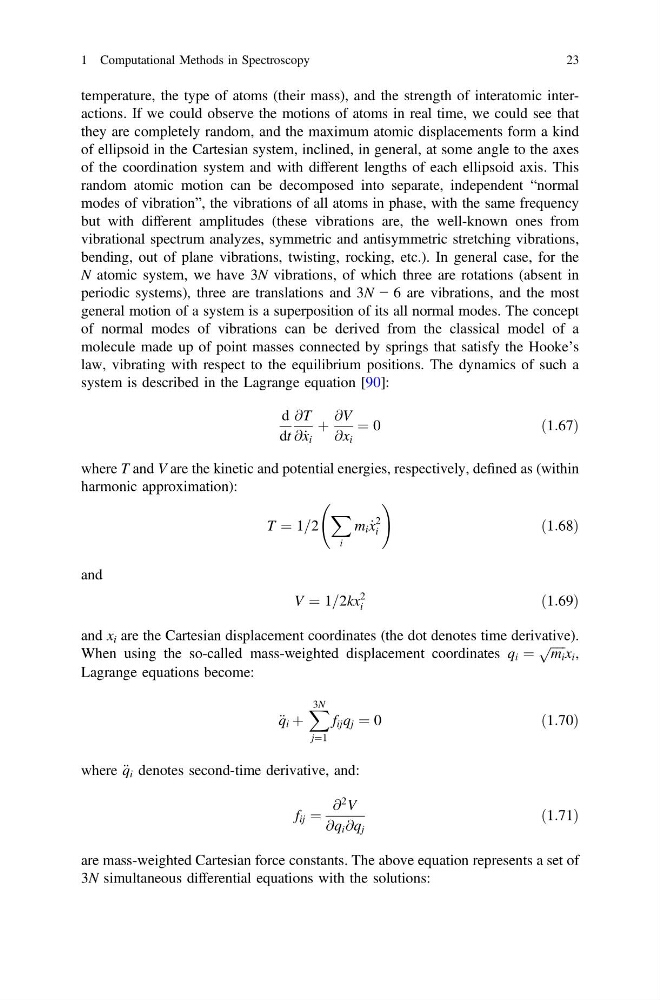
temperature, the type of atoms (their mass), and the strength of interatomic interactions. If we could observe the motions of atoms in real time, we could see that
they are completely random, and the maximum atomic displacements form a kind
of ellipsoid in the Cartesian system, inclined, in general, at some angle to the axes
of the coordination system and with different lengths of each ellipsoid axis. This
random atomic motion can be decomposed into separate, independent “normal
modes of vibration”, the vibrations of all atoms in phase, with the same frequency
but with different amplitudes (these vibrations are, the well-known ones from
vibrational spectrum analyzes, symmetric and antisymmetric stretching vibrations,
bending, out of plane vibrations, twisting, rocking, etc.). In general case, for the
N atomic system, we have 3N vibrations, of which three are rotations (absent in
periodic systems), three are translations and 3N − 6 are vibrations, and the most
general motion of a system is a superposition of its all normal modes. The concept
of normal modes of vibrations can be derived from the classical model of a
molecule made up of point masses connected by springs that satisfy the Hooke’s
law, vibrating with respect to the equilibrium positions. The dynamics of such a
system is described in the Lagrange equation [90]:
d
dt
@T
@ _
x i
þ
@V
@x i
¼ 0
ð1:67Þ
where T and V are the kinetic and potential energies, respectively, defined as (within
harmonic approximation):
T ¼ 1=2
X
i
m i _
x
2
i
!
ð1:68Þ
and
V ¼ 1=2kx
2
i
ð1:69Þ
and x i are the Cartesian displacement coordinates (the dot denotes time derivative).
When using the so-called mass-weighted displacement coordinates q i ¼
ffiffiffiffiffi
m i
p x i ,
Lagrange equations become:
€ q i þ
X 3N
j¼1
f ij q j ¼ 0
ð1:70Þ
where € q i denotes second-time derivative, and:
f ij ¼
@
2 V
@q i @q j
ð1:71Þ
are mass-weighted Cartesian force constants. The above equation represents a set of
3N simultaneous differential equations with the solutions:
1 Computational Methods in Spectroscopy
23
they are completely random, and the maximum atomic displacements form a kind
of ellipsoid in the Cartesian system, inclined, in general, at some angle to the axes
of the coordination system and with different lengths of each ellipsoid axis. This
random atomic motion can be decomposed into separate, independent “normal
modes of vibration”, the vibrations of all atoms in phase, with the same frequency
but with different amplitudes (these vibrations are, the well-known ones from
vibrational spectrum analyzes, symmetric and antisymmetric stretching vibrations,
bending, out of plane vibrations, twisting, rocking, etc.). In general case, for the
N atomic system, we have 3N vibrations, of which three are rotations (absent in
periodic systems), three are translations and 3N − 6 are vibrations, and the most
general motion of a system is a superposition of its all normal modes. The concept
of normal modes of vibrations can be derived from the classical model of a
molecule made up of point masses connected by springs that satisfy the Hooke’s
law, vibrating with respect to the equilibrium positions. The dynamics of such a
system is described in the Lagrange equation [90]:
d
dt
@T
@ _
x i
þ
@V
@x i
¼ 0
ð1:67Þ
where T and V are the kinetic and potential energies, respectively, defined as (within
harmonic approximation):
T ¼ 1=2
X
i
m i _
x
2
i
!
ð1:68Þ
and
V ¼ 1=2kx
2
i
ð1:69Þ
and x i are the Cartesian displacement coordinates (the dot denotes time derivative).
When using the so-called mass-weighted displacement coordinates q i ¼
ffiffiffiffiffi
m i
p x i ,
Lagrange equations become:
€ q i þ
X 3N
j¼1
f ij q j ¼ 0
ð1:70Þ
where € q i denotes second-time derivative, and:
f ij ¼
@
2 V
@q i @q j
ð1:71Þ
are mass-weighted Cartesian force constants. The above equation represents a set of
3N simultaneous differential equations with the solutions:
1 Computational Methods in Spectroscopy
23