

11.2.4 In Situ UV-Vis Spectroscopy
Electron transition molecular spectroscopy is one of the oldest techniques used to
investigate catalyst materials, but its role is limited due to complexity of the
absorption signals. The instrumentation used for in situ catalyst investigations relies
mainly on the diffuse reflectance and fibre optic spectroscopy, and on microscopy in
a similar manner to IR. The same concerns the choice and arrangements of the
temperature cells.
A broad presentation of examples of the use of UV-Vis in situ techniques can be
found in the review [96]. The most important domains of the application of this
technique for solving catalytic problems are the determination of the coordination
of transition metal ions to surface oxygens and quantitative determination of the
oxidation states of transition metal ions. An interesting application of UV-Vis
analysis is for the determination of the degree of “polymerisation” or clusterisation
of surface metal oxides, as for example in Bañares et al. [97]. For this purpose, edge
energy is derived from the UV-Vis spectra of single supported metal oxides [98].
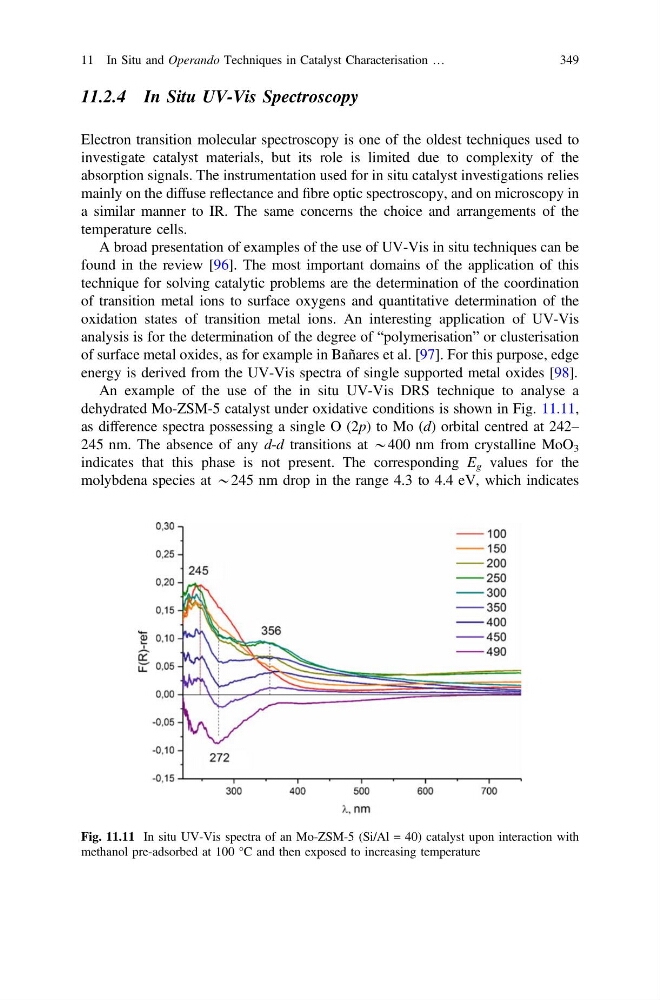
An example of the use of the in situ UV-Vis DRS technique to analyse a
dehydrated Mo-ZSM-5 catalyst under oxidative conditions is shown in Fig. 11.11,
as difference spectra possessing a single O (2p) to Mo (d) orbital centred at 242–
245 nm. The absence of any d-d transitions at *400 nm from crystalline MoO 3
indicates that this phase is not present. The corresponding E g values for the
molybdena species at *245 nm drop in the range 4.3 to 4.4 eV, which indicates
Fig. 11.11 In situ UV-Vis spectra of an Mo-ZSM-5 (Si/Al = 40) catalyst upon interaction with
methanol pre-adsorbed at 100 °C and then exposed to increasing temperature
11 In Situ and Operando Techniques in Catalyst Characterisation …
349
Electron transition molecular spectroscopy is one of the oldest techniques used to
investigate catalyst materials, but its role is limited due to complexity of the
absorption signals. The instrumentation used for in situ catalyst investigations relies
mainly on the diffuse reflectance and fibre optic spectroscopy, and on microscopy in
a similar manner to IR. The same concerns the choice and arrangements of the
temperature cells.
A broad presentation of examples of the use of UV-Vis in situ techniques can be
found in the review [96]. The most important domains of the application of this
technique for solving catalytic problems are the determination of the coordination
of transition metal ions to surface oxygens and quantitative determination of the
oxidation states of transition metal ions. An interesting application of UV-Vis
analysis is for the determination of the degree of “polymerisation” or clusterisation
of surface metal oxides, as for example in Bañares et al. [97]. For this purpose, edge
energy is derived from the UV-Vis spectra of single supported metal oxides [98].
An example of the use of the in situ UV-Vis DRS technique to analyse a
dehydrated Mo-ZSM-5 catalyst under oxidative conditions is shown in Fig. 11.11,
as difference spectra possessing a single O (2p) to Mo (d) orbital centred at 242–
245 nm. The absence of any d-d transitions at *400 nm from crystalline MoO 3
indicates that this phase is not present. The corresponding E g values for the
molybdena species at *245 nm drop in the range 4.3 to 4.4 eV, which indicates
Fig. 11.11 In situ UV-Vis spectra of an Mo-ZSM-5 (Si/Al = 40) catalyst upon interaction with
methanol pre-adsorbed at 100 °C and then exposed to increasing temperature
11 In Situ and Operando Techniques in Catalyst Characterisation …
349