

Raman spectroscopy also provides information on the special distribution of bulk
metal oxides.
As regards supported metal oxides, Raman spectroscopy is able to provide
useful data on the molecular structure of the metal oxide on the support, its specific
location and surface coverage and surface acidity. If used in an in situ mode upon a
catalytic reaction, the technique is able to trace the changes in the structure of the
metal oxide catalyst, and in particular the engagement of the metal-oxygen bonds in
the reaction mechanism [93, 94]. For this class of catalysts, great efforts were made
to understand the vanadium and chromium group of elements, due to their widespread application in many chemical industrial processes, examples of which can be
found in numerous works by Bañares and Wachs. Raman is especially suitable for
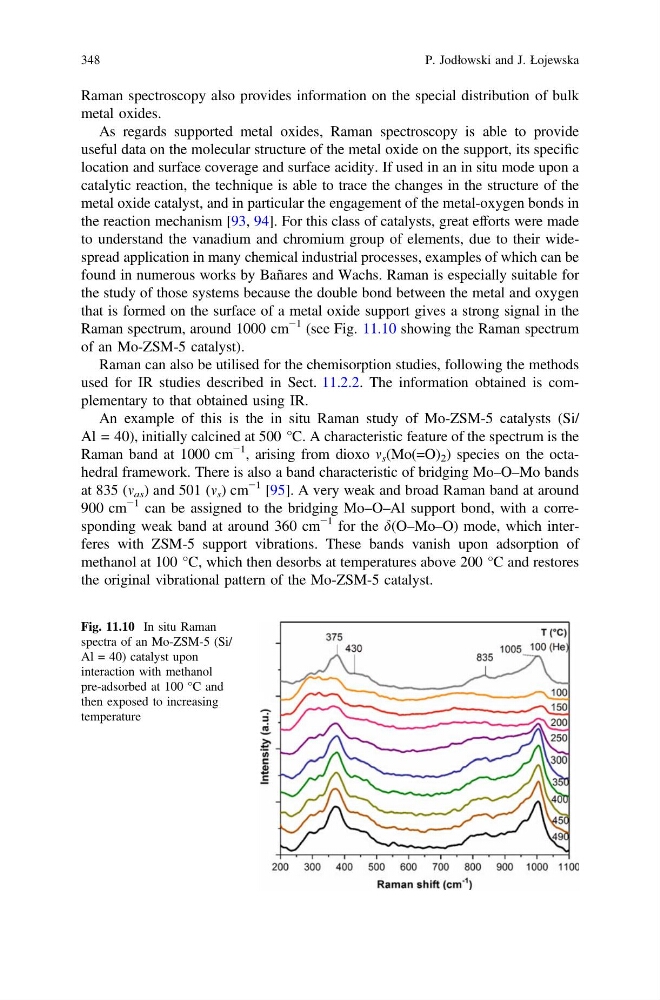
the study of those systems because the double bond between the metal and oxygen
that is formed on the surface of a metal oxide support gives a strong signal in the
Raman spectrum, around 1000 cm
−1 (see Fig. 11.10 showing the Raman spectrum
of an Mo-ZSM-5 catalyst).
Raman can also be utilised for the chemisorption studies, following the methods
used for IR studies described in Sect. 11.2.2. The information obtained is complementary to that obtained using IR.
An example of this is the in situ Raman study of Mo-ZSM-5 catalysts (Si/
Al = 40), initially calcined at 500 °C. A characteristic feature of the spectrum is the
Raman band at 1000 cm
−1 , arising from dioxo m s (Mo(=O) 2 ) species on the octahedral framework. There is also a band characteristic of bridging Mo–O–Mo bands
at 835 (m as ) and 501 (m s ) cm
−1 [95]. A very weak and broad Raman band at around
900 cm
−1 can be assigned to the bridging Mo–O–Al support bond, with a corresponding weak band at around 360 cm
−1 for the d(O–Mo–O) mode, which interferes with ZSM-5 support vibrations. These bands vanish upon adsorption of
methanol at 100 °C, which then desorbs at temperatures above 200 °C and restores
the original vibrational pattern of the Mo-ZSM-5 catalyst.
Fig. 11.10 In situ Raman
spectra of an Mo-ZSM-5 (Si/
Al = 40) catalyst upon
interaction with methanol
pre-adsorbed at 100 °C and
then exposed to increasing
temperature
348
P. Jodłowski and J. Łojewska
metal oxides.
As regards supported metal oxides, Raman spectroscopy is able to provide
useful data on the molecular structure of the metal oxide on the support, its specific
location and surface coverage and surface acidity. If used in an in situ mode upon a
catalytic reaction, the technique is able to trace the changes in the structure of the
metal oxide catalyst, and in particular the engagement of the metal-oxygen bonds in
the reaction mechanism [93, 94]. For this class of catalysts, great efforts were made
to understand the vanadium and chromium group of elements, due to their widespread application in many chemical industrial processes, examples of which can be
found in numerous works by Bañares and Wachs. Raman is especially suitable for
the study of those systems because the double bond between the metal and oxygen
that is formed on the surface of a metal oxide support gives a strong signal in the
Raman spectrum, around 1000 cm
−1 (see Fig. 11.10 showing the Raman spectrum
of an Mo-ZSM-5 catalyst).
Raman can also be utilised for the chemisorption studies, following the methods
used for IR studies described in Sect. 11.2.2. The information obtained is complementary to that obtained using IR.
An example of this is the in situ Raman study of Mo-ZSM-5 catalysts (Si/
Al = 40), initially calcined at 500 °C. A characteristic feature of the spectrum is the
Raman band at 1000 cm
−1 , arising from dioxo m s (Mo(=O) 2 ) species on the octahedral framework. There is also a band characteristic of bridging Mo–O–Mo bands
at 835 (m as ) and 501 (m s ) cm
−1 [95]. A very weak and broad Raman band at around
900 cm
−1 can be assigned to the bridging Mo–O–Al support bond, with a corresponding weak band at around 360 cm
−1 for the d(O–Mo–O) mode, which interferes with ZSM-5 support vibrations. These bands vanish upon adsorption of
methanol at 100 °C, which then desorbs at temperatures above 200 °C and restores
the original vibrational pattern of the Mo-ZSM-5 catalyst.
Fig. 11.10 In situ Raman
spectra of an Mo-ZSM-5 (Si/
Al = 40) catalyst upon
interaction with methanol
pre-adsorbed at 100 °C and
then exposed to increasing
temperature
348
P. Jodłowski and J. Łojewska