

Alternatively, a similar effect to that observed for CO probe molecules can be
achieved by NO, which has similar properties [22, 32]. However, the adsorption of
NO molecules over copper-exchanged ZSM-5 catalysts at room temperature provides a complex spectroscopic pattern (Fig. 11.2b). The bands shifted to the higher
wavenumber (1850–2000 cm
−1 ) can be assigned to Cu
2+
–NO, whereas those below
1850 cm
−1 can be assigned to both Cu
+
–NO and Cu
2+
–(NO) 2 .
Amongst the probe molecules, alcohols play a special role in the studies of the
nature and number of active sites at a catalyst’s surface [33–35]. The literature
provides the number of reports of probing catalyst surfaces using alcohols of
various acidities, including (CF 3 ) 3 COH (pKa = 5.4) (CF 3 ) 2 CHOH (pKa = 9.3),
CF 3 CH 2 OH (pKa = 12.3) and CH 3 OH (pKa = 15.1) [23], ethanol, 2-propanol and
tetr-butyl [33]. The adsorption of the alcohols proceeds irreversibly with the formation of two species at the catalyst surface (Fig. 11.4). The dissociative
chemisorption of alcohols on weak Lewis acid sites results in the formation of
alkoxy species (Fig. 11.4a), whereas undissociated species are chemisorbed on
strong Lewis acid sites, resulting in the formation of structure B, as shown in
Fig. 11.4b [23].
The chemisorption of alcohols over metal oxide catalysts results in the formation
of two characteristic regions in the IR spectrum. In the range 3000–2800 cm
−1 ,
characteristic –CH vibrations are shifted to higher wavenumber for species B
(Fig. 11.4b), whereas dissociative adsorption with the characteristic adsorbed
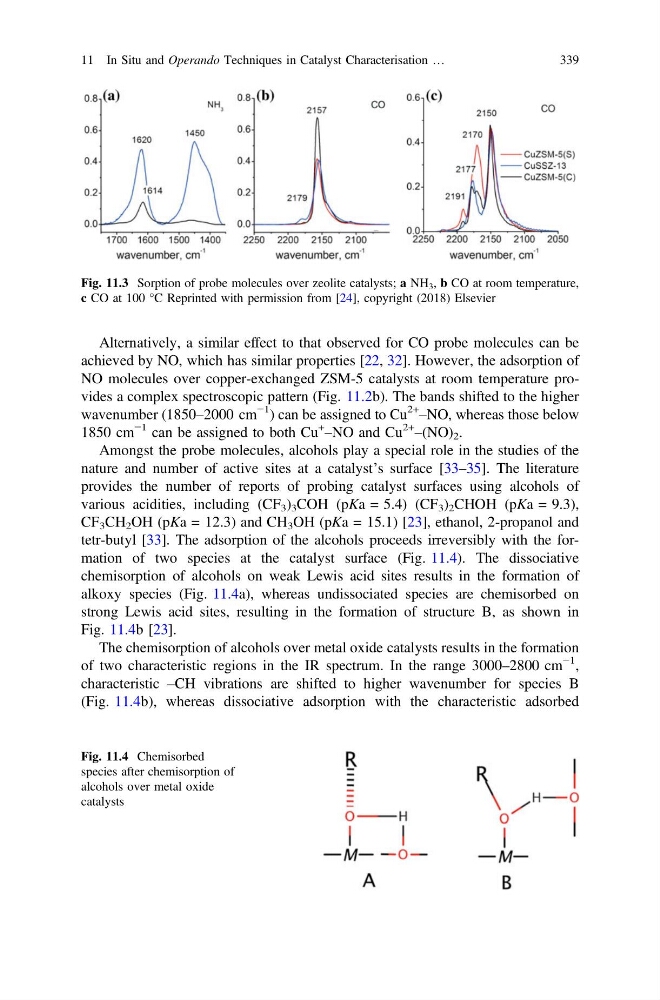
Fig. 11.3 Sorption of probe molecules over zeolite catalysts; a NH 3 , b CO at room temperature,
c CO at 100 °C Reprinted with permission from [24], copyright (2018) Elsevier
Fig. 11.4 Chemisorbed
species after chemisorption of
alcohols over metal oxide
catalysts
11 In Situ and Operando Techniques in Catalyst Characterisation …
339
achieved by NO, which has similar properties [22, 32]. However, the adsorption of
NO molecules over copper-exchanged ZSM-5 catalysts at room temperature provides a complex spectroscopic pattern (Fig. 11.2b). The bands shifted to the higher
wavenumber (1850–2000 cm
−1 ) can be assigned to Cu
2+
–NO, whereas those below
1850 cm
−1 can be assigned to both Cu
+
–NO and Cu
2+
–(NO) 2 .
Amongst the probe molecules, alcohols play a special role in the studies of the
nature and number of active sites at a catalyst’s surface [33–35]. The literature
provides the number of reports of probing catalyst surfaces using alcohols of
various acidities, including (CF 3 ) 3 COH (pKa = 5.4) (CF 3 ) 2 CHOH (pKa = 9.3),
CF 3 CH 2 OH (pKa = 12.3) and CH 3 OH (pKa = 15.1) [23], ethanol, 2-propanol and
tetr-butyl [33]. The adsorption of the alcohols proceeds irreversibly with the formation of two species at the catalyst surface (Fig. 11.4). The dissociative
chemisorption of alcohols on weak Lewis acid sites results in the formation of
alkoxy species (Fig. 11.4a), whereas undissociated species are chemisorbed on
strong Lewis acid sites, resulting in the formation of structure B, as shown in
Fig. 11.4b [23].
The chemisorption of alcohols over metal oxide catalysts results in the formation
of two characteristic regions in the IR spectrum. In the range 3000–2800 cm
−1 ,
characteristic –CH vibrations are shifted to higher wavenumber for species B
(Fig. 11.4b), whereas dissociative adsorption with the characteristic adsorbed
Fig. 11.3 Sorption of probe molecules over zeolite catalysts; a NH 3 , b CO at room temperature,
c CO at 100 °C Reprinted with permission from [24], copyright (2018) Elsevier
Fig. 11.4 Chemisorbed
species after chemisorption of
alcohols over metal oxide
catalysts
11 In Situ and Operando Techniques in Catalyst Characterisation …
339