

selective catalytic removal of NO x from stationary sources. In this study, the nature
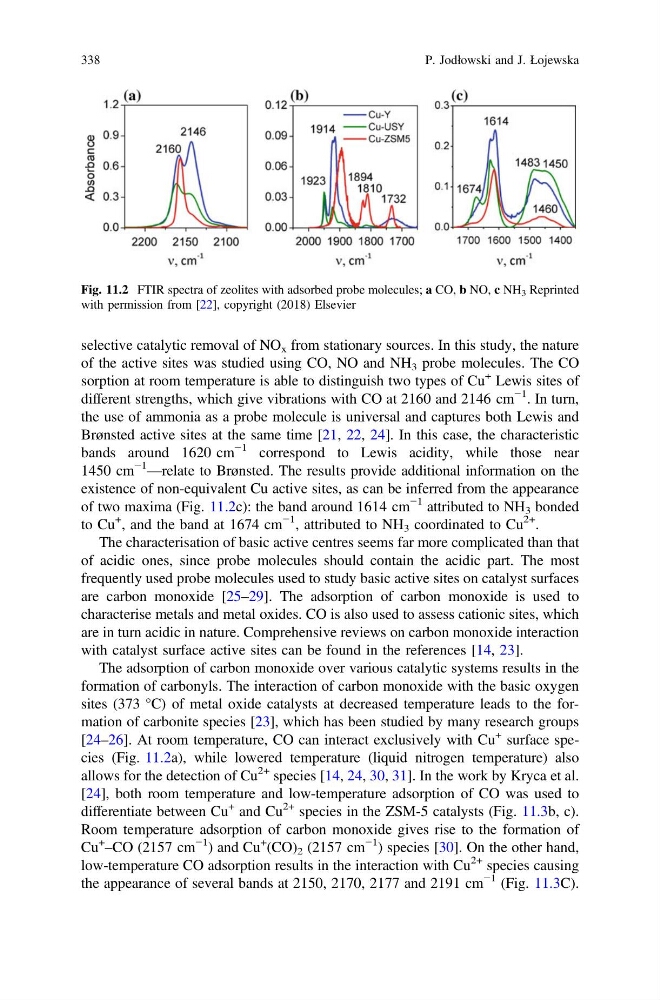
of the active sites was studied using CO, NO and NH 3 probe molecules. The CO
sorption at room temperature is able to distinguish two types of Cu
+ Lewis sites of
different strengths, which give vibrations with CO at 2160 and 2146 cm
−1 . In turn,
the use of ammonia as a probe molecule is universal and captures both Lewis and
Brønsted active sites at the same time [21, 22, 24]. In this case, the characteristic
bands around 1620 cm
−1 correspond to Lewis acidity, while those near
1450 cm
−1
—relate to Brønsted. The results provide additional information on the
existence of non-equivalent Cu active sites, as can be inferred from the appearance
of two maxima (Fig. 11.2c): the band around 1614 cm
−1 attributed to NH 3 bonded
to Cu
+
, and the band at 1674 cm
−1 , attributed to NH 3 coordinated to Cu
2+ .
The characterisation of basic active centres seems far more complicated than that
of acidic ones, since probe molecules should contain the acidic part. The most
frequently used probe molecules used to study basic active sites on catalyst surfaces
are carbon monoxide [25–29]. The adsorption of carbon monoxide is used to
characterise metals and metal oxides. CO is also used to assess cationic sites, which
are in turn acidic in nature. Comprehensive reviews on carbon monoxide interaction
with catalyst surface active sites can be found in the references [14, 23].
The adsorption of carbon monoxide over various catalytic systems results in the
formation of carbonyls. The interaction of carbon monoxide with the basic oxygen
sites (373 °C) of metal oxide catalysts at decreased temperature leads to the formation of carbonite species [23], which has been studied by many research groups
[24–26]. At room temperature, CO can interact exclusively with Cu
+ surface species (Fig. 11.2a), while lowered temperature (liquid nitrogen temperature) also
allows for the detection of Cu
2+ species [14, 24, 30, 31]. In the work by Kryca et al.
[24], both room temperature and low-temperature adsorption of CO was used to
differentiate between Cu
+ and Cu
2+ species in the ZSM-5 catalysts (Fig. 11.3b, c).
Room temperature adsorption of carbon monoxide gives rise to the formation of
Cu
+
–CO (2157 cm
−1 ) and Cu
+
(CO) 2 (2157 cm
−1 ) species [30]. On the other hand,
low-temperature CO adsorption results in the interaction with Cu
2+ species causing
the appearance of several bands at 2150, 2170, 2177 and 2191 cm
−1 (Fig. 11.3C).
Fig. 11.2 FTIR spectra of zeolites with adsorbed probe molecules; a CO, b NO, c NH 3 Reprinted
with permission from [22], copyright (2018) Elsevier
338
P. Jodłowski and J. Łojewska
of the active sites was studied using CO, NO and NH 3 probe molecules. The CO
sorption at room temperature is able to distinguish two types of Cu
+ Lewis sites of
different strengths, which give vibrations with CO at 2160 and 2146 cm
−1 . In turn,
the use of ammonia as a probe molecule is universal and captures both Lewis and
Brønsted active sites at the same time [21, 22, 24]. In this case, the characteristic
bands around 1620 cm
−1 correspond to Lewis acidity, while those near
1450 cm
−1
—relate to Brønsted. The results provide additional information on the
existence of non-equivalent Cu active sites, as can be inferred from the appearance
of two maxima (Fig. 11.2c): the band around 1614 cm
−1 attributed to NH 3 bonded
to Cu
+
, and the band at 1674 cm
−1 , attributed to NH 3 coordinated to Cu
2+ .
The characterisation of basic active centres seems far more complicated than that
of acidic ones, since probe molecules should contain the acidic part. The most
frequently used probe molecules used to study basic active sites on catalyst surfaces
are carbon monoxide [25–29]. The adsorption of carbon monoxide is used to
characterise metals and metal oxides. CO is also used to assess cationic sites, which
are in turn acidic in nature. Comprehensive reviews on carbon monoxide interaction
with catalyst surface active sites can be found in the references [14, 23].
The adsorption of carbon monoxide over various catalytic systems results in the
formation of carbonyls. The interaction of carbon monoxide with the basic oxygen
sites (373 °C) of metal oxide catalysts at decreased temperature leads to the formation of carbonite species [23], which has been studied by many research groups
[24–26]. At room temperature, CO can interact exclusively with Cu
+ surface species (Fig. 11.2a), while lowered temperature (liquid nitrogen temperature) also
allows for the detection of Cu
2+ species [14, 24, 30, 31]. In the work by Kryca et al.
[24], both room temperature and low-temperature adsorption of CO was used to
differentiate between Cu
+ and Cu
2+ species in the ZSM-5 catalysts (Fig. 11.3b, c).
Room temperature adsorption of carbon monoxide gives rise to the formation of
Cu
+
–CO (2157 cm
−1 ) and Cu
+
(CO) 2 (2157 cm
−1 ) species [30]. On the other hand,
low-temperature CO adsorption results in the interaction with Cu
2+ species causing
the appearance of several bands at 2150, 2170, 2177 and 2191 cm
−1 (Fig. 11.3C).
Fig. 11.2 FTIR spectra of zeolites with adsorbed probe molecules; a CO, b NO, c NH 3 Reprinted
with permission from [22], copyright (2018) Elsevier
338
P. Jodłowski and J. Łojewska