

species A is represented by lower –CH frequencies. In the second region, the
bending modes of –OH vibrations are coupled with the d–CH 2 and d–CH modes.
A number of studies have been devoted to the adsorption of halogeno-alcohols over
selected metal oxide supports such as alumina or titania, proving dissociative
adsorption [34, 36]. The adsorption of acidic alcohols proceeds over active centres
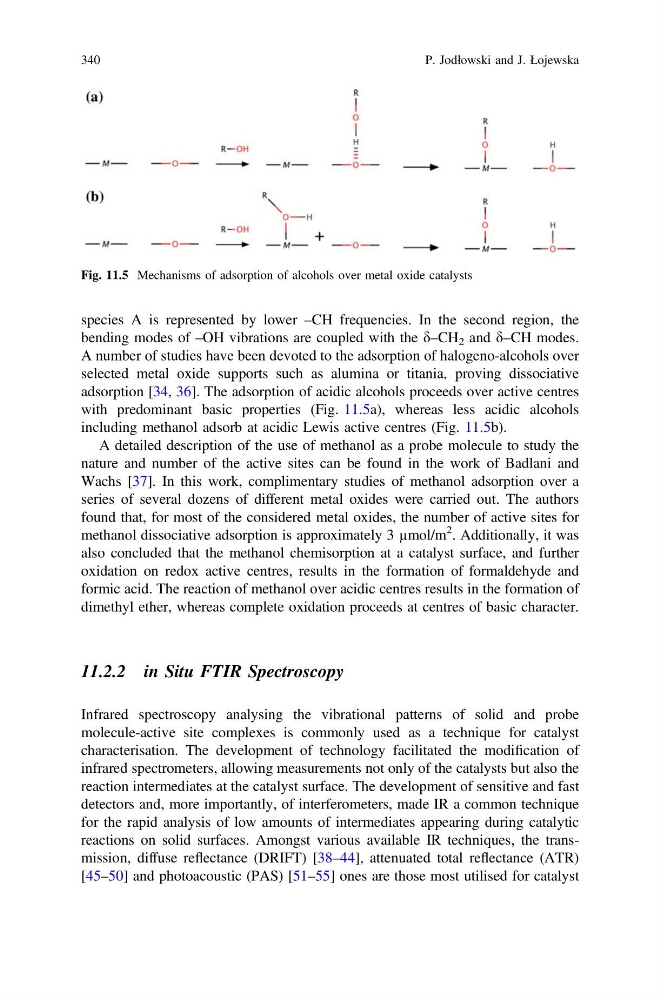
with predominant basic properties (Fig. 11.5a), whereas less acidic alcohols
including methanol adsorb at acidic Lewis active centres (Fig. 11.5b).
A detailed description of the use of methanol as a probe molecule to study the
nature and number of the active sites can be found in the work of Badlani and
Wachs [37]. In this work, complimentary studies of methanol adsorption over a
series of several dozens of different metal oxides were carried out. The authors
found that, for most of the considered metal oxides, the number of active sites for
methanol dissociative adsorption is approximately 3 µmol/m
2 . Additionally, it was
also concluded that the methanol chemisorption at a catalyst surface, and further
oxidation on redox active centres, results in the formation of formaldehyde and
formic acid. The reaction of methanol over acidic centres results in the formation of
dimethyl ether, whereas complete oxidation proceeds at centres of basic character.
11.2.2 in Situ FTIR Spectroscopy
Infrared spectroscopy analysing the vibrational patterns of solid and probe
molecule-active site complexes is commonly used as a technique for catalyst
characterisation. The development of technology facilitated the modification of
infrared spectrometers, allowing measurements not only of the catalysts but also the
reaction intermediates at the catalyst surface. The development of sensitive and fast
detectors and, more importantly, of interferometers, made IR a common technique
for the rapid analysis of low amounts of intermediates appearing during catalytic
reactions on solid surfaces. Amongst various available IR techniques, the transmission, diffuse reflectance (DRIFT) [38–44], attenuated total reflectance (ATR)
[45–50] and photoacoustic (PAS) [51–55] ones are those most utilised for catalyst
Fig. 11.5 Mechanisms of adsorption of alcohols over metal oxide catalysts
340
P. Jodłowski and J. Łojewska
bending modes of –OH vibrations are coupled with the d–CH 2 and d–CH modes.
A number of studies have been devoted to the adsorption of halogeno-alcohols over
selected metal oxide supports such as alumina or titania, proving dissociative
adsorption [34, 36]. The adsorption of acidic alcohols proceeds over active centres
with predominant basic properties (Fig. 11.5a), whereas less acidic alcohols
including methanol adsorb at acidic Lewis active centres (Fig. 11.5b).
A detailed description of the use of methanol as a probe molecule to study the
nature and number of the active sites can be found in the work of Badlani and
Wachs [37]. In this work, complimentary studies of methanol adsorption over a
series of several dozens of different metal oxides were carried out. The authors
found that, for most of the considered metal oxides, the number of active sites for
methanol dissociative adsorption is approximately 3 µmol/m
2 . Additionally, it was
also concluded that the methanol chemisorption at a catalyst surface, and further
oxidation on redox active centres, results in the formation of formaldehyde and
formic acid. The reaction of methanol over acidic centres results in the formation of
dimethyl ether, whereas complete oxidation proceeds at centres of basic character.
11.2.2 in Situ FTIR Spectroscopy
Infrared spectroscopy analysing the vibrational patterns of solid and probe
molecule-active site complexes is commonly used as a technique for catalyst
characterisation. The development of technology facilitated the modification of
infrared spectrometers, allowing measurements not only of the catalysts but also the
reaction intermediates at the catalyst surface. The development of sensitive and fast
detectors and, more importantly, of interferometers, made IR a common technique
for the rapid analysis of low amounts of intermediates appearing during catalytic
reactions on solid surfaces. Amongst various available IR techniques, the transmission, diffuse reflectance (DRIFT) [38–44], attenuated total reflectance (ATR)
[45–50] and photoacoustic (PAS) [51–55] ones are those most utilised for catalyst
Fig. 11.5 Mechanisms of adsorption of alcohols over metal oxide catalysts
340
P. Jodłowski and J. Łojewska