

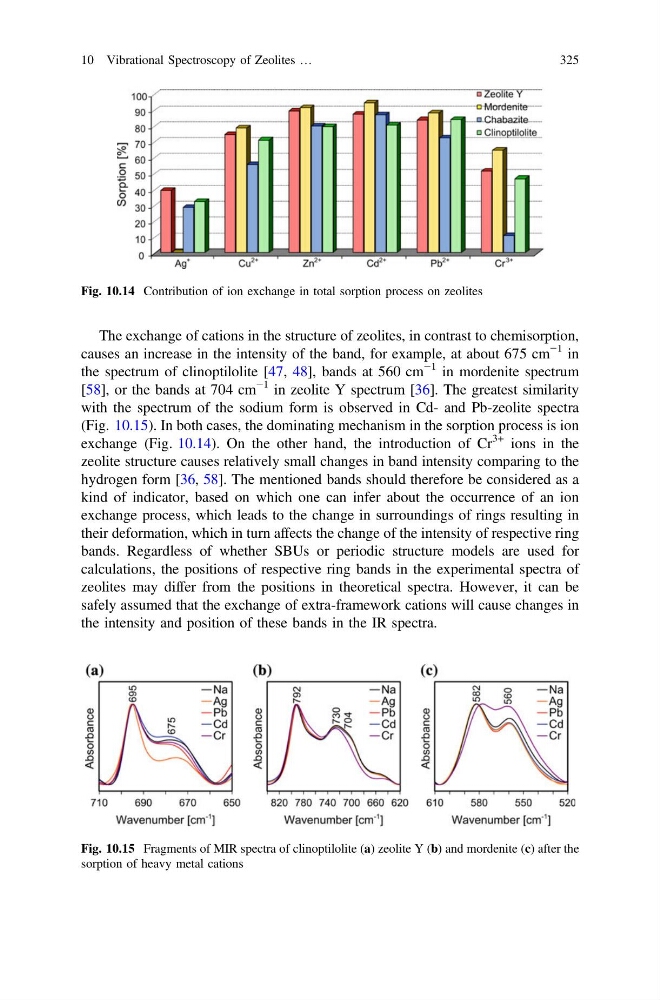
The exchange of cations in the structure of zeolites, in contrast to chemisorption,
causes an increase in the intensity of the band, for example, at about 675 cm
−1 in
the spectrum of clinoptilolite [47, 48], bands at 560 cm
−1 in mordenite spectrum
[58], or the bands at 704 cm
−1 in zeolite Y spectrum [36]. The greatest similarity
with the spectrum of the sodium form is observed in Cd- and Pb-zeolite spectra
(Fig. 10.15). In both cases, the dominating mechanism in the sorption process is ion
exchange (Fig. 10.14). On the other hand, the introduction of Cr
3+ ions in the
zeolite structure causes relatively small changes in band intensity comparing to the
hydrogen form [36, 58]. The mentioned bands should therefore be considered as a
kind of indicator, based on which one can infer about the occurrence of an ion
exchange process, which leads to the change in surroundings of rings resulting in
their deformation, which in turn affects the change of the intensity of respective ring
bands. Regardless of whether SBUs or periodic structure models are used for
calculations, the positions of respective ring bands in the experimental spectra of
zeolites may differ from the positions in theoretical spectra. However, it can be
safely assumed that the exchange of extra-framework cations will cause changes in
the intensity and position of these bands in the IR spectra.
Fig. 10.14 Contribution of ion exchange in total sorption process on zeolites
Fig. 10.15 Fragments of MIR spectra of clinoptilolite (a) zeolite Y (b) and mordenite (c) after the
sorption of heavy metal cations
10 Vibrational Spectroscopy of Zeolites …
325
causes an increase in the intensity of the band, for example, at about 675 cm
−1 in
the spectrum of clinoptilolite [47, 48], bands at 560 cm
−1 in mordenite spectrum
[58], or the bands at 704 cm
−1 in zeolite Y spectrum [36]. The greatest similarity
with the spectrum of the sodium form is observed in Cd- and Pb-zeolite spectra
(Fig. 10.15). In both cases, the dominating mechanism in the sorption process is ion
exchange (Fig. 10.14). On the other hand, the introduction of Cr
3+ ions in the
zeolite structure causes relatively small changes in band intensity comparing to the
hydrogen form [36, 58]. The mentioned bands should therefore be considered as a
kind of indicator, based on which one can infer about the occurrence of an ion
exchange process, which leads to the change in surroundings of rings resulting in
their deformation, which in turn affects the change of the intensity of respective ring
bands. Regardless of whether SBUs or periodic structure models are used for
calculations, the positions of respective ring bands in the experimental spectra of
zeolites may differ from the positions in theoretical spectra. However, it can be
safely assumed that the exchange of extra-framework cations will cause changes in
the intensity and position of these bands in the IR spectra.
Fig. 10.14 Contribution of ion exchange in total sorption process on zeolites
Fig. 10.15 Fragments of MIR spectra of clinoptilolite (a) zeolite Y (b) and mordenite (c) after the
sorption of heavy metal cations
10 Vibrational Spectroscopy of Zeolites …
325