

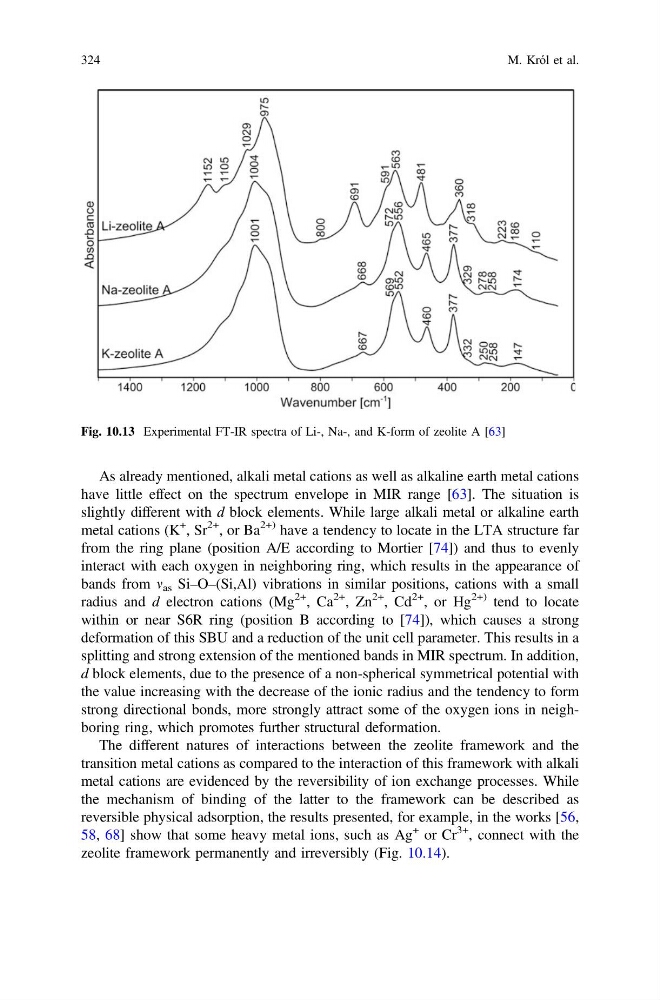
As already mentioned, alkali metal cations as well as alkaline earth metal cations
have little effect on the spectrum envelope in MIR range [63]. The situation is
slightly different with d block elements. While large alkali metal or alkaline earth
metal cations (K
+
, Sr
2+ , or Ba
2+) have a tendency to locate in the LTA structure far
from the ring plane (position A/E according to Mortier [74]) and thus to evenly
interact with each oxygen in neighboring ring, which results in the appearance of
bands from m as Si–O–(Si,Al) vibrations in similar positions, cations with a small
radius and d electron cations (Mg
2+ , Ca
2+ , Zn
2+ , Cd
2+ , or Hg
2+) tend to locate
within or near S6R ring (position B according to [74]), which causes a strong
deformation of this SBU and a reduction of the unit cell parameter. This results in a
splitting and strong extension of the mentioned bands in MIR spectrum. In addition,
d block elements, due to the presence of a non-spherical symmetrical potential with
the value increasing with the decrease of the ionic radius and the tendency to form
strong directional bonds, more strongly attract some of the oxygen ions in neighboring ring, which promotes further structural deformation.
The different natures of interactions between the zeolite framework and the
transition metal cations as compared to the interaction of this framework with alkali
metal cations are evidenced by the reversibility of ion exchange processes. While
the mechanism of binding of the latter to the framework can be described as
reversible physical adsorption, the results presented, for example, in the works [56,
58, 68] show that some heavy metal ions, such as Ag
+ or Cr
3+ , connect with the
zeolite framework permanently and irreversibly (Fig. 10.14).
Fig. 10.13 Experimental FT-IR spectra of Li-, Na-, and K-form of zeolite A [63]
324
M. Król et al.
have little effect on the spectrum envelope in MIR range [63]. The situation is
slightly different with d block elements. While large alkali metal or alkaline earth
metal cations (K
+
, Sr
2+ , or Ba
2+) have a tendency to locate in the LTA structure far
from the ring plane (position A/E according to Mortier [74]) and thus to evenly
interact with each oxygen in neighboring ring, which results in the appearance of
bands from m as Si–O–(Si,Al) vibrations in similar positions, cations with a small
radius and d electron cations (Mg
2+ , Ca
2+ , Zn
2+ , Cd
2+ , or Hg
2+) tend to locate
within or near S6R ring (position B according to [74]), which causes a strong
deformation of this SBU and a reduction of the unit cell parameter. This results in a
splitting and strong extension of the mentioned bands in MIR spectrum. In addition,
d block elements, due to the presence of a non-spherical symmetrical potential with
the value increasing with the decrease of the ionic radius and the tendency to form
strong directional bonds, more strongly attract some of the oxygen ions in neighboring ring, which promotes further structural deformation.
The different natures of interactions between the zeolite framework and the
transition metal cations as compared to the interaction of this framework with alkali
metal cations are evidenced by the reversibility of ion exchange processes. While
the mechanism of binding of the latter to the framework can be described as
reversible physical adsorption, the results presented, for example, in the works [56,
58, 68] show that some heavy metal ions, such as Ag
+ or Cr
3+ , connect with the
zeolite framework permanently and irreversibly (Fig. 10.14).
Fig. 10.13 Experimental FT-IR spectra of Li-, Na-, and K-form of zeolite A [63]
324
M. Król et al.