

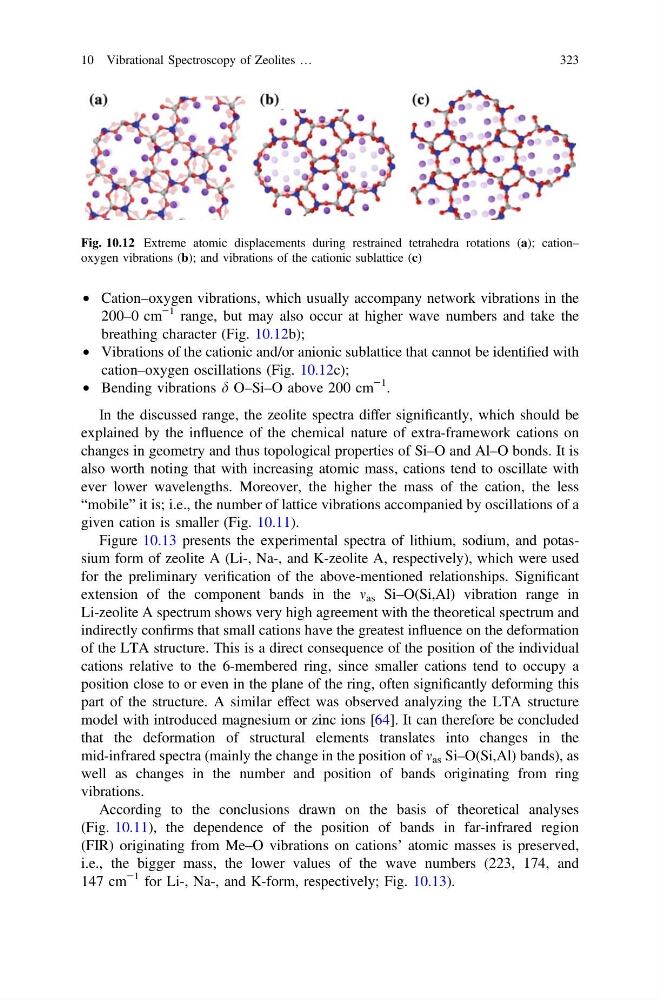
• Cation–oxygen vibrations, which usually accompany network vibrations in the
200–0 cm
−1 range, but may also occur at higher wave numbers and take the
breathing character (Fig. 10.12b);
• Vibrations of the cationic and/or anionic sublattice that cannot be identified with
cation–oxygen oscillations (Fig. 10.12c);
• Bending vibrations d O–Si–O above 200 cm
−1 .
In the discussed range, the zeolite spectra differ significantly, which should be
explained by the influence of the chemical nature of extra-framework cations on
changes in geometry and thus topological properties of Si–O and Al–O bonds. It is
also worth noting that with increasing atomic mass, cations tend to oscillate with
ever lower wavelengths. Moreover, the higher the mass of the cation, the less
“mobile” it is; i.e., the number of lattice vibrations accompanied by oscillations of a
given cation is smaller (Fig. 10.11).
Figure 10.13 presents the experimental spectra of lithium, sodium, and potassium form of zeolite A (Li-, Na-, and K-zeolite A, respectively), which were used
for the preliminary verification of the above-mentioned relationships. Significant
extension of the component bands in the m as Si–O(Si,Al) vibration range in
Li-zeolite A spectrum shows very high agreement with the theoretical spectrum and
indirectly confirms that small cations have the greatest influence on the deformation
of the LTA structure. This is a direct consequence of the position of the individual
cations relative to the 6-membered ring, since smaller cations tend to occupy a
position close to or even in the plane of the ring, often significantly deforming this
part of the structure. A similar effect was observed analyzing the LTA structure
model with introduced magnesium or zinc ions [64]. It can therefore be concluded
that the deformation of structural elements translates into changes in the
mid-infrared spectra (mainly the change in the position of m as Si–O(Si,Al) bands), as
well as changes in the number and position of bands originating from ring
vibrations.
According to the conclusions drawn on the basis of theoretical analyses
(Fig. 10.11), the dependence of the position of bands in far-infrared region
(FIR) originating from Me–O vibrations on cations’ atomic masses is preserved,
i.e., the bigger mass, the lower values of the wave numbers (223, 174, and
147 cm
−1 for Li-, Na-, and K-form, respectively; Fig. 10.13).
Fig. 10.12 Extreme atomic displacements during restrained tetrahedra rotations (a); cation–
oxygen vibrations (b); and vibrations of the cationic sublattice (c)
10 Vibrational Spectroscopy of Zeolites …
323
200–0 cm
−1 range, but may also occur at higher wave numbers and take the
breathing character (Fig. 10.12b);
• Vibrations of the cationic and/or anionic sublattice that cannot be identified with
cation–oxygen oscillations (Fig. 10.12c);
• Bending vibrations d O–Si–O above 200 cm
−1 .
In the discussed range, the zeolite spectra differ significantly, which should be
explained by the influence of the chemical nature of extra-framework cations on
changes in geometry and thus topological properties of Si–O and Al–O bonds. It is
also worth noting that with increasing atomic mass, cations tend to oscillate with
ever lower wavelengths. Moreover, the higher the mass of the cation, the less
“mobile” it is; i.e., the number of lattice vibrations accompanied by oscillations of a
given cation is smaller (Fig. 10.11).
Figure 10.13 presents the experimental spectra of lithium, sodium, and potassium form of zeolite A (Li-, Na-, and K-zeolite A, respectively), which were used
for the preliminary verification of the above-mentioned relationships. Significant
extension of the component bands in the m as Si–O(Si,Al) vibration range in
Li-zeolite A spectrum shows very high agreement with the theoretical spectrum and
indirectly confirms that small cations have the greatest influence on the deformation
of the LTA structure. This is a direct consequence of the position of the individual
cations relative to the 6-membered ring, since smaller cations tend to occupy a
position close to or even in the plane of the ring, often significantly deforming this
part of the structure. A similar effect was observed analyzing the LTA structure
model with introduced magnesium or zinc ions [64]. It can therefore be concluded
that the deformation of structural elements translates into changes in the
mid-infrared spectra (mainly the change in the position of m as Si–O(Si,Al) bands), as
well as changes in the number and position of bands originating from ring
vibrations.
According to the conclusions drawn on the basis of theoretical analyses
(Fig. 10.11), the dependence of the position of bands in far-infrared region
(FIR) originating from Me–O vibrations on cations’ atomic masses is preserved,
i.e., the bigger mass, the lower values of the wave numbers (223, 174, and
147 cm
−1 for Li-, Na-, and K-form, respectively; Fig. 10.13).
Fig. 10.12 Extreme atomic displacements during restrained tetrahedra rotations (a); cation–
oxygen vibrations (b); and vibrations of the cationic sublattice (c)
10 Vibrational Spectroscopy of Zeolites …
323