

In far-IR range of the spectrum, the changes caused by the presence of a given
extra-framework ion are more pronounced and the position and intensity of the
bands in this range are strongly dependent on the nature of interaction with the
framework, the mass of the ion, and the position relative to the 6-membered ring. It
should be noted that in the case of a detailed theoretical analysis of the far-infrared
range, it is of great importance that the proposed model reflects the state of the real
system as much as possible.
10.7.2 Anions in the Structure of Zeolites
In zeolite structures (especially in some natural zeolites), in addition to cations also
water molecules and selected inorganic anions are naturally present. For example,
in sodalite structure sulfide S
2– or chloride Cl
– ions [75] are present, while CO 3
2À
ions stabilize the ring system in the cancrinite [76, 77]. The nature of interactions of
anions with aluminosilicate framework has not been the subject of intensive
research so far; however, it is known that due to relatively large dimensions and
negative net charge they are located in centers of sufficiently large chambers in
which they are coordinated by positively charged extra-framework ions.
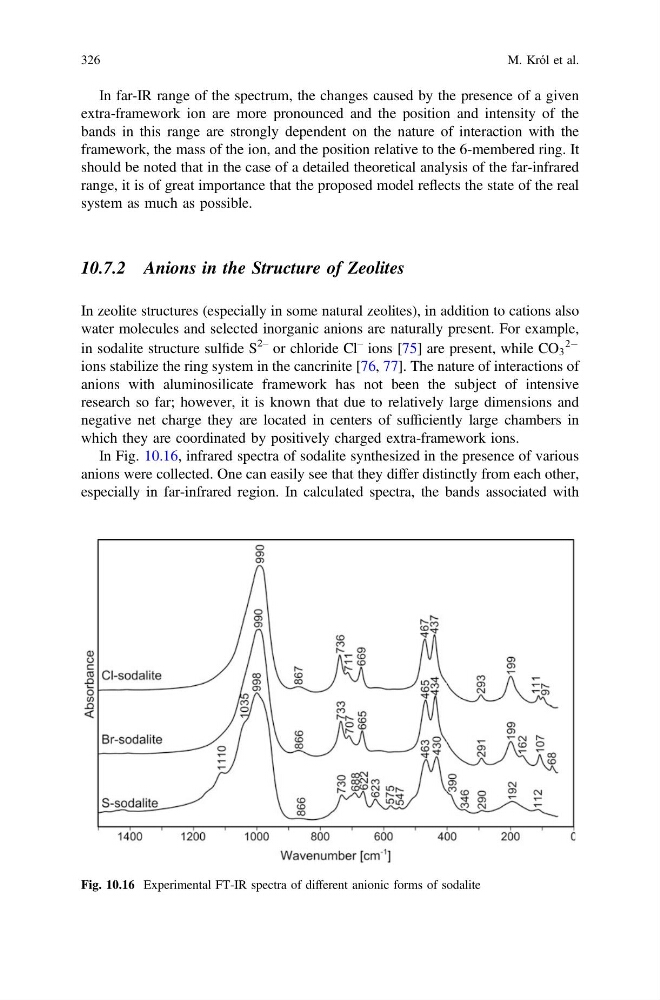
In Fig. 10.16, infrared spectra of sodalite synthesized in the presence of various
anions were collected. One can easily see that they differ distinctly from each other,
especially in far-infrared region. In calculated spectra, the bands associated with
Fig. 10.16 Experimental FT-IR spectra of different anionic forms of sodalite
326
M. Król et al.
extra-framework ion are more pronounced and the position and intensity of the
bands in this range are strongly dependent on the nature of interaction with the
framework, the mass of the ion, and the position relative to the 6-membered ring. It
should be noted that in the case of a detailed theoretical analysis of the far-infrared
range, it is of great importance that the proposed model reflects the state of the real
system as much as possible.
10.7.2 Anions in the Structure of Zeolites
In zeolite structures (especially in some natural zeolites), in addition to cations also
water molecules and selected inorganic anions are naturally present. For example,
in sodalite structure sulfide S
2– or chloride Cl
– ions [75] are present, while CO 3
2À
ions stabilize the ring system in the cancrinite [76, 77]. The nature of interactions of
anions with aluminosilicate framework has not been the subject of intensive
research so far; however, it is known that due to relatively large dimensions and
negative net charge they are located in centers of sufficiently large chambers in
which they are coordinated by positively charged extra-framework ions.
In Fig. 10.16, infrared spectra of sodalite synthesized in the presence of various
anions were collected. One can easily see that they differ distinctly from each other,
especially in far-infrared region. In calculated spectra, the bands associated with
Fig. 10.16 Experimental FT-IR spectra of different anionic forms of sodalite
326
M. Król et al.