

Since the Kohn–Sham potential V KS (r) depends on the total electron density n
(r), dependent on the Kohn–Sham one-electron orbitals w i (r), which in turn depend
on the V KS (r) potential, such system of equations (in analogy to the Hartree–Fock
equation system) must be solved in a self-consistent way. Since we do not know the
exact form of the exchange–correlation potential, it is necessary to define it in an
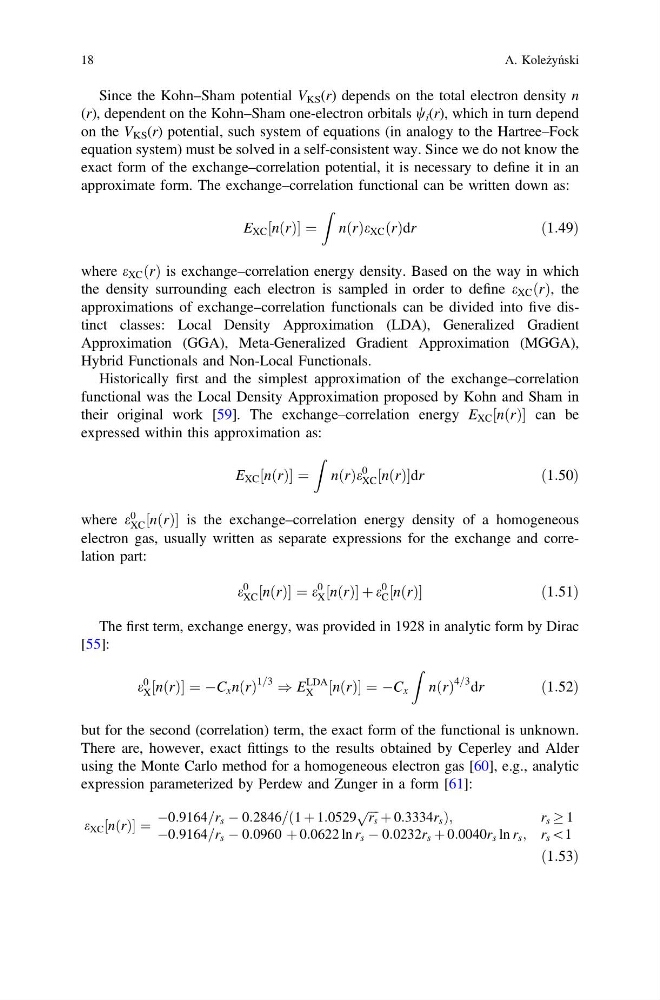
approximate form. The exchange–correlation functional can be written down as:
E XC ½nðrÞ ¼
Z
nðrÞe XC ðrÞdr
ð1:49Þ
where e XC r
ð Þ is exchange–correlation energy density. Based on the way in which
the density surrounding each electron is sampled in order to define e XC r
ð Þ, the
approximations of exchange–correlation functionals can be divided into five distinct classes: Local Density Approximation (LDA), Generalized Gradient
Approximation (GGA), Meta-Generalized Gradient Approximation (MGGA),
Hybrid Functionals and Non-Local Functionals.
Historically first and the simplest approximation of the exchange–correlation
functional was the Local Density Approximation proposed by Kohn and Sham in
their original work [59]. The exchange–correlation energy E XC n r
ð Þ
½
can be
expressed within this approximation as:
E XC ½nðrÞ ¼
Z
nðrÞe
0
XC ½nðrÞdr
ð1:50Þ
where e
0
XC n r
ð Þ
½
is the exchange–correlation energy density of a homogeneous
electron gas, usually written as separate expressions for the exchange and correlation part:
e
0
XC ½nðrÞ ¼ e
0
X ½nðrÞ þ e
0
C ½nðrÞ
ð1:51Þ
The first term, exchange energy, was provided in 1928 in analytic form by Dirac
[55]:
e
0
X ½nðrÞ ¼ ÀC x nðrÞ
1=3 ) E
LDA
X ½nðrÞ ¼ ÀC x
Z
nðrÞ
4=3 dr
ð1:52Þ
but for the second (correlation) term, the exact form of the functional is unknown.
There are, however, exact fittings to the results obtained by Ceperley and Alder
using the Monte Carlo method for a homogeneous electron gas [60], e.g., analytic
expression parameterized by Perdew and Zunger in a form [61]:
e XC ½nðrÞ ¼
À0:9164=r s À 0:2846=ð1 þ 1:0529
ffiffiffi ffi
r s
p þ 0:3334r s Þ;
r s ! 1
À0:9164=r s À 0:0960 þ 0:0622 ln r s À 0:0232r s þ 0:0040r s ln r s ; r s \1
ð1:53Þ
18
A. Koleżyński
(r), dependent on the Kohn–Sham one-electron orbitals w i (r), which in turn depend
on the V KS (r) potential, such system of equations (in analogy to the Hartree–Fock
equation system) must be solved in a self-consistent way. Since we do not know the
exact form of the exchange–correlation potential, it is necessary to define it in an
approximate form. The exchange–correlation functional can be written down as:
E XC ½nðrÞ ¼
Z
nðrÞe XC ðrÞdr
ð1:49Þ
where e XC r
ð Þ is exchange–correlation energy density. Based on the way in which
the density surrounding each electron is sampled in order to define e XC r
ð Þ, the
approximations of exchange–correlation functionals can be divided into five distinct classes: Local Density Approximation (LDA), Generalized Gradient
Approximation (GGA), Meta-Generalized Gradient Approximation (MGGA),
Hybrid Functionals and Non-Local Functionals.
Historically first and the simplest approximation of the exchange–correlation
functional was the Local Density Approximation proposed by Kohn and Sham in
their original work [59]. The exchange–correlation energy E XC n r
ð Þ
½
can be
expressed within this approximation as:
E XC ½nðrÞ ¼
Z
nðrÞe
0
XC ½nðrÞdr
ð1:50Þ
where e
0
XC n r
ð Þ
½
is the exchange–correlation energy density of a homogeneous
electron gas, usually written as separate expressions for the exchange and correlation part:
e
0
XC ½nðrÞ ¼ e
0
X ½nðrÞ þ e
0
C ½nðrÞ
ð1:51Þ
The first term, exchange energy, was provided in 1928 in analytic form by Dirac
[55]:
e
0
X ½nðrÞ ¼ ÀC x nðrÞ
1=3 ) E
LDA
X ½nðrÞ ¼ ÀC x
Z
nðrÞ
4=3 dr
ð1:52Þ
but for the second (correlation) term, the exact form of the functional is unknown.
There are, however, exact fittings to the results obtained by Ceperley and Alder
using the Monte Carlo method for a homogeneous electron gas [60], e.g., analytic
expression parameterized by Perdew and Zunger in a form [61]:
e XC ½nðrÞ ¼
À0:9164=r s À 0:2846=ð1 þ 1:0529
ffiffiffi ffi
r s
p þ 0:3334r s Þ;
r s ! 1
À0:9164=r s À 0:0960 þ 0:0622 ln r s À 0:0232r s þ 0:0040r s ln r s ; r s \1
ð1:53Þ
18
A. Koleżyński