

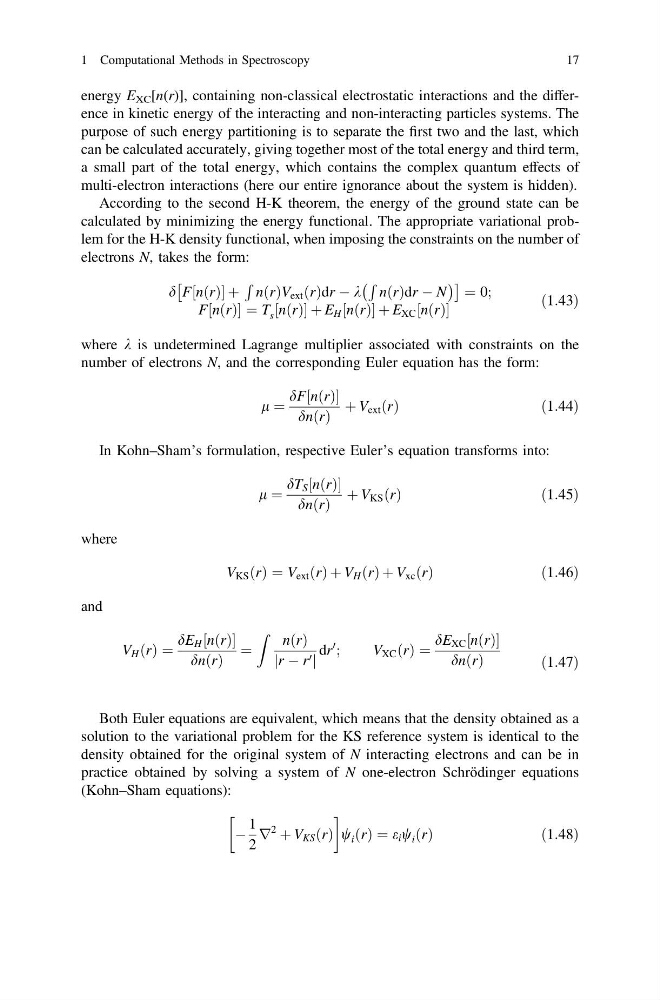
energy E XC [n(r)], containing non-classical electrostatic interactions and the difference in kinetic energy of the interacting and non-interacting particles systems. The
purpose of such energy partitioning is to separate the first two and the last, which
can be calculated accurately, giving together most of the total energy and third term,
a small part of the total energy, which contains the complex quantum effects of
multi-electron interactions (here our entire ignorance about the system is hidden).
According to the second H-K theorem, the energy of the ground state can be
calculated by minimizing the energy functional. The appropriate variational problem for the H-K density functional, when imposing the constraints on the number of
electrons N, takes the form:
d F½nðrÞ þ
R
nðrÞV ext ðrÞdr À k
R
nðrÞdr À N
À
Á
Â
à ¼ 0;
F½nðrÞ ¼ T s ½nðrÞ þ E H ½nðrÞ þ E XC ½nðrÞ
ð1:43Þ
where k is undetermined Lagrange multiplier associated with constraints on the
number of electrons N, and the corresponding Euler equation has the form:
l ¼
dF½nðrÞ
dnðrÞ
þ V ext ðrÞ
ð 1:44Þ
In Kohn–Sham’s formulation, respective Euler’s equation transforms into:
l ¼
dT S ½nðrÞ
dnðrÞ
þ V KS ðrÞ
ð 1:45Þ
where
V KS ðrÞ ¼ V ext ðrÞ þ V H ðrÞ þ V xc ðrÞ
ð 1:46Þ
and
V H ðrÞ ¼
dE H ½nðrÞ
dnðrÞ
¼
Z nðrÞ
r À r 0
j
j
dr
0
;
V XC ðrÞ ¼
dE XC ½nðrÞ
dnðrÞ
ð1:47Þ
Both Euler equations are equivalent, which means that the density obtained as a
solution to the variational problem for the KS reference system is identical to the
density obtained for the original system of N interacting electrons and can be in
practice obtained by solving a system of N one-electron Schrödinger equations
(Kohn–Sham equations):
À
1
2
r
2
þ V KS ðrÞ
!
w i ðrÞ ¼ e i w i ðrÞ
ð 1:48Þ
1 Computational Methods in Spectroscopy
17
purpose of such energy partitioning is to separate the first two and the last, which
can be calculated accurately, giving together most of the total energy and third term,
a small part of the total energy, which contains the complex quantum effects of
multi-electron interactions (here our entire ignorance about the system is hidden).
According to the second H-K theorem, the energy of the ground state can be
calculated by minimizing the energy functional. The appropriate variational problem for the H-K density functional, when imposing the constraints on the number of
electrons N, takes the form:
d F½nðrÞ þ
R
nðrÞV ext ðrÞdr À k
R
nðrÞdr À N
À
Á
Â
à ¼ 0;
F½nðrÞ ¼ T s ½nðrÞ þ E H ½nðrÞ þ E XC ½nðrÞ
ð1:43Þ
where k is undetermined Lagrange multiplier associated with constraints on the
number of electrons N, and the corresponding Euler equation has the form:
l ¼
dF½nðrÞ
dnðrÞ
þ V ext ðrÞ
ð 1:44Þ
In Kohn–Sham’s formulation, respective Euler’s equation transforms into:
l ¼
dT S ½nðrÞ
dnðrÞ
þ V KS ðrÞ
ð 1:45Þ
where
V KS ðrÞ ¼ V ext ðrÞ þ V H ðrÞ þ V xc ðrÞ
ð 1:46Þ
and
V H ðrÞ ¼
dE H ½nðrÞ
dnðrÞ
¼
Z nðrÞ
r À r 0
j
j
dr
0
;
V XC ðrÞ ¼
dE XC ½nðrÞ
dnðrÞ
ð1:47Þ
Both Euler equations are equivalent, which means that the density obtained as a
solution to the variational problem for the KS reference system is identical to the
density obtained for the original system of N interacting electrons and can be in
practice obtained by solving a system of N one-electron Schrödinger equations
(Kohn–Sham equations):
À
1
2
r
2
þ V KS ðrÞ
!
w i ðrÞ ¼ e i w i ðrÞ
ð 1:48Þ
1 Computational Methods in Spectroscopy
17