

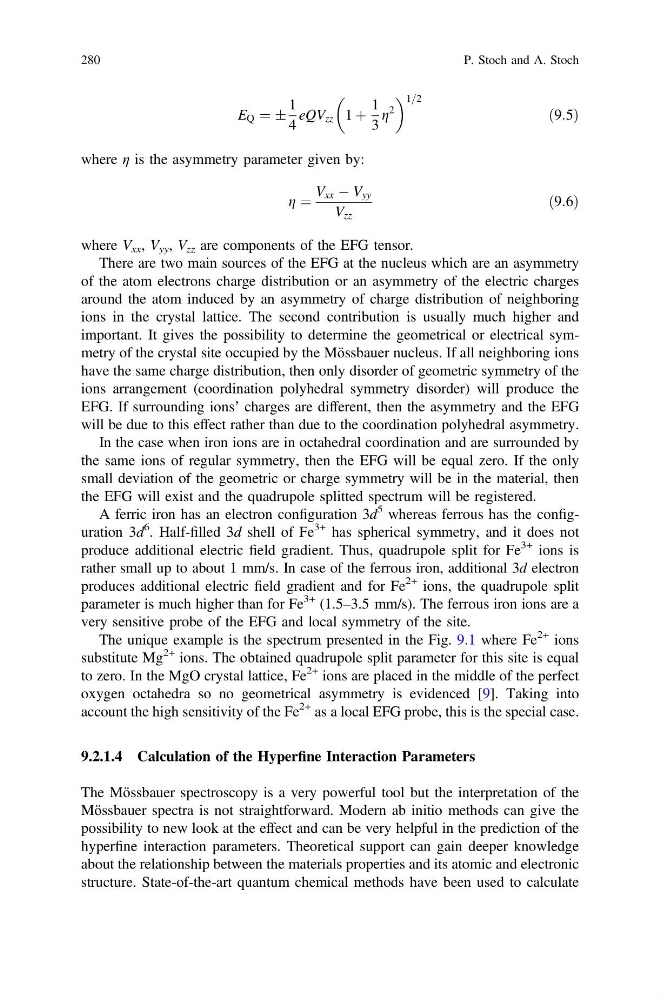
E Q ¼ Æ
1
4
eQV zz 1 þ
1
3
g
2
1=2
ð9:5Þ
where ƞ is the asymmetry parameter given by:
g ¼
V xx À V yy
V zz
ð9:6Þ
where V xx , V yy , V zz are components of the EFG tensor.
There are two main sources of the EFG at the nucleus which are an asymmetry
of the atom electrons charge distribution or an asymmetry of the electric charges
around the atom induced by an asymmetry of charge distribution of neighboring
ions in the crystal lattice. The second contribution is usually much higher and
important. It gives the possibility to determine the geometrical or electrical symmetry of the crystal site occupied by the Mössbauer nucleus. If all neighboring ions
have the same charge distribution, then only disorder of geometric symmetry of the
ions arrangement (coordination polyhedral symmetry disorder) will produce the
EFG. If surrounding ions’ charges are different, then the asymmetry and the EFG
will be due to this effect rather than due to the coordination polyhedral asymmetry.
In the case when iron ions are in octahedral coordination and are surrounded by
the same ions of regular symmetry, then the EFG will be equal zero. If the only
small deviation of the geometric or charge symmetry will be in the material, then
the EFG will exist and the quadrupole splitted spectrum will be registered.
A ferric iron has an electron configuration 3d
5 whereas ferrous has the configuration 3d
6 . Half-filled 3d shell of Fe
3+ has spherical symmetry, and it does not
produce additional electric field gradient. Thus, quadrupole split for Fe
3+ ions is
rather small up to about 1 mm/s. In case of the ferrous iron, additional 3d electron
produces additional electric field gradient and for Fe
2+ ions, the quadrupole split
parameter is much higher than for Fe
3+ (1.5–3.5 mm/s). The ferrous iron ions are a
very sensitive probe of the EFG and local symmetry of the site.
The unique example is the spectrum presented in the Fig. 9.1 where Fe
2+ ions
substitute Mg
2+ ions. The obtained quadrupole split parameter for this site is equal
to zero. In the MgO crystal lattice, Fe
2+ ions are placed in the middle of the perfect
oxygen octahedra so no geometrical asymmetry is evidenced [9]. Taking into
account the high sensitivity of the Fe
2+ as a local EFG probe, this is the special case.
9.2.1.4 Calculation of the Hyperfine Interaction Parameters
The Mössbauer spectroscopy is a very powerful tool but the interpretation of the
Mössbauer spectra is not straightforward. Modern ab initio methods can give the
possibility to new look at the effect and can be very helpful in the prediction of the
hyperfine interaction parameters. Theoretical support can gain deeper knowledge
about the relationship between the materials properties and its atomic and electronic
structure. State-of-the-art quantum chemical methods have been used to calculate
280
P. Stoch and A. Stoch
1
4
eQV zz 1 þ
1
3
g
2
1=2
ð9:5Þ
where ƞ is the asymmetry parameter given by:
g ¼
V xx À V yy
V zz
ð9:6Þ
where V xx , V yy , V zz are components of the EFG tensor.
There are two main sources of the EFG at the nucleus which are an asymmetry
of the atom electrons charge distribution or an asymmetry of the electric charges
around the atom induced by an asymmetry of charge distribution of neighboring
ions in the crystal lattice. The second contribution is usually much higher and
important. It gives the possibility to determine the geometrical or electrical symmetry of the crystal site occupied by the Mössbauer nucleus. If all neighboring ions
have the same charge distribution, then only disorder of geometric symmetry of the
ions arrangement (coordination polyhedral symmetry disorder) will produce the
EFG. If surrounding ions’ charges are different, then the asymmetry and the EFG
will be due to this effect rather than due to the coordination polyhedral asymmetry.
In the case when iron ions are in octahedral coordination and are surrounded by
the same ions of regular symmetry, then the EFG will be equal zero. If the only
small deviation of the geometric or charge symmetry will be in the material, then
the EFG will exist and the quadrupole splitted spectrum will be registered.
A ferric iron has an electron configuration 3d
5 whereas ferrous has the configuration 3d
6 . Half-filled 3d shell of Fe
3+ has spherical symmetry, and it does not
produce additional electric field gradient. Thus, quadrupole split for Fe
3+ ions is
rather small up to about 1 mm/s. In case of the ferrous iron, additional 3d electron
produces additional electric field gradient and for Fe
2+ ions, the quadrupole split
parameter is much higher than for Fe
3+ (1.5–3.5 mm/s). The ferrous iron ions are a
very sensitive probe of the EFG and local symmetry of the site.
The unique example is the spectrum presented in the Fig. 9.1 where Fe
2+ ions
substitute Mg
2+ ions. The obtained quadrupole split parameter for this site is equal
to zero. In the MgO crystal lattice, Fe
2+ ions are placed in the middle of the perfect
oxygen octahedra so no geometrical asymmetry is evidenced [9]. Taking into
account the high sensitivity of the Fe
2+ as a local EFG probe, this is the special case.
9.2.1.4 Calculation of the Hyperfine Interaction Parameters
The Mössbauer spectroscopy is a very powerful tool but the interpretation of the
Mössbauer spectra is not straightforward. Modern ab initio methods can give the
possibility to new look at the effect and can be very helpful in the prediction of the
hyperfine interaction parameters. Theoretical support can gain deeper knowledge
about the relationship between the materials properties and its atomic and electronic
structure. State-of-the-art quantum chemical methods have been used to calculate
280
P. Stoch and A. Stoch