

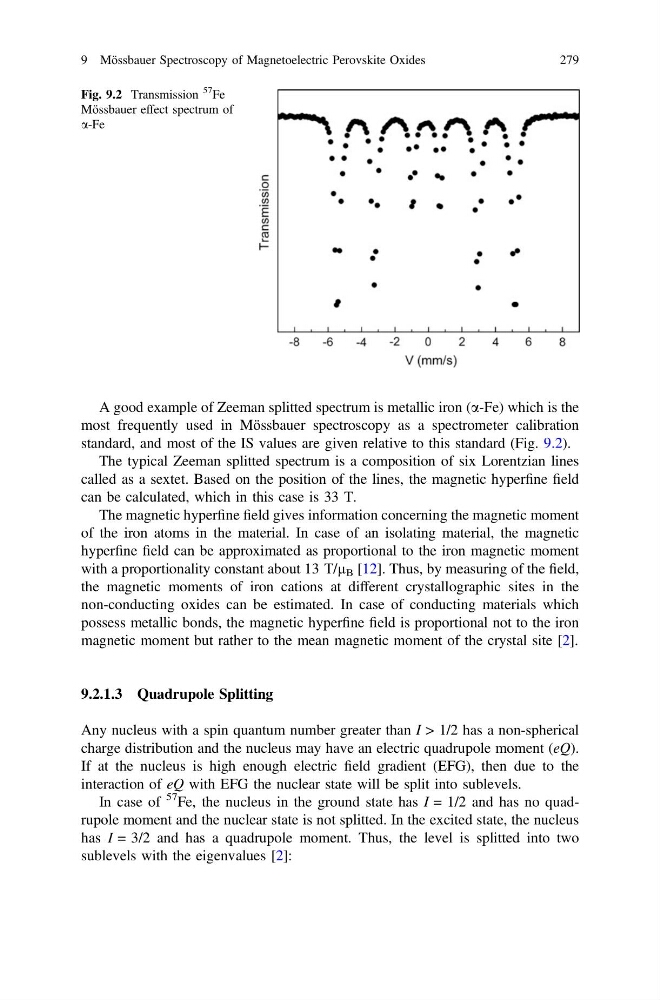
A good example of Zeeman splitted spectrum is metallic iron (a-Fe) which is the
most frequently used in Mössbauer spectroscopy as a spectrometer calibration
standard, and most of the IS values are given relative to this standard (Fig. 9.2).
The typical Zeeman splitted spectrum is a composition of six Lorentzian lines
called as a sextet. Based on the position of the lines, the magnetic hyperfine field
can be calculated, which in this case is 33 T.
The magnetic hyperfine field gives information concerning the magnetic moment
of the iron atoms in the material. In case of an isolating material, the magnetic
hyperfine field can be approximated as proportional to the iron magnetic moment
with a proportionality constant about 13 T/µ B [12]. Thus, by measuring of the field,
the magnetic moments of iron cations at different crystallographic sites in the
non-conducting oxides can be estimated. In case of conducting materials which
possess metallic bonds, the magnetic hyperfine field is proportional not to the iron
magnetic moment but rather to the mean magnetic moment of the crystal site [2].
9.2.1.3 Quadrupole Splitting
Any nucleus with a spin quantum number greater than I > 1/2 has a non-spherical
charge distribution and the nucleus may have an electric quadrupole moment (eQ).
If at the nucleus is high enough electric field gradient (EFG), then due to the
interaction of eQ with EFG the nuclear state will be split into sublevels.
In case of
57 Fe, the nucleus in the ground state has I = 1/2 and has no quadrupole moment and the nuclear state is not splitted. In the excited state, the nucleus
has I = 3/2 and has a quadrupole moment. Thus, the level is splitted into two
sublevels with the eigenvalues [2]:
Fig. 9.2 Transmission
57
Fe
Mössbauer effect spectrum of
a-Fe
9 Mössbauer Spectroscopy of Magnetoelectric Perovskite Oxides
279
most frequently used in Mössbauer spectroscopy as a spectrometer calibration
standard, and most of the IS values are given relative to this standard (Fig. 9.2).
The typical Zeeman splitted spectrum is a composition of six Lorentzian lines
called as a sextet. Based on the position of the lines, the magnetic hyperfine field
can be calculated, which in this case is 33 T.
The magnetic hyperfine field gives information concerning the magnetic moment
of the iron atoms in the material. In case of an isolating material, the magnetic
hyperfine field can be approximated as proportional to the iron magnetic moment
with a proportionality constant about 13 T/µ B [12]. Thus, by measuring of the field,
the magnetic moments of iron cations at different crystallographic sites in the
non-conducting oxides can be estimated. In case of conducting materials which
possess metallic bonds, the magnetic hyperfine field is proportional not to the iron
magnetic moment but rather to the mean magnetic moment of the crystal site [2].
9.2.1.3 Quadrupole Splitting
Any nucleus with a spin quantum number greater than I > 1/2 has a non-spherical
charge distribution and the nucleus may have an electric quadrupole moment (eQ).
If at the nucleus is high enough electric field gradient (EFG), then due to the
interaction of eQ with EFG the nuclear state will be split into sublevels.
In case of
57 Fe, the nucleus in the ground state has I = 1/2 and has no quadrupole moment and the nuclear state is not splitted. In the excited state, the nucleus
has I = 3/2 and has a quadrupole moment. Thus, the level is splitted into two
sublevels with the eigenvalues [2]:
Fig. 9.2 Transmission
57
Fe
Mössbauer effect spectrum of
a-Fe
9 Mössbauer Spectroscopy of Magnetoelectric Perovskite Oxides
279