

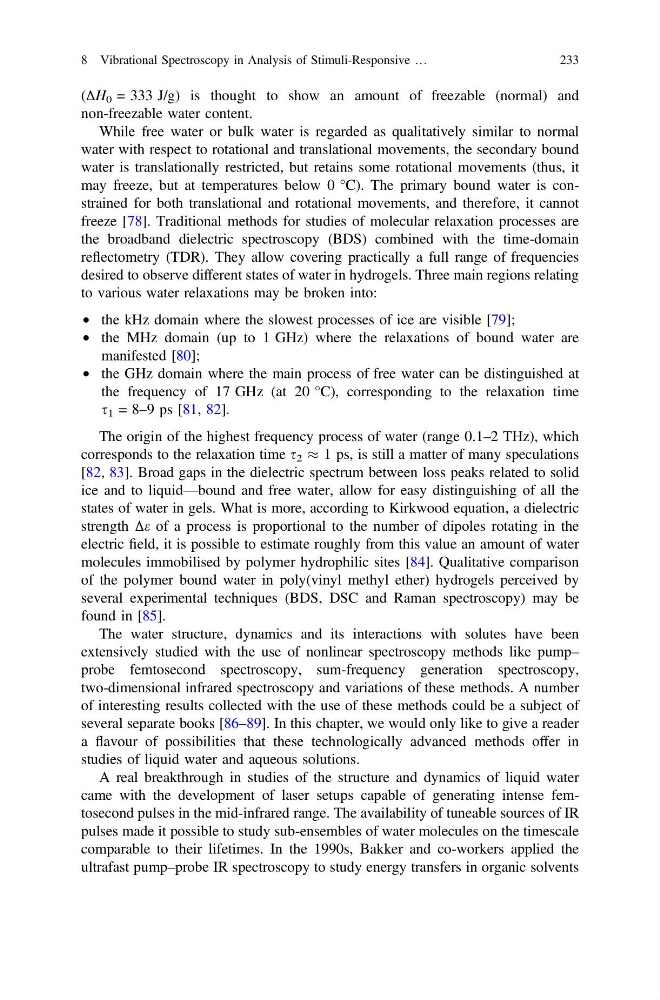
(ΔH 0 = 333 J/g) is thought to show an amount of freezable (normal) and
non-freezable water content.
While free water or bulk water is regarded as qualitatively similar to normal
water with respect to rotational and translational movements, the secondary bound
water is translationally restricted, but retains some rotational movements (thus, it
may freeze, but at temperatures below 0 °C). The primary bound water is constrained for both translational and rotational movements, and therefore, it cannot
freeze [78]. Traditional methods for studies of molecular relaxation processes are
the broadband dielectric spectroscopy (BDS) combined with the time-domain
reflectometry (TDR). They allow covering practically a full range of frequencies
desired to observe different states of water in hydrogels. Three main regions relating
to various water relaxations may be broken into:
• the kHz domain where the slowest processes of ice are visible [79];
• the MHz domain (up to 1 GHz) where the relaxations of bound water are
manifested [80];
• the GHz domain where the main process of free water can be distinguished at
the frequency of 17 GHz (at 20 °C), corresponding to the relaxation time
s 1 = 8–9 ps [81, 82].
The origin of the highest frequency process of water (range 0.1–2 THz), which
corresponds to the relaxation time s 2 % 1 ps, is still a matter of many speculations
[82, 83]. Broad gaps in the dielectric spectrum between loss peaks related to solid
ice and to liquid—bound and free water, allow for easy distinguishing of all the
states of water in gels. What is more, according to Kirkwood equation, a dielectric
strength Δe of a process is proportional to the number of dipoles rotating in the
electric field, it is possible to estimate roughly from this value an amount of water
molecules immobilised by polymer hydrophilic sites [84]. Qualitative comparison
of the polymer bound water in poly(vinyl methyl ether) hydrogels perceived by
several experimental techniques (BDS, DSC and Raman spectroscopy) may be
found in [85].
The water structure, dynamics and its interactions with solutes have been
extensively studied with the use of nonlinear spectroscopy methods like pump–
probe femtosecond spectroscopy, sum-frequency generation spectroscopy,
two-dimensional infrared spectroscopy and variations of these methods. A number
of interesting results collected with the use of these methods could be a subject of
several separate books [86–89]. In this chapter, we would only like to give a reader
a flavour of possibilities that these technologically advanced methods offer in
studies of liquid water and aqueous solutions.
A real breakthrough in studies of the structure and dynamics of liquid water
came with the development of laser setups capable of generating intense femtosecond pulses in the mid-infrared range. The availability of tuneable sources of IR
pulses made it possible to study sub-ensembles of water molecules on the timescale
comparable to their lifetimes. In the 1990s, Bakker and co-workers applied the
ultrafast pump–probe IR spectroscopy to study energy transfers in organic solvents
8 Vibrational Spectroscopy in Analysis of Stimuli-Responsive …
233
non-freezable water content.
While free water or bulk water is regarded as qualitatively similar to normal
water with respect to rotational and translational movements, the secondary bound
water is translationally restricted, but retains some rotational movements (thus, it
may freeze, but at temperatures below 0 °C). The primary bound water is constrained for both translational and rotational movements, and therefore, it cannot
freeze [78]. Traditional methods for studies of molecular relaxation processes are
the broadband dielectric spectroscopy (BDS) combined with the time-domain
reflectometry (TDR). They allow covering practically a full range of frequencies
desired to observe different states of water in hydrogels. Three main regions relating
to various water relaxations may be broken into:
• the kHz domain where the slowest processes of ice are visible [79];
• the MHz domain (up to 1 GHz) where the relaxations of bound water are
manifested [80];
• the GHz domain where the main process of free water can be distinguished at
the frequency of 17 GHz (at 20 °C), corresponding to the relaxation time
s 1 = 8–9 ps [81, 82].
The origin of the highest frequency process of water (range 0.1–2 THz), which
corresponds to the relaxation time s 2 % 1 ps, is still a matter of many speculations
[82, 83]. Broad gaps in the dielectric spectrum between loss peaks related to solid
ice and to liquid—bound and free water, allow for easy distinguishing of all the
states of water in gels. What is more, according to Kirkwood equation, a dielectric
strength Δe of a process is proportional to the number of dipoles rotating in the
electric field, it is possible to estimate roughly from this value an amount of water
molecules immobilised by polymer hydrophilic sites [84]. Qualitative comparison
of the polymer bound water in poly(vinyl methyl ether) hydrogels perceived by
several experimental techniques (BDS, DSC and Raman spectroscopy) may be
found in [85].
The water structure, dynamics and its interactions with solutes have been
extensively studied with the use of nonlinear spectroscopy methods like pump–
probe femtosecond spectroscopy, sum-frequency generation spectroscopy,
two-dimensional infrared spectroscopy and variations of these methods. A number
of interesting results collected with the use of these methods could be a subject of
several separate books [86–89]. In this chapter, we would only like to give a reader
a flavour of possibilities that these technologically advanced methods offer in
studies of liquid water and aqueous solutions.
A real breakthrough in studies of the structure and dynamics of liquid water
came with the development of laser setups capable of generating intense femtosecond pulses in the mid-infrared range. The availability of tuneable sources of IR
pulses made it possible to study sub-ensembles of water molecules on the timescale
comparable to their lifetimes. In the 1990s, Bakker and co-workers applied the
ultrafast pump–probe IR spectroscopy to study energy transfers in organic solvents
8 Vibrational Spectroscopy in Analysis of Stimuli-Responsive …
233