

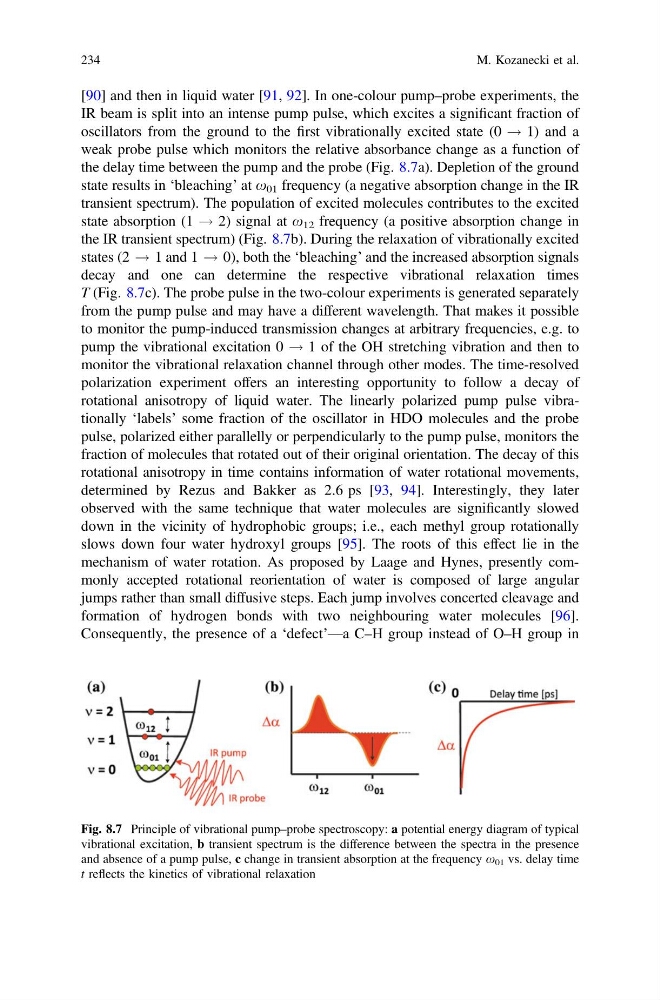
[90] and then in liquid water [91, 92]. In one-colour pump–probe experiments, the
IR beam is split into an intense pump pulse, which excites a significant fraction of
oscillators from the ground to the first vibrationally excited state (0 ! 1) and a
weak probe pulse which monitors the relative absorbance change as a function of
the delay time between the pump and the probe (Fig. 8.7a). Depletion of the ground
state results in ‘bleaching’ at x 01 frequency (a negative absorption change in the IR
transient spectrum). The population of excited molecules contributes to the excited
state absorption (1 ! 2) signal at x 12 frequency (a positive absorption change in
the IR transient spectrum) (Fig. 8.7b). During the relaxation of vibrationally excited
states (2 ! 1 and 1 ! 0), both the ‘bleaching’ and the increased absorption signals
decay and one can determine the respective vibrational relaxation times
T (Fig. 8.7c). The probe pulse in the two-colour experiments is generated separately
from the pump pulse and may have a different wavelength. That makes it possible
to monitor the pump-induced transmission changes at arbitrary frequencies, e.g. to
pump the vibrational excitation 0 ! 1 of the OH stretching vibration and then to
monitor the vibrational relaxation channel through other modes. The time-resolved
polarization experiment offers an interesting opportunity to follow a decay of
rotational anisotropy of liquid water. The linearly polarized pump pulse vibrationally ‘labels’ some fraction of the oscillator in HDO molecules and the probe
pulse, polarized either parallelly or perpendicularly to the pump pulse, monitors the
fraction of molecules that rotated out of their original orientation. The decay of this
rotational anisotropy in time contains information of water rotational movements,
determined by Rezus and Bakker as 2.6 ps [93, 94]. Interestingly, they later
observed with the same technique that water molecules are significantly slowed
down in the vicinity of hydrophobic groups; i.e., each methyl group rotationally
slows down four water hydroxyl groups [95]. The roots of this effect lie in the
mechanism of water rotation. As proposed by Laage and Hynes, presently commonly accepted rotational reorientation of water is composed of large angular
jumps rather than small diffusive steps. Each jump involves concerted cleavage and
formation of hydrogen bonds with two neighbouring water molecules [96].
Consequently, the presence of a ‘defect’—a C–H group instead of O–H group in
Fig. 8.7 Principle of vibrational pump–probe spectroscopy: a potential energy diagram of typical
vibrational excitation, b transient spectrum is the difference between the spectra in the presence
and absence of a pump pulse, c change in transient absorption at the frequency x 01 vs. delay time
t reflects the kinetics of vibrational relaxation
234
M. Kozanecki et al.
IR beam is split into an intense pump pulse, which excites a significant fraction of
oscillators from the ground to the first vibrationally excited state (0 ! 1) and a
weak probe pulse which monitors the relative absorbance change as a function of
the delay time between the pump and the probe (Fig. 8.7a). Depletion of the ground
state results in ‘bleaching’ at x 01 frequency (a negative absorption change in the IR
transient spectrum). The population of excited molecules contributes to the excited
state absorption (1 ! 2) signal at x 12 frequency (a positive absorption change in
the IR transient spectrum) (Fig. 8.7b). During the relaxation of vibrationally excited
states (2 ! 1 and 1 ! 0), both the ‘bleaching’ and the increased absorption signals
decay and one can determine the respective vibrational relaxation times
T (Fig. 8.7c). The probe pulse in the two-colour experiments is generated separately
from the pump pulse and may have a different wavelength. That makes it possible
to monitor the pump-induced transmission changes at arbitrary frequencies, e.g. to
pump the vibrational excitation 0 ! 1 of the OH stretching vibration and then to
monitor the vibrational relaxation channel through other modes. The time-resolved
polarization experiment offers an interesting opportunity to follow a decay of
rotational anisotropy of liquid water. The linearly polarized pump pulse vibrationally ‘labels’ some fraction of the oscillator in HDO molecules and the probe
pulse, polarized either parallelly or perpendicularly to the pump pulse, monitors the
fraction of molecules that rotated out of their original orientation. The decay of this
rotational anisotropy in time contains information of water rotational movements,
determined by Rezus and Bakker as 2.6 ps [93, 94]. Interestingly, they later
observed with the same technique that water molecules are significantly slowed
down in the vicinity of hydrophobic groups; i.e., each methyl group rotationally
slows down four water hydroxyl groups [95]. The roots of this effect lie in the
mechanism of water rotation. As proposed by Laage and Hynes, presently commonly accepted rotational reorientation of water is composed of large angular
jumps rather than small diffusive steps. Each jump involves concerted cleavage and
formation of hydrogen bonds with two neighbouring water molecules [96].
Consequently, the presence of a ‘defect’—a C–H group instead of O–H group in
Fig. 8.7 Principle of vibrational pump–probe spectroscopy: a potential energy diagram of typical
vibrational excitation, b transient spectrum is the difference between the spectra in the presence
and absence of a pump pulse, c change in transient absorption at the frequency x 01 vs. delay time
t reflects the kinetics of vibrational relaxation
234
M. Kozanecki et al.