

(1–2 nm; between phospholipids bilayers or between myosin molecules in muscle
fibres) and revealed a greater orientational disorder than in case of normal bulk
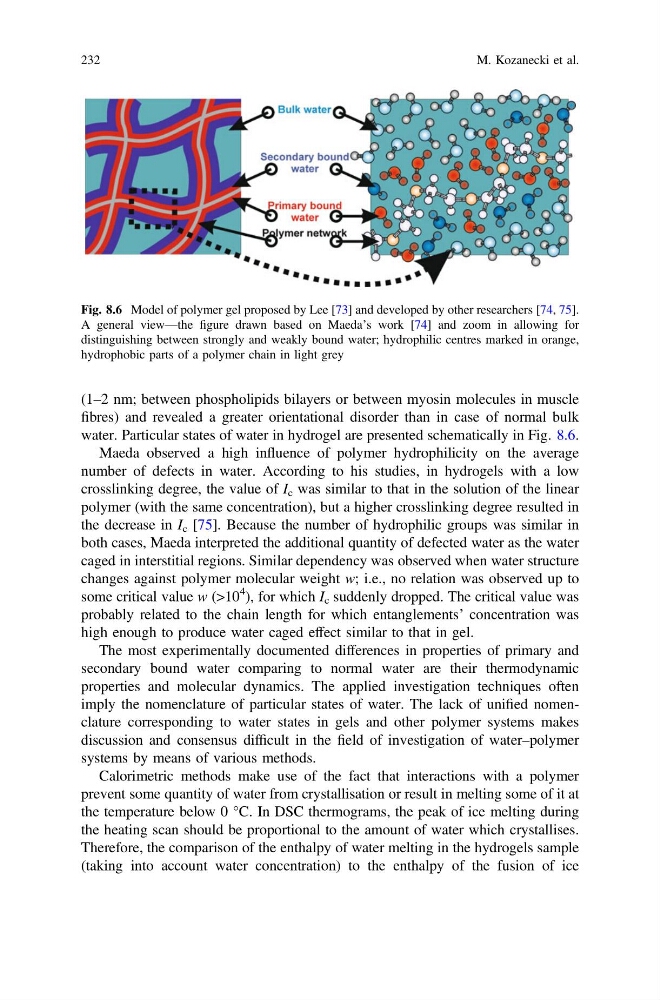
water. Particular states of water in hydrogel are presented schematically in Fig. 8.6.
Maeda observed a high influence of polymer hydrophilicity on the average
number of defects in water. According to his studies, in hydrogels with a low
crosslinking degree, the value of I c was similar to that in the solution of the linear
polymer (with the same concentration), but a higher crosslinking degree resulted in
the decrease in I c [75]. Because the number of hydrophilic groups was similar in
both cases, Maeda interpreted the additional quantity of defected water as the water
caged in interstitial regions. Similar dependency was observed when water structure
changes against polymer molecular weight w; i.e., no relation was observed up to
some critical value w (>10
4 ), for which I c suddenly dropped. The critical value was
probably related to the chain length for which entanglements’ concentration was
high enough to produce water caged effect similar to that in gel.
The most experimentally documented differences in properties of primary and
secondary bound water comparing to normal water are their thermodynamic
properties and molecular dynamics. The applied investigation techniques often
imply the nomenclature of particular states of water. The lack of unified nomenclature corresponding to water states in gels and other polymer systems makes
discussion and consensus difficult in the field of investigation of water–polymer
systems by means of various methods.
Calorimetric methods make use of the fact that interactions with a polymer
prevent some quantity of water from crystallisation or result in melting some of it at
the temperature below 0 °C. In DSC thermograms, the peak of ice melting during
the heating scan should be proportional to the amount of water which crystallises.
Therefore, the comparison of the enthalpy of water melting in the hydrogels sample
(taking into account water concentration) to the enthalpy of the fusion of ice
Fig. 8.6 Model of polymer gel proposed by Lee [73] and developed by other researchers [74, 75].
A general view—the figure drawn based on Maeda’s work [74] and zoom in allowing for
distinguishing between strongly and weakly bound water; hydrophilic centres marked in orange,
hydrophobic parts of a polymer chain in light grey
232
M. Kozanecki et al.
fibres) and revealed a greater orientational disorder than in case of normal bulk
water. Particular states of water in hydrogel are presented schematically in Fig. 8.6.
Maeda observed a high influence of polymer hydrophilicity on the average
number of defects in water. According to his studies, in hydrogels with a low
crosslinking degree, the value of I c was similar to that in the solution of the linear
polymer (with the same concentration), but a higher crosslinking degree resulted in
the decrease in I c [75]. Because the number of hydrophilic groups was similar in
both cases, Maeda interpreted the additional quantity of defected water as the water
caged in interstitial regions. Similar dependency was observed when water structure
changes against polymer molecular weight w; i.e., no relation was observed up to
some critical value w (>10
4 ), for which I c suddenly dropped. The critical value was
probably related to the chain length for which entanglements’ concentration was
high enough to produce water caged effect similar to that in gel.
The most experimentally documented differences in properties of primary and
secondary bound water comparing to normal water are their thermodynamic
properties and molecular dynamics. The applied investigation techniques often
imply the nomenclature of particular states of water. The lack of unified nomenclature corresponding to water states in gels and other polymer systems makes
discussion and consensus difficult in the field of investigation of water–polymer
systems by means of various methods.
Calorimetric methods make use of the fact that interactions with a polymer
prevent some quantity of water from crystallisation or result in melting some of it at
the temperature below 0 °C. In DSC thermograms, the peak of ice melting during
the heating scan should be proportional to the amount of water which crystallises.
Therefore, the comparison of the enthalpy of water melting in the hydrogels sample
(taking into account water concentration) to the enthalpy of the fusion of ice
Fig. 8.6 Model of polymer gel proposed by Lee [73] and developed by other researchers [74, 75].
A general view—the figure drawn based on Maeda’s work [74] and zoom in allowing for
distinguishing between strongly and weakly bound water; hydrophilic centres marked in orange,
hydrophobic parts of a polymer chain in light grey
232
M. Kozanecki et al.