

providing that no isotopic exchange between polymer hydrogen and water deuterium atoms takes place. However, it is necessary to remember that isotopic
H ! D exchange in water takes place easily (due to the already mentioned
Grothuss mechanism of proton/deuteron transport) and leads to the formation of
some fraction of HDO. The presence of HDO contributes to the vibrational spectrum with OD and OH stretching bands and an additional bending mode at
1450 cm
−1 . Similar isotopic substitution may happen when D 2 O-swollen sample is
exposed to humid air for a long time.
In polymer solutions, dispersions and gels, the structure of water is mainly
determined by a number of hydrophilic centres (binding sites) in polymer chains,
which decides of a number of hydrogen bonds between both components and of an
amount of ‘hydration water’. A model of the supramolecular structure of hydrogels
proposed by Lee et al. [73] and developed later by Maeda [74, 75] and other
researchers may be generalised as follows: the ‘hydration water’ (called also primary bound water), which is strongly bound to a polymer chain, disturbs also the
structure of water molecules located at the second hydration shell. This water,
usually named secondary bound water, is, according to Hoffman [76], also the one
bound by hydrophobic sites of a polymer (the contemporary view on hydrophobically bound water seen by ultrafast spectroscopy will be presented later in this
chapter). The rest of water (called bulk or free water) fills cavities between hydrated
chains and does not differ from ‘normal’ water in its properties. Nevertheless,
Lafleur et al. [77] distinguished also interstitial water trapped in small interstices
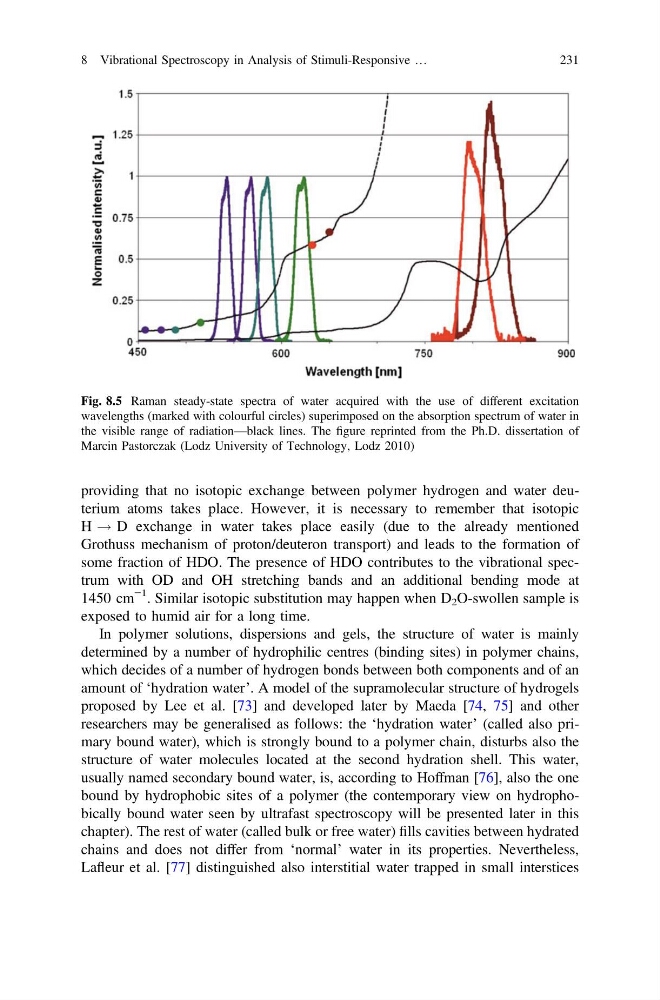
Fig. 8.5 Raman steady-state spectra of water acquired with the use of different excitation
wavelengths (marked with colourful circles) superimposed on the absorption spectrum of water in
the visible range of radiation—black lines. The figure reprinted from the Ph.D. dissertation of
Marcin Pastorczak (Lodz University of Technology, Lodz 2010)
8 Vibrational Spectroscopy in Analysis of Stimuli-Responsive …
231
H ! D exchange in water takes place easily (due to the already mentioned
Grothuss mechanism of proton/deuteron transport) and leads to the formation of
some fraction of HDO. The presence of HDO contributes to the vibrational spectrum with OD and OH stretching bands and an additional bending mode at
1450 cm
−1 . Similar isotopic substitution may happen when D 2 O-swollen sample is
exposed to humid air for a long time.
In polymer solutions, dispersions and gels, the structure of water is mainly
determined by a number of hydrophilic centres (binding sites) in polymer chains,
which decides of a number of hydrogen bonds between both components and of an
amount of ‘hydration water’. A model of the supramolecular structure of hydrogels
proposed by Lee et al. [73] and developed later by Maeda [74, 75] and other
researchers may be generalised as follows: the ‘hydration water’ (called also primary bound water), which is strongly bound to a polymer chain, disturbs also the
structure of water molecules located at the second hydration shell. This water,
usually named secondary bound water, is, according to Hoffman [76], also the one
bound by hydrophobic sites of a polymer (the contemporary view on hydrophobically bound water seen by ultrafast spectroscopy will be presented later in this
chapter). The rest of water (called bulk or free water) fills cavities between hydrated
chains and does not differ from ‘normal’ water in its properties. Nevertheless,
Lafleur et al. [77] distinguished also interstitial water trapped in small interstices
Fig. 8.5 Raman steady-state spectra of water acquired with the use of different excitation
wavelengths (marked with colourful circles) superimposed on the absorption spectrum of water in
the visible range of radiation—black lines. The figure reprinted from the Ph.D. dissertation of
Marcin Pastorczak (Lodz University of Technology, Lodz 2010)
8 Vibrational Spectroscopy in Analysis of Stimuli-Responsive …
231