

5.5.2 Bulky Counter-Ions—a Simple Route to Enhance
the TPEF Efficiencies
At this stage, we reckon that protected gold quantum clusters are excellent two-photon
absorbers but rather poor two-photon excited emitters [58]. To enhance emission efficiencies, the ligand shell rigidity is an interesting strategy that would allow for enhanced
photon emission as compared to non-radiative relaxation upon photo-excitation. Pyo
et al. [21] have shown that it is possible to achieve OPEF quantum yield >60% by
rigidifying the metal–sulfur interface with the binding of bulky groups. We recently
pushed forward this concept to the nonlinear optical regime.
The strategy developed recently is to use bulky ammonium counter-ions, a
nitrogen cation surrounded by four alkyl chains. In solution, the luminescence of
the NCs is often affected by the solvent (in particular water). Counter-ions will
interact with the NC surface by electrostatic interaction (between the counter-ions
and the carboxylate groups of the glutathione ligands) to stick to the surface of the
NCs which will have the effect of protecting it from the environment and also to
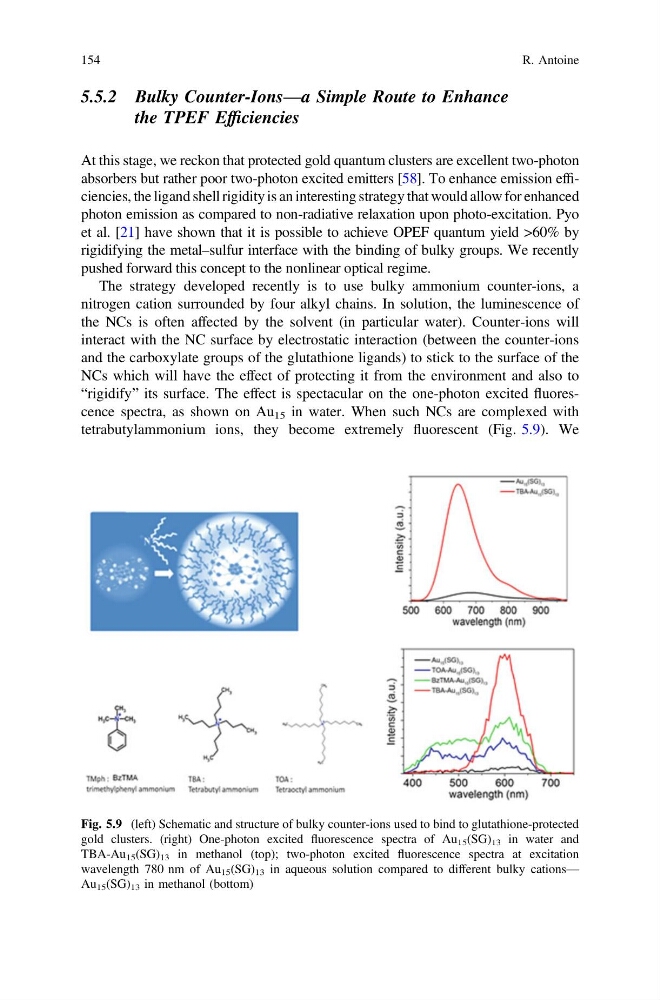
“rigidify” its surface. The effect is spectacular on the one-photon excited fluorescence spectra, as shown on Au 15 in water. When such NCs are complexed with
tetrabutylammonium ions, they become extremely fluorescent (Fig. 5.9). We
Fig. 5.9 (left) Schematic and structure of bulky counter-ions used to bind to glutathione-protected
gold clusters. (right) One-photon excited fluorescence spectra of Au 15 (SG) 13 in water and
TBA-Au 15 (SG) 13 in methanol (top); two-photon excited fluorescence spectra at excitation
wavelength 780 nm of Au 15 (SG) 13 in aqueous solution compared to different bulky cations—
Au 15 (SG) 13 in methanol (bottom)
154
R. Antoine
the TPEF Efficiencies
At this stage, we reckon that protected gold quantum clusters are excellent two-photon
absorbers but rather poor two-photon excited emitters [58]. To enhance emission efficiencies, the ligand shell rigidity is an interesting strategy that would allow for enhanced
photon emission as compared to non-radiative relaxation upon photo-excitation. Pyo
et al. [21] have shown that it is possible to achieve OPEF quantum yield >60% by
rigidifying the metal–sulfur interface with the binding of bulky groups. We recently
pushed forward this concept to the nonlinear optical regime.
The strategy developed recently is to use bulky ammonium counter-ions, a
nitrogen cation surrounded by four alkyl chains. In solution, the luminescence of
the NCs is often affected by the solvent (in particular water). Counter-ions will
interact with the NC surface by electrostatic interaction (between the counter-ions
and the carboxylate groups of the glutathione ligands) to stick to the surface of the
NCs which will have the effect of protecting it from the environment and also to
“rigidify” its surface. The effect is spectacular on the one-photon excited fluorescence spectra, as shown on Au 15 in water. When such NCs are complexed with
tetrabutylammonium ions, they become extremely fluorescent (Fig. 5.9). We
Fig. 5.9 (left) Schematic and structure of bulky counter-ions used to bind to glutathione-protected
gold clusters. (right) One-photon excited fluorescence spectra of Au 15 (SG) 13 in water and
TBA-Au 15 (SG) 13 in methanol (top); two-photon excited fluorescence spectra at excitation
wavelength 780 nm of Au 15 (SG) 13 in aqueous solution compared to different bulky cations—
Au 15 (SG) 13 in methanol (bottom)
154
R. Antoine