

extended this study to the NLO regime and were able to show that the same
dramatic effect is observed for TPEF and with a variety of bulky counter-ions; the
best candidate to date is tetrabutylammonium (TBA). The TPEF cross sections of
these objects then become interesting for multi-photon optics, and we have bridged
the gap toward two-photon confocal microscopy.
TPEF measurements were made with a confocal microscope with 780 nm
excitation from a focused fs laser in a small well containing the NCs solution. We
carried out an XY mapping of the sample which allowed us to locate an interesting
area and then a Z-scan with a motorized microscope objective. The emitted signal
was collected in epifluorescence mode. As a proof of concept and before going to
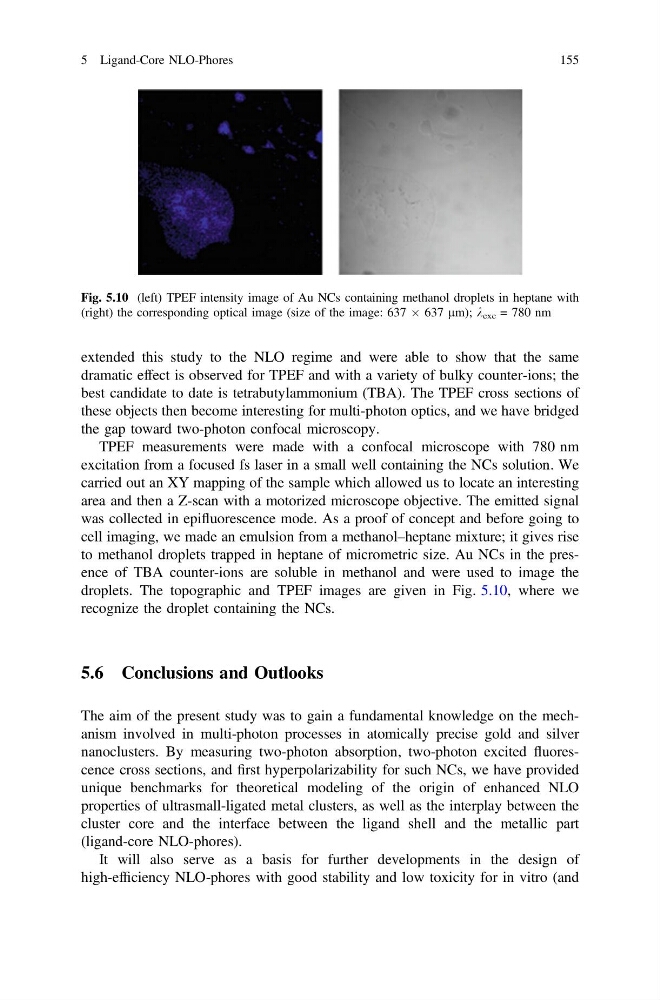
cell imaging, we made an emulsion from a methanol–heptane mixture; it gives rise
to methanol droplets trapped in heptane of micrometric size. Au NCs in the presence of TBA counter-ions are soluble in methanol and were used to image the
droplets. The topographic and TPEF images are given in Fig. 5.10, where we
recognize the droplet containing the NCs.
5.6 Conclusions and Outlooks
The aim of the present study was to gain a fundamental knowledge on the mechanism involved in multi-photon processes in atomically precise gold and silver
nanoclusters. By measuring two-photon absorption, two-photon excited fluorescence cross sections, and first hyperpolarizability for such NCs, we have provided
unique benchmarks for theoretical modeling of the origin of enhanced NLO
properties of ultrasmall-ligated metal clusters, as well as the interplay between the
cluster core and the interface between the ligand shell and the metallic part
(ligand-core NLO-phores).
It will also serve as a basis for further developments in the design of
high-efficiency NLO-phores with good stability and low toxicity for in vitro (and
Fig. 5.10 (left) TPEF intensity image of Au NCs containing methanol droplets in heptane with
(right) the corresponding optical image (size of the image: 637 Â 637 lm); k exc = 780 nm
5 Ligand-Core NLO-Phores
155
dramatic effect is observed for TPEF and with a variety of bulky counter-ions; the
best candidate to date is tetrabutylammonium (TBA). The TPEF cross sections of
these objects then become interesting for multi-photon optics, and we have bridged
the gap toward two-photon confocal microscopy.
TPEF measurements were made with a confocal microscope with 780 nm
excitation from a focused fs laser in a small well containing the NCs solution. We
carried out an XY mapping of the sample which allowed us to locate an interesting
area and then a Z-scan with a motorized microscope objective. The emitted signal
was collected in epifluorescence mode. As a proof of concept and before going to
cell imaging, we made an emulsion from a methanol–heptane mixture; it gives rise
to methanol droplets trapped in heptane of micrometric size. Au NCs in the presence of TBA counter-ions are soluble in methanol and were used to image the
droplets. The topographic and TPEF images are given in Fig. 5.10, where we
recognize the droplet containing the NCs.
5.6 Conclusions and Outlooks
The aim of the present study was to gain a fundamental knowledge on the mechanism involved in multi-photon processes in atomically precise gold and silver
nanoclusters. By measuring two-photon absorption, two-photon excited fluorescence cross sections, and first hyperpolarizability for such NCs, we have provided
unique benchmarks for theoretical modeling of the origin of enhanced NLO
properties of ultrasmall-ligated metal clusters, as well as the interplay between the
cluster core and the interface between the ligand shell and the metallic part
(ligand-core NLO-phores).
It will also serve as a basis for further developments in the design of
high-efficiency NLO-phores with good stability and low toxicity for in vitro (and
Fig. 5.10 (left) TPEF intensity image of Au NCs containing methanol droplets in heptane with
(right) the corresponding optical image (size of the image: 637 Â 637 lm); k exc = 780 nm
5 Ligand-Core NLO-Phores
155