

This behavior is still poorly understood and probably reflects the complexity of
the relaxation of excited electronic state characteristic of the quantum
regime.
For organic molecules, the emission typically occurs from its lowest excited
energy level for a given spin multiplicity (referred to as Kasha’s rule [61]).
However, nanoclusters, as well as certain organic molecules, tend to break this rule
and emit at more than one possible wavelength depending on the electronic
structure, density of states, and excited state dynamics involved. Regardless of
whether a molecule/nanocluster obeys the Kasha’s rule or not, in order to gain more
detailed understanding of the excited state emission dynamics of a chromophore,
one may carry out the time-resolved experiments. Note that the photochemistry of
gold nanoclusters is more complex than the de-excitation of p–p* states of organic
molecules, where excitations within the gold core as well as couplings with surface
states (through LMCT and LMMCT), singlet to triplet states conversion, may
occur.
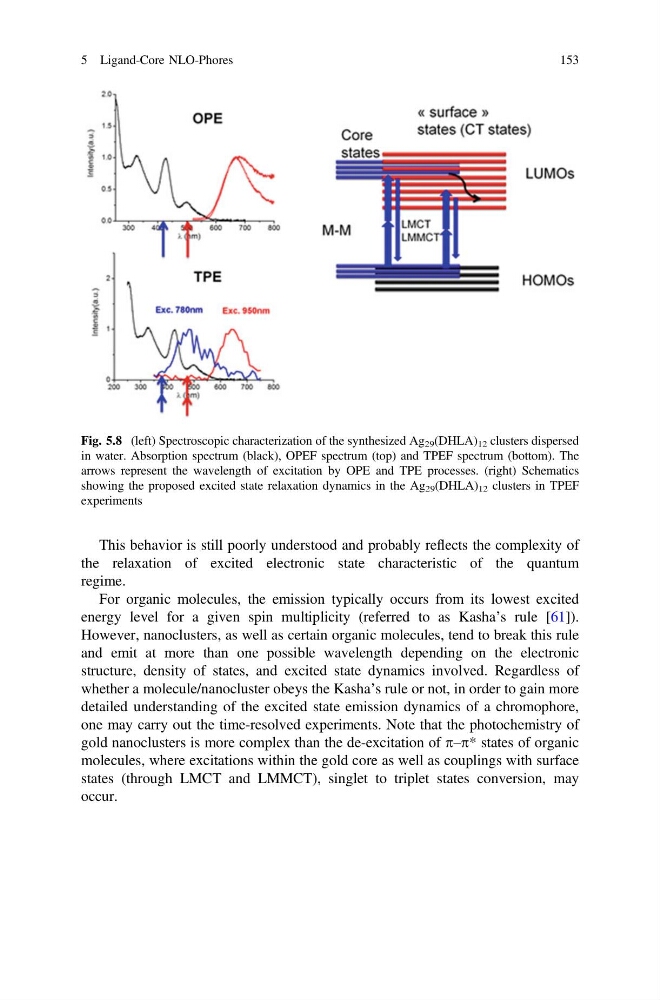
Fig. 5.8 (left) Spectroscopic characterization of the synthesized Ag 29 (DHLA) 12 clusters dispersed
in water. Absorption spectrum (black), OPEF spectrum (top) and TPEF spectrum (bottom). The
arrows represent the wavelength of excitation by OPE and TPE processes. (right) Schematics
showing the proposed excited state relaxation dynamics in the Ag 29 (DHLA) 12 clusters in TPEF
experiments
5 Ligand-Core NLO-Phores
153
the relaxation of excited electronic state characteristic of the quantum
regime.
For organic molecules, the emission typically occurs from its lowest excited
energy level for a given spin multiplicity (referred to as Kasha’s rule [61]).
However, nanoclusters, as well as certain organic molecules, tend to break this rule
and emit at more than one possible wavelength depending on the electronic
structure, density of states, and excited state dynamics involved. Regardless of
whether a molecule/nanocluster obeys the Kasha’s rule or not, in order to gain more
detailed understanding of the excited state emission dynamics of a chromophore,
one may carry out the time-resolved experiments. Note that the photochemistry of
gold nanoclusters is more complex than the de-excitation of p–p* states of organic
molecules, where excitations within the gold core as well as couplings with surface
states (through LMCT and LMMCT), singlet to triplet states conversion, may
occur.
Fig. 5.8 (left) Spectroscopic characterization of the synthesized Ag 29 (DHLA) 12 clusters dispersed
in water. Absorption spectrum (black), OPEF spectrum (top) and TPEF spectrum (bottom). The
arrows represent the wavelength of excitation by OPE and TPE processes. (right) Schematics
showing the proposed excited state relaxation dynamics in the Ag 29 (DHLA) 12 clusters in TPEF
experiments
5 Ligand-Core NLO-Phores
153