

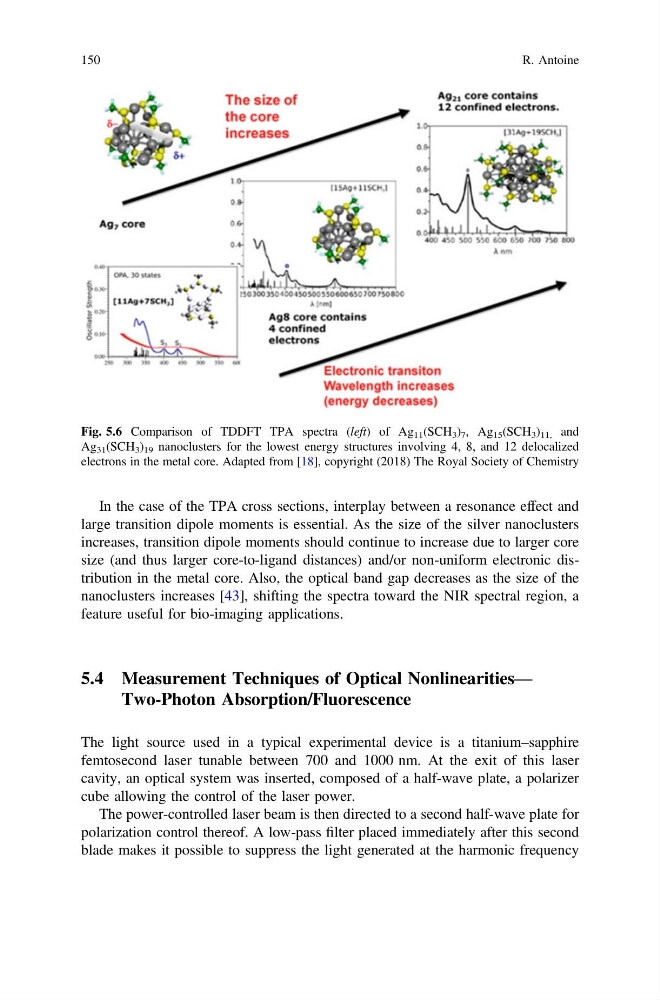
In the case of the TPA cross sections, interplay between a resonance effect and
large transition dipole moments is essential. As the size of the silver nanoclusters
increases, transition dipole moments should continue to increase due to larger core
size (and thus larger core-to-ligand distances) and/or non-uniform electronic distribution in the metal core. Also, the optical band gap decreases as the size of the
nanoclusters increases [43], shifting the spectra toward the NIR spectral region, a
feature useful for bio-imaging applications.
5.4 Measurement Techniques of Optical Nonlinearities—
Two-Photon Absorption/Fluorescence
The light source used in a typical experimental device is a titanium–sapphire
femtosecond laser tunable between 700 and 1000 nm. At the exit of this laser
cavity, an optical system was inserted, composed of a half-wave plate, a polarizer
cube allowing the control of the laser power.
The power-controlled laser beam is then directed to a second half-wave plate for
polarization control thereof. A low-pass filter placed immediately after this second
blade makes it possible to suppress the light generated at the harmonic frequency
Fig. 5.6 Comparison of TDDFT TPA spectra (left) of Ag 11 (SCH 3 ) 7 , Ag 15 (SCH 3 ) 11, and
Ag 31 (SCH 3 ) 19 nanoclusters for the lowest energy structures involving 4, 8, and 12 delocalized
electrons in the metal core. Adapted from [18], copyright (2018) The Royal Society of Chemistry
150
R. Antoine
large transition dipole moments is essential. As the size of the silver nanoclusters
increases, transition dipole moments should continue to increase due to larger core
size (and thus larger core-to-ligand distances) and/or non-uniform electronic distribution in the metal core. Also, the optical band gap decreases as the size of the
nanoclusters increases [43], shifting the spectra toward the NIR spectral region, a
feature useful for bio-imaging applications.
5.4 Measurement Techniques of Optical Nonlinearities—
Two-Photon Absorption/Fluorescence
The light source used in a typical experimental device is a titanium–sapphire
femtosecond laser tunable between 700 and 1000 nm. At the exit of this laser
cavity, an optical system was inserted, composed of a half-wave plate, a polarizer
cube allowing the control of the laser power.
The power-controlled laser beam is then directed to a second half-wave plate for
polarization control thereof. A low-pass filter placed immediately after this second
blade makes it possible to suppress the light generated at the harmonic frequency
Fig. 5.6 Comparison of TDDFT TPA spectra (left) of Ag 11 (SCH 3 ) 7 , Ag 15 (SCH 3 ) 11, and
Ag 31 (SCH 3 ) 19 nanoclusters for the lowest energy structures involving 4, 8, and 12 delocalized
electrons in the metal core. Adapted from [18], copyright (2018) The Royal Society of Chemistry
150
R. Antoine