

cross section. In spite of the success, it is necessary to notice that in standard
response theory, the response functions can diverge, since the response function has
poles whenever one or more of the optical frequencies equal excitation energy. This
can lead to nonphysical behavior for molecular properties in the resonance region.
However, introducing damping terms in different ways the singularities of the
response functions can be corrected or effectively removed [17].
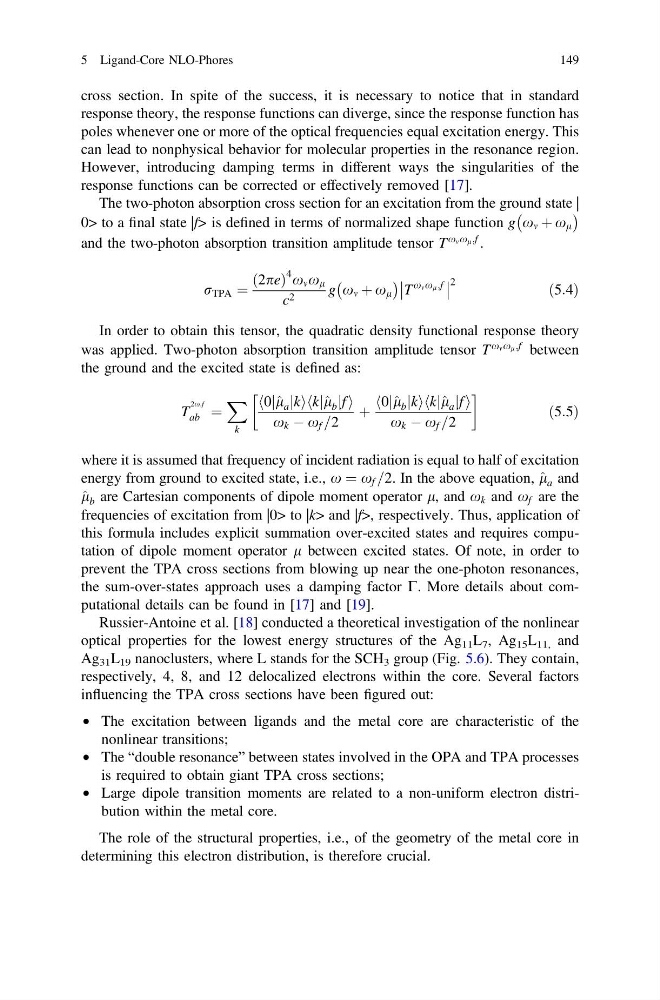
The two-photon absorption cross section for an excitation from the ground state |
0> to a final state |f> is defined in terms of normalized shape function g x m þ x l
À
Á
and the two-photon absorption transition amplitude tensor T
x m x l ;f .
r TPA ¼
ð2peÞ
4 x m x l
c 2
g x m þ x l
À
Á
T
x m x l ;f
2
ð5:4Þ
In order to obtain this tensor, the quadratic density functional response theory
was applied. Two-photon absorption transition amplitude tensor T
x m x l ;f between
the ground and the excited state is defined as:
T
2x;f
ab ¼
X
k
0 ^
l a
j jk
h
i k ^
l b
j jf
h
i
x k À x f =2
þ
0 ^
l b
j jk
h
i k ^
l a
j jf
h
i
x k À x f =2
!
ð5:5Þ
where it is assumed that frequency of incident radiation is equal to half of excitation
energy from ground to excited state, i.e., x ¼ x f =2. In the above equation, ^
l a and
^
l b are Cartesian components of dipole moment operator l, and x k and x f are the
frequencies of excitation from |0> to |k> and |f>, respectively. Thus, application of
this formula includes explicit summation over-excited states and requires computation of dipole moment operator l between excited states. Of note, in order to
prevent the TPA cross sections from blowing up near the one-photon resonances,
the sum-over-states approach uses a damping factor C. More details about computational details can be found in [17] and [19].
Russier-Antoine et al. [18] conducted a theoretical investigation of the nonlinear
optical properties for the lowest energy structures of the Ag 11 L 7 , Ag 15 L 11, and
Ag 31 L 19 nanoclusters, where L stands for the SCH 3 group (Fig. 5.6). They contain,
respectively, 4, 8, and 12 delocalized electrons within the core. Several factors
influencing the TPA cross sections have been figured out:
• The excitation between ligands and the metal core are characteristic of the
nonlinear transitions;
• The “double resonance” between states involved in the OPA and TPA processes
is required to obtain giant TPA cross sections;
• Large dipole transition moments are related to a non-uniform electron distribution within the metal core.
The role of the structural properties, i.e., of the geometry of the metal core in
determining this electron distribution, is therefore crucial.
5 Ligand-Core NLO-Phores
149
response theory, the response functions can diverge, since the response function has
poles whenever one or more of the optical frequencies equal excitation energy. This
can lead to nonphysical behavior for molecular properties in the resonance region.
However, introducing damping terms in different ways the singularities of the
response functions can be corrected or effectively removed [17].
The two-photon absorption cross section for an excitation from the ground state |
0> to a final state |f> is defined in terms of normalized shape function g x m þ x l
À
Á
and the two-photon absorption transition amplitude tensor T
x m x l ;f .
r TPA ¼
ð2peÞ
4 x m x l
c 2
g x m þ x l
À
Á
T
x m x l ;f
2
ð5:4Þ
In order to obtain this tensor, the quadratic density functional response theory
was applied. Two-photon absorption transition amplitude tensor T
x m x l ;f between
the ground and the excited state is defined as:
T
2x;f
ab ¼
X
k
0 ^
l a
j jk
h
i k ^
l b
j jf
h
i
x k À x f =2
þ
0 ^
l b
j jk
h
i k ^
l a
j jf
h
i
x k À x f =2
!
ð5:5Þ
where it is assumed that frequency of incident radiation is equal to half of excitation
energy from ground to excited state, i.e., x ¼ x f =2. In the above equation, ^
l a and
^
l b are Cartesian components of dipole moment operator l, and x k and x f are the
frequencies of excitation from |0> to |k> and |f>, respectively. Thus, application of
this formula includes explicit summation over-excited states and requires computation of dipole moment operator l between excited states. Of note, in order to
prevent the TPA cross sections from blowing up near the one-photon resonances,
the sum-over-states approach uses a damping factor C. More details about computational details can be found in [17] and [19].
Russier-Antoine et al. [18] conducted a theoretical investigation of the nonlinear
optical properties for the lowest energy structures of the Ag 11 L 7 , Ag 15 L 11, and
Ag 31 L 19 nanoclusters, where L stands for the SCH 3 group (Fig. 5.6). They contain,
respectively, 4, 8, and 12 delocalized electrons within the core. Several factors
influencing the TPA cross sections have been figured out:
• The excitation between ligands and the metal core are characteristic of the
nonlinear transitions;
• The “double resonance” between states involved in the OPA and TPA processes
is required to obtain giant TPA cross sections;
• Large dipole transition moments are related to a non-uniform electron distribution within the metal core.
The role of the structural properties, i.e., of the geometry of the metal core in
determining this electron distribution, is therefore crucial.
5 Ligand-Core NLO-Phores
149