

d TPA ðxÞ ¼
1
5c 2 hn 2 e 2
0
ð hxÞ
2
hx eg À hx
À
Á 2 þ C
2
eg
Â
l eg
2 Dl
j j
2 C eg
hx eg À 2 hx
À
Á 2 þ C
2
eg
þ
l eg
2 l ee 0
j j
2 C e 0 g
hx e 0 g À 2 hx
À
Á 2 þ C
2
e 0 g
"
#
ð5:3Þ
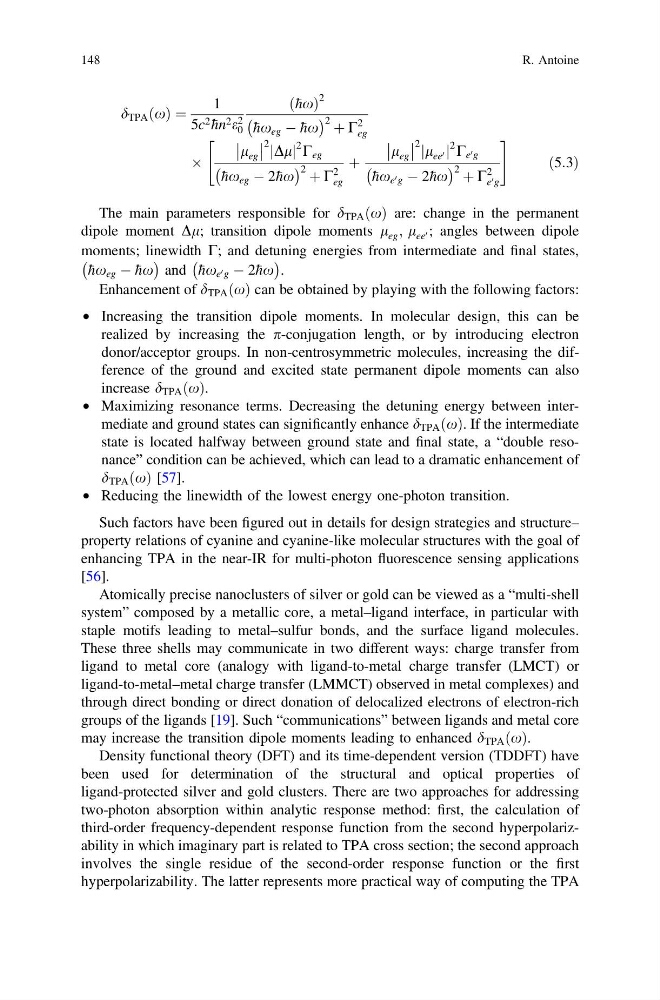
The main parameters responsible for d TPA ðxÞ are: change in the permanent
dipole moment Dl; transition dipole moments l eg ; l ee 0 ; angles between dipole
moments; linewidth C; and detuning energies from intermediate and final states,
hx eg À hx
À
Á
and hx e 0 g À 2 hx
À
Á
.
Enhancement of d TPA ðxÞ can be obtained by playing with the following factors:
• Increasing the transition dipole moments. In molecular design, this can be
realized by increasing the p-conjugation length, or by introducing electron
donor/acceptor groups. In non-centrosymmetric molecules, increasing the difference of the ground and excited state permanent dipole moments can also
increase d TPA ðxÞ.
• Maximizing resonance terms. Decreasing the detuning energy between intermediate and ground states can significantly enhance d TPA ðxÞ. If the intermediate
state is located halfway between ground state and final state, a “double resonance” condition can be achieved, which can lead to a dramatic enhancement of
d TPA ðxÞ [57].
• Reducing the linewidth of the lowest energy one-photon transition.
Such factors have been figured out in details for design strategies and structure–
property relations of cyanine and cyanine-like molecular structures with the goal of
enhancing TPA in the near-IR for multi-photon fluorescence sensing applications
[56].
Atomically precise nanoclusters of silver or gold can be viewed as a “multi-shell
system” composed by a metallic core, a metal–ligand interface, in particular with
staple motifs leading to metal–sulfur bonds, and the surface ligand molecules.
These three shells may communicate in two different ways: charge transfer from
ligand to metal core (analogy with ligand-to-metal charge transfer (LMCT) or
ligand-to-metal–metal charge transfer (LMMCT) observed in metal complexes) and
through direct bonding or direct donation of delocalized electrons of electron-rich
groups of the ligands [19]. Such “communications” between ligands and metal core
may increase the transition dipole moments leading to enhanced d TPA ðxÞ.
Density functional theory (DFT) and its time-dependent version (TDDFT) have
been used for determination of the structural and optical properties of
ligand-protected silver and gold clusters. There are two approaches for addressing
two-photon absorption within analytic response method: first, the calculation of
third-order frequency-dependent response function from the second hyperpolarizability in which imaginary part is related to TPA cross section; the second approach
involves the single residue of the second-order response function or the first
hyperpolarizability. The latter represents more practical way of computing the TPA
148
R. Antoine
1
5c 2 hn 2 e 2
0
ð hxÞ
2
hx eg À hx
À
Á 2 þ C
2
eg
Â
l eg
2 Dl
j j
2 C eg
hx eg À 2 hx
À
Á 2 þ C
2
eg
þ
l eg
2 l ee 0
j j
2 C e 0 g
hx e 0 g À 2 hx
À
Á 2 þ C
2
e 0 g
"
#
ð5:3Þ
The main parameters responsible for d TPA ðxÞ are: change in the permanent
dipole moment Dl; transition dipole moments l eg ; l ee 0 ; angles between dipole
moments; linewidth C; and detuning energies from intermediate and final states,
hx eg À hx
À
Á
and hx e 0 g À 2 hx
À
Á
.
Enhancement of d TPA ðxÞ can be obtained by playing with the following factors:
• Increasing the transition dipole moments. In molecular design, this can be
realized by increasing the p-conjugation length, or by introducing electron
donor/acceptor groups. In non-centrosymmetric molecules, increasing the difference of the ground and excited state permanent dipole moments can also
increase d TPA ðxÞ.
• Maximizing resonance terms. Decreasing the detuning energy between intermediate and ground states can significantly enhance d TPA ðxÞ. If the intermediate
state is located halfway between ground state and final state, a “double resonance” condition can be achieved, which can lead to a dramatic enhancement of
d TPA ðxÞ [57].
• Reducing the linewidth of the lowest energy one-photon transition.
Such factors have been figured out in details for design strategies and structure–
property relations of cyanine and cyanine-like molecular structures with the goal of
enhancing TPA in the near-IR for multi-photon fluorescence sensing applications
[56].
Atomically precise nanoclusters of silver or gold can be viewed as a “multi-shell
system” composed by a metallic core, a metal–ligand interface, in particular with
staple motifs leading to metal–sulfur bonds, and the surface ligand molecules.
These three shells may communicate in two different ways: charge transfer from
ligand to metal core (analogy with ligand-to-metal charge transfer (LMCT) or
ligand-to-metal–metal charge transfer (LMMCT) observed in metal complexes) and
through direct bonding or direct donation of delocalized electrons of electron-rich
groups of the ligands [19]. Such “communications” between ligands and metal core
may increase the transition dipole moments leading to enhanced d TPA ðxÞ.
Density functional theory (DFT) and its time-dependent version (TDDFT) have
been used for determination of the structural and optical properties of
ligand-protected silver and gold clusters. There are two approaches for addressing
two-photon absorption within analytic response method: first, the calculation of
third-order frequency-dependent response function from the second hyperpolarizability in which imaginary part is related to TPA cross section; the second approach
involves the single residue of the second-order response function or the first
hyperpolarizability. The latter represents more practical way of computing the TPA
148
R. Antoine