

theoretical data can be used to get an extensive comprehension of the physics
underlying the two-photon process and its amplitude, as well as to suggest an
exploratory root for novel chemical engineering for further enhancement of TPA in
atomically precise clusters of silver and gold.
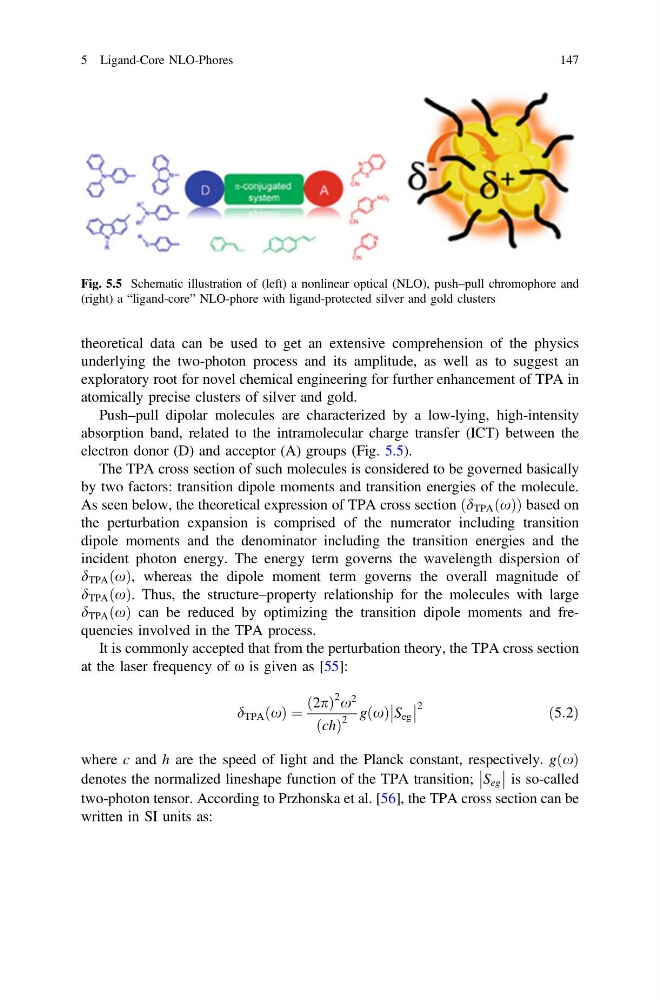
Push–pull dipolar molecules are characterized by a low-lying, high-intensity
absorption band, related to the intramolecular charge transfer (ICT) between the
electron donor (D) and acceptor (A) groups (Fig. 5.5).
The TPA cross section of such molecules is considered to be governed basically
by two factors: transition dipole moments and transition energies of the molecule.
As seen below, the theoretical expression of TPA cross section d TPA ðxÞ
ð
Þbased on
the perturbation expansion is comprised of the numerator including transition
dipole moments and the denominator including the transition energies and the
incident photon energy. The energy term governs the wavelength dispersion of
d TPA ðxÞ, whereas the dipole moment term governs the overall magnitude of
d TPA ðxÞ. Thus, the structure–property relationship for the molecules with large
d TPA ðxÞ can be reduced by optimizing the transition dipole moments and frequencies involved in the TPA process.
It is commonly accepted that from the perturbation theory, the TPA cross section
at the laser frequency of x is given as [55]:
d TPA ðxÞ ¼
ð2pÞ
2 x
2
ðchÞ
2
gðxÞ S eg
2
ð5:2Þ
where c and h are the speed of light and the Planck constant, respectively. gðxÞ
denotes the normalized lineshape function of the TPA transition; S eg
is so-called
two-photon tensor. According to Przhonska et al. [56], the TPA cross section can be
written in SI units as:
Fig. 5.5 Schematic illustration of (left) a nonlinear optical (NLO), push–pull chromophore and
(right) a “ligand-core” NLO-phore with ligand-protected silver and gold clusters
5 Ligand-Core NLO-Phores
147
underlying the two-photon process and its amplitude, as well as to suggest an
exploratory root for novel chemical engineering for further enhancement of TPA in
atomically precise clusters of silver and gold.
Push–pull dipolar molecules are characterized by a low-lying, high-intensity
absorption band, related to the intramolecular charge transfer (ICT) between the
electron donor (D) and acceptor (A) groups (Fig. 5.5).
The TPA cross section of such molecules is considered to be governed basically
by two factors: transition dipole moments and transition energies of the molecule.
As seen below, the theoretical expression of TPA cross section d TPA ðxÞ
ð
Þbased on
the perturbation expansion is comprised of the numerator including transition
dipole moments and the denominator including the transition energies and the
incident photon energy. The energy term governs the wavelength dispersion of
d TPA ðxÞ, whereas the dipole moment term governs the overall magnitude of
d TPA ðxÞ. Thus, the structure–property relationship for the molecules with large
d TPA ðxÞ can be reduced by optimizing the transition dipole moments and frequencies involved in the TPA process.
It is commonly accepted that from the perturbation theory, the TPA cross section
at the laser frequency of x is given as [55]:
d TPA ðxÞ ¼
ð2pÞ
2 x
2
ðchÞ
2
gðxÞ S eg
2
ð5:2Þ
where c and h are the speed of light and the Planck constant, respectively. gðxÞ
denotes the normalized lineshape function of the TPA transition; S eg
is so-called
two-photon tensor. According to Przhonska et al. [56], the TPA cross section can be
written in SI units as:
Fig. 5.5 Schematic illustration of (left) a nonlinear optical (NLO), push–pull chromophore and
(right) a “ligand-core” NLO-phore with ligand-protected silver and gold clusters
5 Ligand-Core NLO-Phores
147