

understanding the photoluminescence mechanism of Au 25 clusters. Devadas et al.
[53] found that 500 nm emission fundamentally arises from the electron–hole
recombination in the Au 13 core with little perturbation from surface ligands, but
NIR emission at 700 nm originates from the recombination of holes in the ground
core state and electron decay from core-excited states to S–Au–S–Au–S semi-rings.
Wu and Jin in a seminal work [31] found that charge state and surface ligands also
have a significant influence on the NIR emission wavelength and quantum yields of
Au 25 clusters. Clearly, more detailed photophysical studies are required for evaluating how surface ligands influence the photoluminescence mechanisms of such
systems. Over the last ten years, some general trends have been figured out concerning the de-excitation pathways following a visible or near-UV absorption. The
following experimental and theoretical findings were assembled from the present
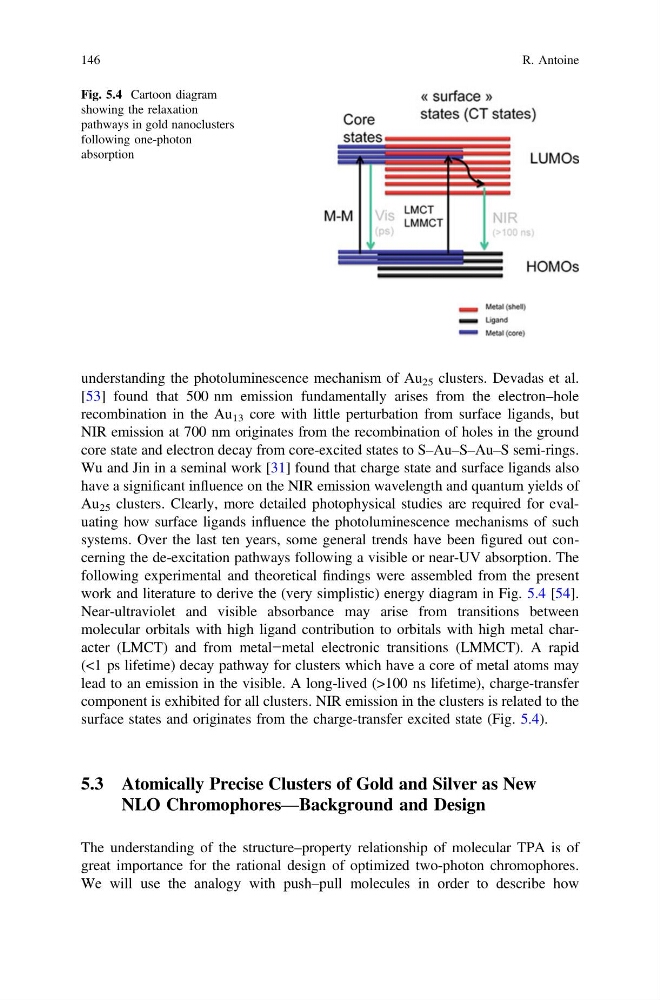
work and literature to derive the (very simplistic) energy diagram in Fig. 5.4 [54].
Near-ultraviolet and visible absorbance may arise from transitions between
molecular orbitals with high ligand contribution to orbitals with high metal character (LMCT) and from metal−metal electronic transitions (LMMCT). A rapid
(<1 ps lifetime) decay pathway for clusters which have a core of metal atoms may
lead to an emission in the visible. A long-lived (>100 ns lifetime), charge-transfer
component is exhibited for all clusters. NIR emission in the clusters is related to the
surface states and originates from the charge-transfer excited state (Fig. 5.4).
5.3 Atomically Precise Clusters of Gold and Silver as New
NLO Chromophores—Background and Design
The understanding of the structure–property relationship of molecular TPA is of
great importance for the rational design of optimized two-photon chromophores.
We will use the analogy with push–pull molecules in order to describe how
Fig. 5.4 Cartoon diagram
showing the relaxation
pathways in gold nanoclusters
following one-photon
absorption
146
R. Antoine
[53] found that 500 nm emission fundamentally arises from the electron–hole
recombination in the Au 13 core with little perturbation from surface ligands, but
NIR emission at 700 nm originates from the recombination of holes in the ground
core state and electron decay from core-excited states to S–Au–S–Au–S semi-rings.
Wu and Jin in a seminal work [31] found that charge state and surface ligands also
have a significant influence on the NIR emission wavelength and quantum yields of
Au 25 clusters. Clearly, more detailed photophysical studies are required for evaluating how surface ligands influence the photoluminescence mechanisms of such
systems. Over the last ten years, some general trends have been figured out concerning the de-excitation pathways following a visible or near-UV absorption. The
following experimental and theoretical findings were assembled from the present
work and literature to derive the (very simplistic) energy diagram in Fig. 5.4 [54].
Near-ultraviolet and visible absorbance may arise from transitions between
molecular orbitals with high ligand contribution to orbitals with high metal character (LMCT) and from metal−metal electronic transitions (LMMCT). A rapid
(<1 ps lifetime) decay pathway for clusters which have a core of metal atoms may
lead to an emission in the visible. A long-lived (>100 ns lifetime), charge-transfer
component is exhibited for all clusters. NIR emission in the clusters is related to the
surface states and originates from the charge-transfer excited state (Fig. 5.4).
5.3 Atomically Precise Clusters of Gold and Silver as New
NLO Chromophores—Background and Design
The understanding of the structure–property relationship of molecular TPA is of
great importance for the rational design of optimized two-photon chromophores.
We will use the analogy with push–pull molecules in order to describe how
Fig. 5.4 Cartoon diagram
showing the relaxation
pathways in gold nanoclusters
following one-photon
absorption
146
R. Antoine