

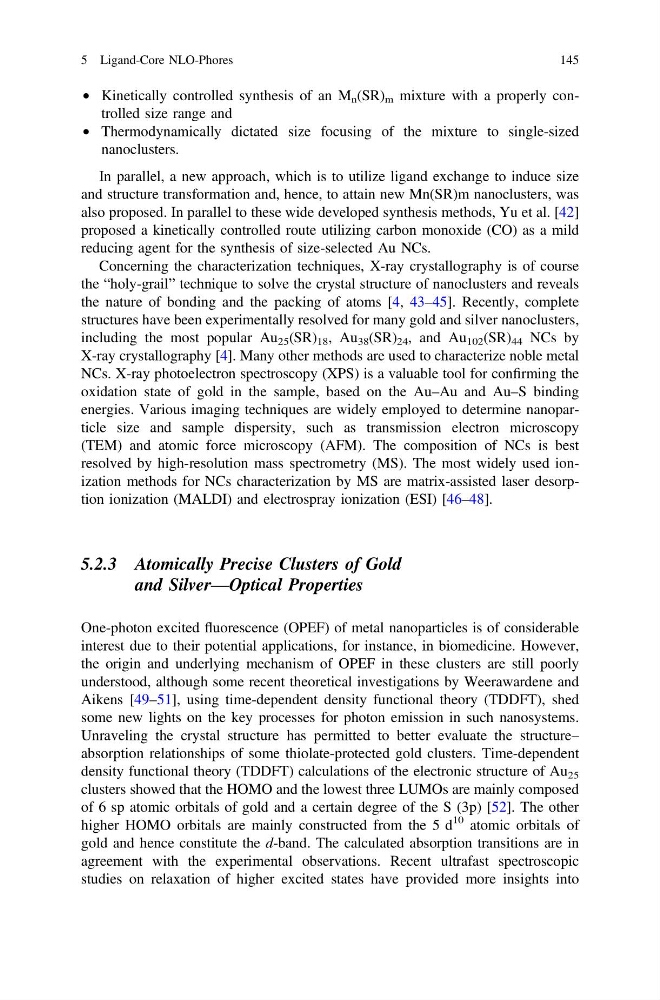
• Kinetically controlled synthesis of an M n (SR) m mixture with a properly controlled size range and
• Thermodynamically dictated size focusing of the mixture to single-sized
nanoclusters.
In parallel, a new approach, which is to utilize ligand exchange to induce size
and structure transformation and, hence, to attain new Mn(SR)m nanoclusters, was
also proposed. In parallel to these wide developed synthesis methods, Yu et al. [42]
proposed a kinetically controlled route utilizing carbon monoxide (CO) as a mild
reducing agent for the synthesis of size-selected Au NCs.
Concerning the characterization techniques, X-ray crystallography is of course
the “holy-grail” technique to solve the crystal structure of nanoclusters and reveals
the nature of bonding and the packing of atoms [4, 43–45]. Recently, complete
structures have been experimentally resolved for many gold and silver nanoclusters,
including the most popular Au 25 (SR) 18 , Au 38 (SR) 24 , and Au 102 (SR) 44 NCs by
X-ray crystallography [4]. Many other methods are used to characterize noble metal
NCs. X-ray photoelectron spectroscopy (XPS) is a valuable tool for confirming the
oxidation state of gold in the sample, based on the Au–Au and Au–S binding
energies. Various imaging techniques are widely employed to determine nanoparticle size and sample dispersity, such as transmission electron microscopy
(TEM) and atomic force microscopy (AFM). The composition of NCs is best
resolved by high-resolution mass spectrometry (MS). The most widely used ionization methods for NCs characterization by MS are matrix-assisted laser desorption ionization (MALDI) and electrospray ionization (ESI) [46–48].
5.2.3 Atomically Precise Clusters of Gold
and Silver—Optical Properties
One-photon excited fluorescence (OPEF) of metal nanoparticles is of considerable
interest due to their potential applications, for instance, in biomedicine. However,
the origin and underlying mechanism of OPEF in these clusters are still poorly
understood, although some recent theoretical investigations by Weerawardene and
Aikens [49–51], using time-dependent density functional theory (TDDFT), shed
some new lights on the key processes for photon emission in such nanosystems.
Unraveling the crystal structure has permitted to better evaluate the structure–
absorption relationships of some thiolate-protected gold clusters. Time-dependent
density functional theory (TDDFT) calculations of the electronic structure of Au 25
clusters showed that the HOMO and the lowest three LUMOs are mainly composed
of 6 sp atomic orbitals of gold and a certain degree of the S (3p) [52]. The other
higher HOMO orbitals are mainly constructed from the 5 d
10 atomic orbitals of
gold and hence constitute the d-band. The calculated absorption transitions are in
agreement with the experimental observations. Recent ultrafast spectroscopic
studies on relaxation of higher excited states have provided more insights into
5 Ligand-Core NLO-Phores
145
• Thermodynamically dictated size focusing of the mixture to single-sized
nanoclusters.
In parallel, a new approach, which is to utilize ligand exchange to induce size
and structure transformation and, hence, to attain new Mn(SR)m nanoclusters, was
also proposed. In parallel to these wide developed synthesis methods, Yu et al. [42]
proposed a kinetically controlled route utilizing carbon monoxide (CO) as a mild
reducing agent for the synthesis of size-selected Au NCs.
Concerning the characterization techniques, X-ray crystallography is of course
the “holy-grail” technique to solve the crystal structure of nanoclusters and reveals
the nature of bonding and the packing of atoms [4, 43–45]. Recently, complete
structures have been experimentally resolved for many gold and silver nanoclusters,
including the most popular Au 25 (SR) 18 , Au 38 (SR) 24 , and Au 102 (SR) 44 NCs by
X-ray crystallography [4]. Many other methods are used to characterize noble metal
NCs. X-ray photoelectron spectroscopy (XPS) is a valuable tool for confirming the
oxidation state of gold in the sample, based on the Au–Au and Au–S binding
energies. Various imaging techniques are widely employed to determine nanoparticle size and sample dispersity, such as transmission electron microscopy
(TEM) and atomic force microscopy (AFM). The composition of NCs is best
resolved by high-resolution mass spectrometry (MS). The most widely used ionization methods for NCs characterization by MS are matrix-assisted laser desorption ionization (MALDI) and electrospray ionization (ESI) [46–48].
5.2.3 Atomically Precise Clusters of Gold
and Silver—Optical Properties
One-photon excited fluorescence (OPEF) of metal nanoparticles is of considerable
interest due to their potential applications, for instance, in biomedicine. However,
the origin and underlying mechanism of OPEF in these clusters are still poorly
understood, although some recent theoretical investigations by Weerawardene and
Aikens [49–51], using time-dependent density functional theory (TDDFT), shed
some new lights on the key processes for photon emission in such nanosystems.
Unraveling the crystal structure has permitted to better evaluate the structure–
absorption relationships of some thiolate-protected gold clusters. Time-dependent
density functional theory (TDDFT) calculations of the electronic structure of Au 25
clusters showed that the HOMO and the lowest three LUMOs are mainly composed
of 6 sp atomic orbitals of gold and a certain degree of the S (3p) [52]. The other
higher HOMO orbitals are mainly constructed from the 5 d
10 atomic orbitals of
gold and hence constitute the d-band. The calculated absorption transitions are in
agreement with the experimental observations. Recent ultrafast spectroscopic
studies on relaxation of higher excited states have provided more insights into
5 Ligand-Core NLO-Phores
145