

It is easy to notice that the differences between k e and k h for investigated corroles
(except 6) are not very distinct—this suggests that it should be also possible to force
them to desired (donor or acceptor) behavior. This is in agreement with the results
of Brizet et al. who showed that direction of the energy transfer in the gallium
corrole-BODIPY dyad can be reversed by putting the appropriate substituent to the
BODIPY moiety [101]. The estimated relative hopping rates of holes versus
electrons k et(h) /k et(e) more or less reflect the values of reorganization energies and
show that mobility of holes in all corroles (except 1) is higher at least twice than
that of electrons. Again, the most distinct value was obtained for corrole 6 (4.99).
The results for 1 and fullerene show rather acceptor behavior (k et(h) /k et(e) < 1).
In addition to the intermolecular charge transfer, one should also consider the
possibility of the intramolecular charge transfer. Such transfer can be identified by
the position of the frontier molecular orbitals (HOMO and LUMO) when the
electron moves from one part of the molecule to another. Moreover, the transfer
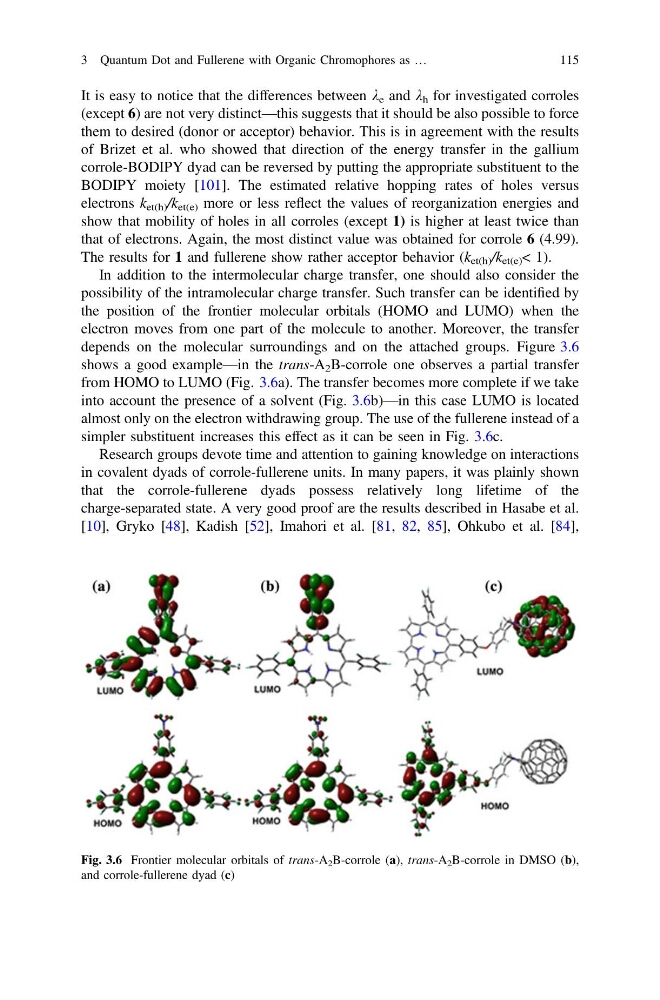
depends on the molecular surroundings and on the attached groups. Figure 3.6
shows a good example—in the trans-A 2 B-corrole one observes a partial transfer
from HOMO to LUMO (Fig. 3.6a). The transfer becomes more complete if we take
into account the presence of a solvent (Fig. 3.6b)—in this case LUMO is located
almost only on the electron withdrawing group. The use of the fullerene instead of a
simpler substituent increases this effect as it can be seen in Fig. 3.6c.
Research groups devote time and attention to gaining knowledge on interactions
in covalent dyads of corrole-fullerene units. In many papers, it was plainly shown
that the corrole-fullerene dyads possess relatively long lifetime of the
charge-separated state. A very good proof are the results described in Hasabe et al.
[10], Gryko [48], Kadish [52], Imahori et al. [81, 82, 85], Ohkubo et al. [84],
Fig. 3.6 Frontier molecular orbitals of trans-A 2 B-corrole (a), trans-A 2 B-corrole in DMSO (b),
and corrole-fullerene dyad (c)
3 Quantum Dot and Fullerene with Organic Chromophores as …
115
(except 6) are not very distinct—this suggests that it should be also possible to force
them to desired (donor or acceptor) behavior. This is in agreement with the results
of Brizet et al. who showed that direction of the energy transfer in the gallium
corrole-BODIPY dyad can be reversed by putting the appropriate substituent to the
BODIPY moiety [101]. The estimated relative hopping rates of holes versus
electrons k et(h) /k et(e) more or less reflect the values of reorganization energies and
show that mobility of holes in all corroles (except 1) is higher at least twice than
that of electrons. Again, the most distinct value was obtained for corrole 6 (4.99).
The results for 1 and fullerene show rather acceptor behavior (k et(h) /k et(e) < 1).
In addition to the intermolecular charge transfer, one should also consider the
possibility of the intramolecular charge transfer. Such transfer can be identified by
the position of the frontier molecular orbitals (HOMO and LUMO) when the
electron moves from one part of the molecule to another. Moreover, the transfer
depends on the molecular surroundings and on the attached groups. Figure 3.6
shows a good example—in the trans-A 2 B-corrole one observes a partial transfer
from HOMO to LUMO (Fig. 3.6a). The transfer becomes more complete if we take
into account the presence of a solvent (Fig. 3.6b)—in this case LUMO is located
almost only on the electron withdrawing group. The use of the fullerene instead of a
simpler substituent increases this effect as it can be seen in Fig. 3.6c.
Research groups devote time and attention to gaining knowledge on interactions
in covalent dyads of corrole-fullerene units. In many papers, it was plainly shown
that the corrole-fullerene dyads possess relatively long lifetime of the
charge-separated state. A very good proof are the results described in Hasabe et al.
[10], Gryko [48], Kadish [52], Imahori et al. [81, 82, 85], Ohkubo et al. [84],
Fig. 3.6 Frontier molecular orbitals of trans-A 2 B-corrole (a), trans-A 2 B-corrole in DMSO (b),
and corrole-fullerene dyad (c)
3 Quantum Dot and Fullerene with Organic Chromophores as …
115