

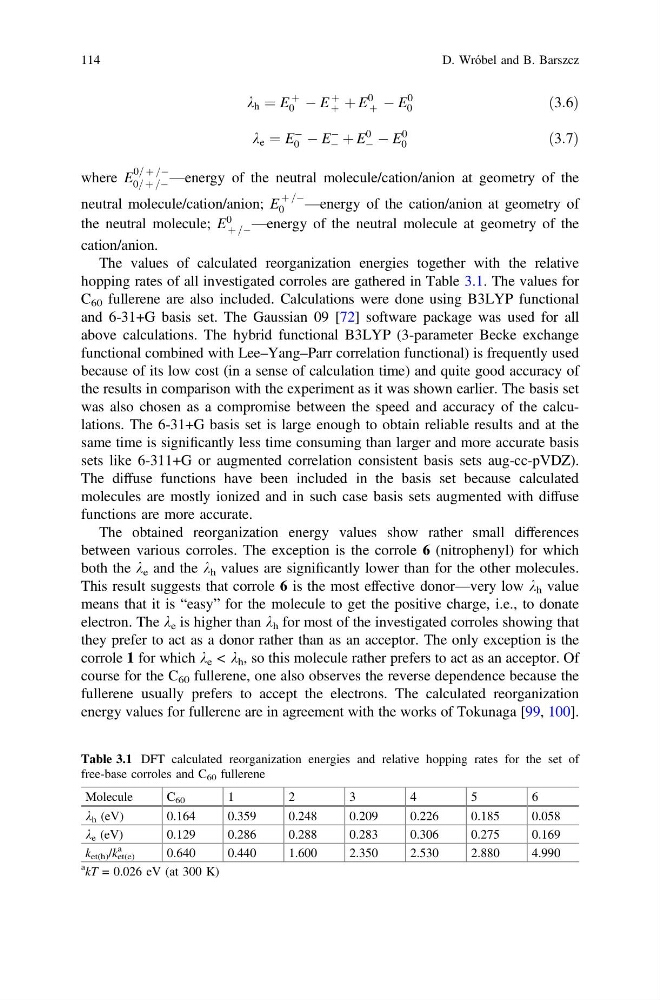
k h ¼ E
þ
0 À E
þ
þ þ E
0
þ À E
0
0
ð3:6Þ
k e ¼ E
À
0 À E
À
À þ E
0
À À E
0
0
ð3:7Þ
where E
0= þ =À
0= þ =À —energy of the neutral molecule/cation/anion at geometry of the
neutral molecule/cation/anion; E
þ =À
0
—energy of the cation/anion at geometry of
the neutral molecule; E
0
þ =À —energy of the neutral molecule at geometry of the
cation/anion.
The values of calculated reorganization energies together with the relative
hopping rates of all investigated corroles are gathered in Table 3.1. The values for
C 60 fullerene are also included. Calculations were done using B3LYP functional
and 6-31+G basis set. The Gaussian 09 [72] software package was used for all
above calculations. The hybrid functional B3LYP (3-parameter Becke exchange
functional combined with Lee–Yang–Parr correlation functional) is frequently used
because of its low cost (in a sense of calculation time) and quite good accuracy of
the results in comparison with the experiment as it was shown earlier. The basis set
was also chosen as a compromise between the speed and accuracy of the calculations. The 6-31+G basis set is large enough to obtain reliable results and at the
same time is significantly less time consuming than larger and more accurate basis
sets like 6-311+G or augmented correlation consistent basis sets aug-cc-pVDZ).
The diffuse functions have been included in the basis set because calculated
molecules are mostly ionized and in such case basis sets augmented with diffuse
functions are more accurate.
The obtained reorganization energy values show rather small differences
between various corroles. The exception is the corrole 6 (nitrophenyl) for which
both the k e and the k h values are significantly lower than for the other molecules.
This result suggests that corrole 6 is the most effective donor—very low k h value
means that it is “easy” for the molecule to get the positive charge, i.e., to donate
electron. The k e is higher than k h for most of the investigated corroles showing that
they prefer to act as a donor rather than as an acceptor. The only exception is the
corrole 1 for which k e < k h , so this molecule rather prefers to act as an acceptor. Of
course for the C 60 fullerene, one also observes the reverse dependence because the
fullerene usually prefers to accept the electrons. The calculated reorganization
energy values for fullerene are in agreement with the works of Tokunaga [99, 100].
Table 3.1 DFT calculated reorganization energies and relative hopping rates for the set of
free-base corroles and C 60 fullerene
Molecule
C 60
1
2
3
4
5
6
k h (eV)
0.164
0.359
0.248
0.209
0.226
0.185
0.058
k e (eV)
0.129
0.286
0.288
0.283
0.306
0.275
0.169
k et(h) /k et(e)
a
0.640
0.440
1.600
2.350
2.530
2.880
4.990
a kT = 0.026 eV (at 300 K)
114
D. Wróbel and B. Barszcz
þ
0 À E
þ
þ þ E
0
þ À E
0
0
ð3:6Þ
k e ¼ E
À
0 À E
À
À þ E
0
À À E
0
0
ð3:7Þ
where E
0= þ =À
0= þ =À —energy of the neutral molecule/cation/anion at geometry of the
neutral molecule/cation/anion; E
þ =À
0
—energy of the cation/anion at geometry of
the neutral molecule; E
0
þ =À —energy of the neutral molecule at geometry of the
cation/anion.
The values of calculated reorganization energies together with the relative
hopping rates of all investigated corroles are gathered in Table 3.1. The values for
C 60 fullerene are also included. Calculations were done using B3LYP functional
and 6-31+G basis set. The Gaussian 09 [72] software package was used for all
above calculations. The hybrid functional B3LYP (3-parameter Becke exchange
functional combined with Lee–Yang–Parr correlation functional) is frequently used
because of its low cost (in a sense of calculation time) and quite good accuracy of
the results in comparison with the experiment as it was shown earlier. The basis set
was also chosen as a compromise between the speed and accuracy of the calculations. The 6-31+G basis set is large enough to obtain reliable results and at the
same time is significantly less time consuming than larger and more accurate basis
sets like 6-311+G or augmented correlation consistent basis sets aug-cc-pVDZ).
The diffuse functions have been included in the basis set because calculated
molecules are mostly ionized and in such case basis sets augmented with diffuse
functions are more accurate.
The obtained reorganization energy values show rather small differences
between various corroles. The exception is the corrole 6 (nitrophenyl) for which
both the k e and the k h values are significantly lower than for the other molecules.
This result suggests that corrole 6 is the most effective donor—very low k h value
means that it is “easy” for the molecule to get the positive charge, i.e., to donate
electron. The k e is higher than k h for most of the investigated corroles showing that
they prefer to act as a donor rather than as an acceptor. The only exception is the
corrole 1 for which k e < k h , so this molecule rather prefers to act as an acceptor. Of
course for the C 60 fullerene, one also observes the reverse dependence because the
fullerene usually prefers to accept the electrons. The calculated reorganization
energy values for fullerene are in agreement with the works of Tokunaga [99, 100].
Table 3.1 DFT calculated reorganization energies and relative hopping rates for the set of
free-base corroles and C 60 fullerene
Molecule
C 60
1
2
3
4
5
6
k h (eV)
0.164
0.359
0.248
0.209
0.226
0.185
0.058
k e (eV)
0.129
0.286
0.288
0.283
0.306
0.275
0.169
k et(h) /k et(e)
a
0.640
0.440
1.600
2.350
2.530
2.880
4.990
a kT = 0.026 eV (at 300 K)
114
D. Wróbel and B. Barszcz