

where H AB is the electronic coupling between the initial and final states, k is the
reorganization energy, DG is the total Gibbs free energy change for the transfer
reaction, K b is the Boltzmann constant, and T is absolute temperature. The energy
reorganization k is a sum of internal energy k i (related to changes in molecular
geometry at the transition from the neutral molecule to its ion) and energy of outer
reorganization (related to the interaction with the solvent molecules). The latter part
is usually significantly smaller than the former and can be neglected. The transfer of
the charge in molecular systems can be described as the hopping of the electron (or
hole) between the adjacent molecules. It means that the electron (hole) is transferred
from the anionic (cationic) form of the molecule A to the neutral as follows:
A
À þ
ð Þ A
0
! A
0 A
À þ
ð Þ
ð3:4Þ
Considering such process, one must remember that conformation and energy of
the ionized molecule are different from the neutral species values. A molecule
which receives the charge (in a form of electron or a hole) is at the conformation
(and energy) of the neutral molecule and must relax to the geometry and energy of
the ionic species. Also the ionized molecule which loses its charge is not at its
equilibrium state and must relax toward the neutral conformation. This process
repeats resulting in the transfer of charge, but the efficiency of it depends on the
type of a molecule and a type of charge carriers. The mentioned differences in
conformation and energy of the neutral and ionic forms of the molecule are the
source of reorganization energy characteristic for every molecule. The electronic
coupling matrix element between a donor and an acceptor presented in the Eq. 3.3
(H AB ) is expected to vary over the limited range of values [98], so we can assume
that difference for hole and electron transfer is relatively low. Thus, neglecting the
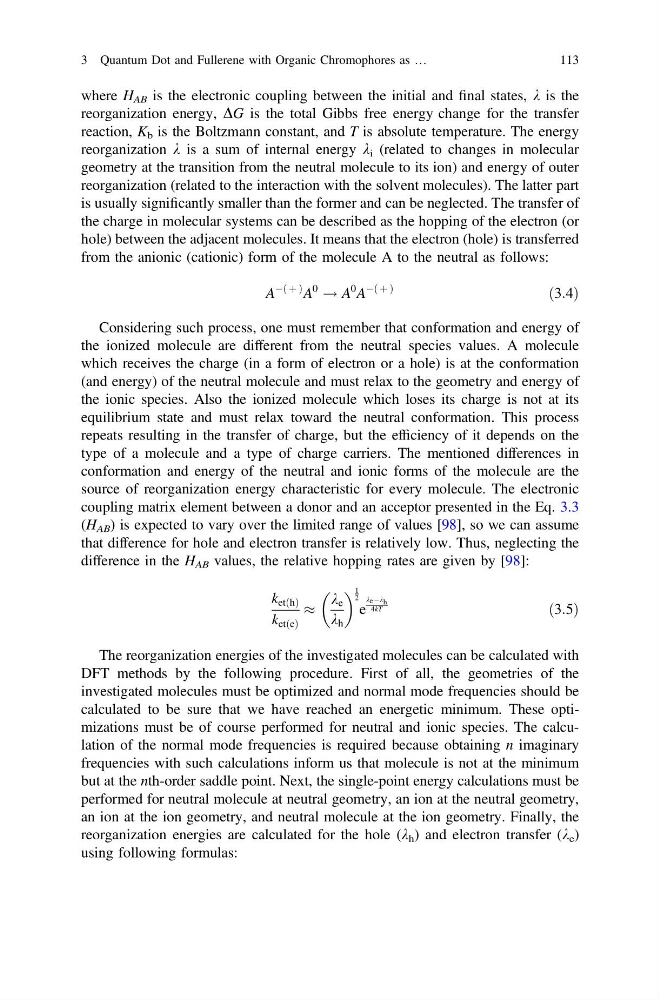
difference in the H AB values, the relative hopping rates are given by [98]:
k et h
ð Þ
k et e
ð Þ
%
k e
k h
1
2
e
keÀk h
4kT
ð3:5Þ
The reorganization energies of the investigated molecules can be calculated with
DFT methods by the following procedure. First of all, the geometries of the
investigated molecules must be optimized and normal mode frequencies should be
calculated to be sure that we have reached an energetic minimum. These optimizations must be of course performed for neutral and ionic species. The calculation of the normal mode frequencies is required because obtaining n imaginary
frequencies with such calculations inform us that molecule is not at the minimum
but at the nth-order saddle point. Next, the single-point energy calculations must be
performed for neutral molecule at neutral geometry, an ion at the neutral geometry,
an ion at the ion geometry, and neutral molecule at the ion geometry. Finally, the
reorganization energies are calculated for the hole (k h ) and electron transfer (k e )
using following formulas:
3 Quantum Dot and Fullerene with Organic Chromophores as …
113
reorganization energy, DG is the total Gibbs free energy change for the transfer
reaction, K b is the Boltzmann constant, and T is absolute temperature. The energy
reorganization k is a sum of internal energy k i (related to changes in molecular
geometry at the transition from the neutral molecule to its ion) and energy of outer
reorganization (related to the interaction with the solvent molecules). The latter part
is usually significantly smaller than the former and can be neglected. The transfer of
the charge in molecular systems can be described as the hopping of the electron (or
hole) between the adjacent molecules. It means that the electron (hole) is transferred
from the anionic (cationic) form of the molecule A to the neutral as follows:
A
À þ
ð Þ A
0
! A
0 A
À þ
ð Þ
ð3:4Þ
Considering such process, one must remember that conformation and energy of
the ionized molecule are different from the neutral species values. A molecule
which receives the charge (in a form of electron or a hole) is at the conformation
(and energy) of the neutral molecule and must relax to the geometry and energy of
the ionic species. Also the ionized molecule which loses its charge is not at its
equilibrium state and must relax toward the neutral conformation. This process
repeats resulting in the transfer of charge, but the efficiency of it depends on the
type of a molecule and a type of charge carriers. The mentioned differences in
conformation and energy of the neutral and ionic forms of the molecule are the
source of reorganization energy characteristic for every molecule. The electronic
coupling matrix element between a donor and an acceptor presented in the Eq. 3.3
(H AB ) is expected to vary over the limited range of values [98], so we can assume
that difference for hole and electron transfer is relatively low. Thus, neglecting the
difference in the H AB values, the relative hopping rates are given by [98]:
k et h
ð Þ
k et e
ð Þ
%
k e
k h
1
2
e
keÀk h
4kT
ð3:5Þ
The reorganization energies of the investigated molecules can be calculated with
DFT methods by the following procedure. First of all, the geometries of the
investigated molecules must be optimized and normal mode frequencies should be
calculated to be sure that we have reached an energetic minimum. These optimizations must be of course performed for neutral and ionic species. The calculation of the normal mode frequencies is required because obtaining n imaginary
frequencies with such calculations inform us that molecule is not at the minimum
but at the nth-order saddle point. Next, the single-point energy calculations must be
performed for neutral molecule at neutral geometry, an ion at the neutral geometry,
an ion at the ion geometry, and neutral molecule at the ion geometry. Finally, the
reorganization energies are calculated for the hole (k h ) and electron transfer (k e )
using following formulas:
3 Quantum Dot and Fullerene with Organic Chromophores as …
113