

electron-donor chromophores and form supermolecular complexes. They are perfect electron acceptors, chemically and temperature very stable. Thus, fullerenes are
materials with special properties, they are currently on the top of the interest of
many researchers due to their specific spectroscopic properties, and it is material of
very low reorganization energy. The more detailed description of fullerene properties and applications is widely described in [80].
3.6 Energy and Electron Transfer
Extensive investigations of photoprocesses and their mechanisms by determination
of the ability of corrole-fullerene dyads to fast charge separation, slow charges
recombination, excitation energy, and electron transfer are being carried out. Thus,
the ability of the system to photocurrent generation after light absorption will be
better recognized. It is also important to get some knowledge what requirements
have to be fulfilled by proposed donor-acceptor units as effective agents in light
energy conversion into electric energy. Up to date, the role of corroles, fullerenes,
corroles-fullerene dyads in organic photovoltaics is not fully known yet. Thus, in
this chapter we have focused our attention on a family of meso-substituted corrole
dyes and their dyads with fullerene as an electron-donor-acceptor model.
One of the most important keys in tailoring new optoelectronic devices is the
knowledge of energy and electron transfer processes between electron donor
(D) and electron acceptor (A) as well as their mechanisms. It is very important and
useful in developing and proper designing of photovoltaic devices based on organic
materials. Participation of organic dyes and their dyads in energy and electron
transfer is the goal of many experimental and theoretical investigations [81–88].
Phenomena and processes essential for high effectiveness of optoelectronic devices
based on molecular systems include: strong p–p light absorption, efficient energy
transfer between D and A, fast electron transfer in a D–A chain followed by charge
separation and slow charge recombination [81–88].
The model of the excitation energy transfer process was proposed for the first
time by Förster [89, 90]—Förster long-range resonance excitation energy transfer
(FRET). The model is useful in studying interaction in a D–A unit distanced in the
nanoscale range. The energy transfer process described by the Förster model takes
place when the distances between D and A ranges from about 10 Å to about 100 Å
and requires overlapping of the D and A wave functions. The Förster mechanism is
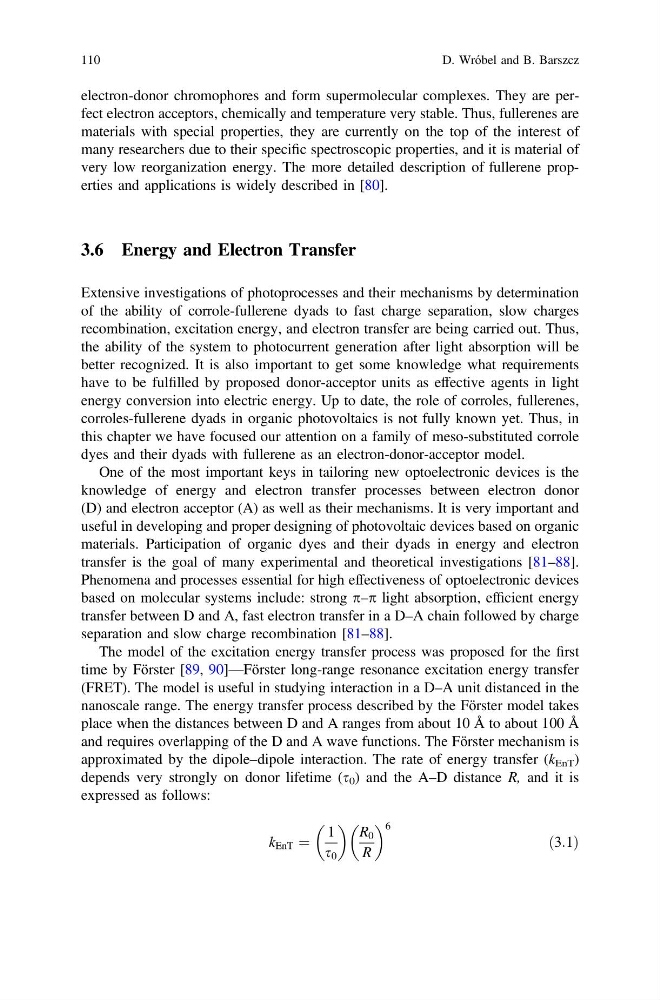
approximated by the dipole–dipole interaction. The rate of energy transfer (k EnT )
depends very strongly on donor lifetime (s 0 ) and the A–D distance R, and it is
expressed as follows:
k EnT ¼
1
s 0
R 0
R
6
ð3:1Þ
110
D. Wróbel and B. Barszcz
materials with special properties, they are currently on the top of the interest of
many researchers due to their specific spectroscopic properties, and it is material of
very low reorganization energy. The more detailed description of fullerene properties and applications is widely described in [80].
3.6 Energy and Electron Transfer
Extensive investigations of photoprocesses and their mechanisms by determination
of the ability of corrole-fullerene dyads to fast charge separation, slow charges
recombination, excitation energy, and electron transfer are being carried out. Thus,
the ability of the system to photocurrent generation after light absorption will be
better recognized. It is also important to get some knowledge what requirements
have to be fulfilled by proposed donor-acceptor units as effective agents in light
energy conversion into electric energy. Up to date, the role of corroles, fullerenes,
corroles-fullerene dyads in organic photovoltaics is not fully known yet. Thus, in
this chapter we have focused our attention on a family of meso-substituted corrole
dyes and their dyads with fullerene as an electron-donor-acceptor model.
One of the most important keys in tailoring new optoelectronic devices is the
knowledge of energy and electron transfer processes between electron donor
(D) and electron acceptor (A) as well as their mechanisms. It is very important and
useful in developing and proper designing of photovoltaic devices based on organic
materials. Participation of organic dyes and their dyads in energy and electron
transfer is the goal of many experimental and theoretical investigations [81–88].
Phenomena and processes essential for high effectiveness of optoelectronic devices
based on molecular systems include: strong p–p light absorption, efficient energy
transfer between D and A, fast electron transfer in a D–A chain followed by charge
separation and slow charge recombination [81–88].
The model of the excitation energy transfer process was proposed for the first
time by Förster [89, 90]—Förster long-range resonance excitation energy transfer
(FRET). The model is useful in studying interaction in a D–A unit distanced in the
nanoscale range. The energy transfer process described by the Förster model takes
place when the distances between D and A ranges from about 10 Å to about 100 Å
and requires overlapping of the D and A wave functions. The Förster mechanism is
approximated by the dipole–dipole interaction. The rate of energy transfer (k EnT )
depends very strongly on donor lifetime (s 0 ) and the A–D distance R, and it is
expressed as follows:
k EnT ¼
1
s 0
R 0
R
6
ð3:1Þ
110
D. Wróbel and B. Barszcz