

some copper(III) corroles, usually at slightly lower wave number [72]. The extra
sample-independent band is also observed at about 929 cm
–1 . It was also observed
earlier [77], and it is assigned to the in-plane deformation of the corrole macroring.
Moreover, the band at about 986 cm
−1 related mainly to the stretching vibration of
the CF bonds in one of the C 6 F 5 rings is also observed in all samples at almost the
same wave number. The group of bands at about 754, 770, and 794 cm
−1 is related
to some in-plane bending of the C–C bonds in the corrole macroring and mostly to
the out-of-plane CH bending in the macroring. Since the common part of the
molecules is involved in those vibrations, the resulting bands also appear in the
spectra of both corroles. The differences related to the presence of the changed
substituent are easy to be noticed besides many similarities in the IR spectra
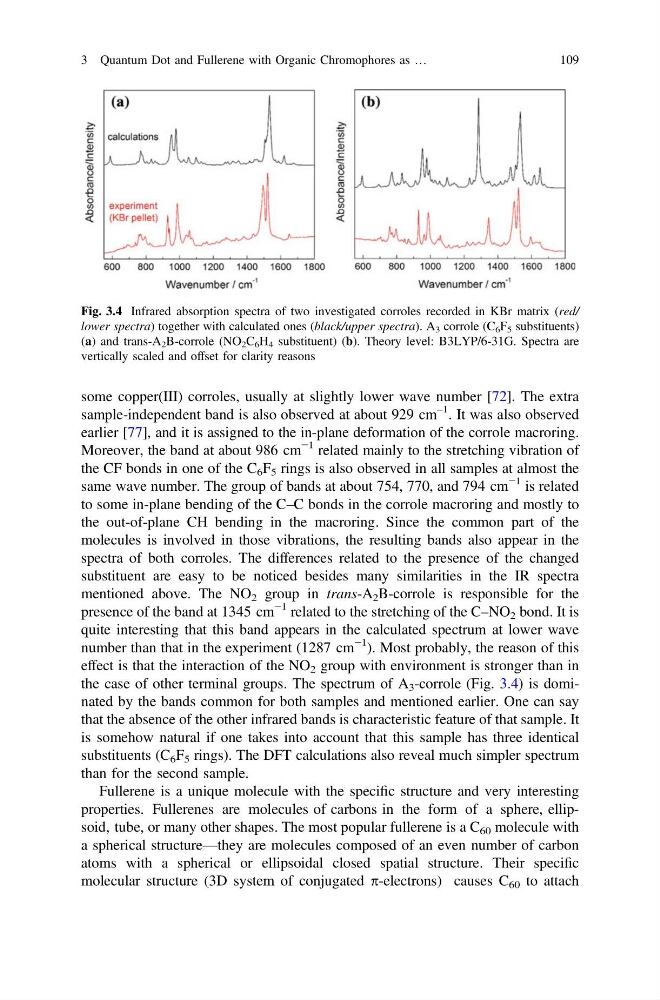
mentioned above. The NO 2 group in trans-A 2 B-corrole is responsible for the
presence of the band at 1345 cm
−1 related to the stretching of the C–NO 2 bond. It is
quite interesting that this band appears in the calculated spectrum at lower wave
number than that in the experiment (1287 cm
−1
). Most probably, the reason of this
effect is that the interaction of the NO 2 group with environment is stronger than in
the case of other terminal groups. The spectrum of A 3 -corrole (Fig. 3.4) is dominated by the bands common for both samples and mentioned earlier. One can say
that the absence of the other infrared bands is characteristic feature of that sample. It
is somehow natural if one takes into account that this sample has three identical
substituents (C 6 F 5 rings). The DFT calculations also reveal much simpler spectrum
than for the second sample.
Fullerene is a unique molecule with the specific structure and very interesting
properties. Fullerenes are molecules of carbons in the form of a sphere, ellipsoid, tube, or many other shapes. The most popular fullerene is a C 60 molecule with
a spherical structure—they are molecules composed of an even number of carbon
atoms with a spherical or ellipsoidal closed spatial structure. Their specific
molecular structure (3D system of conjugated p-electrons) causes C 60 to attach
Fig. 3.4 Infrared absorption spectra of two investigated corroles recorded in KBr matrix (red/
lower spectra) together with calculated ones (black/upper spectra). A 3 corrole (C 6 F 5 substituents)
(a) and trans-A 2 B-corrole (NO 2 C 6 H 4 substituent) (b). Theory level: B3LYP/6-31G. Spectra are
vertically scaled and offset for clarity reasons
3 Quantum Dot and Fullerene with Organic Chromophores as …
109
sample-independent band is also observed at about 929 cm
–1 . It was also observed
earlier [77], and it is assigned to the in-plane deformation of the corrole macroring.
Moreover, the band at about 986 cm
−1 related mainly to the stretching vibration of
the CF bonds in one of the C 6 F 5 rings is also observed in all samples at almost the
same wave number. The group of bands at about 754, 770, and 794 cm
−1 is related
to some in-plane bending of the C–C bonds in the corrole macroring and mostly to
the out-of-plane CH bending in the macroring. Since the common part of the
molecules is involved in those vibrations, the resulting bands also appear in the
spectra of both corroles. The differences related to the presence of the changed
substituent are easy to be noticed besides many similarities in the IR spectra
mentioned above. The NO 2 group in trans-A 2 B-corrole is responsible for the
presence of the band at 1345 cm
−1 related to the stretching of the C–NO 2 bond. It is
quite interesting that this band appears in the calculated spectrum at lower wave
number than that in the experiment (1287 cm
−1
). Most probably, the reason of this
effect is that the interaction of the NO 2 group with environment is stronger than in
the case of other terminal groups. The spectrum of A 3 -corrole (Fig. 3.4) is dominated by the bands common for both samples and mentioned earlier. One can say
that the absence of the other infrared bands is characteristic feature of that sample. It
is somehow natural if one takes into account that this sample has three identical
substituents (C 6 F 5 rings). The DFT calculations also reveal much simpler spectrum
than for the second sample.
Fullerene is a unique molecule with the specific structure and very interesting
properties. Fullerenes are molecules of carbons in the form of a sphere, ellipsoid, tube, or many other shapes. The most popular fullerene is a C 60 molecule with
a spherical structure—they are molecules composed of an even number of carbon
atoms with a spherical or ellipsoidal closed spatial structure. Their specific
molecular structure (3D system of conjugated p-electrons) causes C 60 to attach
Fig. 3.4 Infrared absorption spectra of two investigated corroles recorded in KBr matrix (red/
lower spectra) together with calculated ones (black/upper spectra). A 3 corrole (C 6 F 5 substituents)
(a) and trans-A 2 B-corrole (NO 2 C 6 H 4 substituent) (b). Theory level: B3LYP/6-31G. Spectra are
vertically scaled and offset for clarity reasons
3 Quantum Dot and Fullerene with Organic Chromophores as …
109