

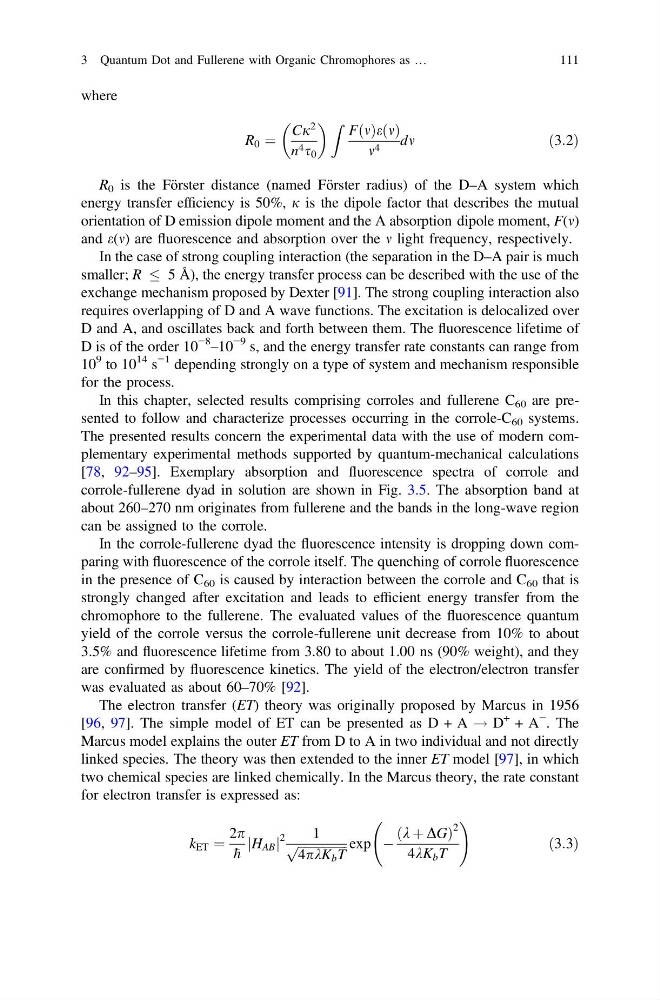
where
R 0 ¼
Cj
2
n 4 s 0
Z
F m
ð Þe m
ð Þ
m 4 dm
ð3:2Þ
R 0 is the Förster distance (named Förster radius) of the D–A system which
energy transfer efficiency is 50%, j is the dipole factor that describes the mutual
orientation of D emission dipole moment and the A absorption dipole moment, F(m)
and e(m) are fluorescence and absorption over the m light frequency, respectively.
In the case of strong coupling interaction (the separation in the D–A pair is much
smaller; R
5 Å), the energy transfer process can be described with the use of the
exchange mechanism proposed by Dexter [91]. The strong coupling interaction also
requires overlapping of D and A wave functions. The excitation is delocalized over
D and A, and oscillates back and forth between them. The fluorescence lifetime of
D is of the order 10
−8
–10
−9 s, and the energy transfer rate constants can range from
10
9 to 10
14 s
−1 depending strongly on a type of system and mechanism responsible
for the process.
In this chapter, selected results comprising corroles and fullerene C 60 are presented to follow and characterize processes occurring in the corrole-C 60 systems.
The presented results concern the experimental data with the use of modern complementary experimental methods supported by quantum-mechanical calculations
[78, 92–95]. Exemplary absorption and fluorescence spectra of corrole and
corrole-fullerene dyad in solution are shown in Fig. 3.5. The absorption band at
about 260–270 nm originates from fullerene and the bands in the long-wave region
can be assigned to the corrole.
In the corrole-fullerene dyad the fluorescence intensity is dropping down comparing with fluorescence of the corrole itself. The quenching of corrole fluorescence
in the presence of C 60 is caused by interaction between the corrole and C 60 that is
strongly changed after excitation and leads to efficient energy transfer from the
chromophore to the fullerene. The evaluated values of the fluorescence quantum
yield of the corrole versus the corrole-fullerene unit decrease from 10% to about
3.5% and fluorescence lifetime from 3.80 to about 1.00 ns (90% weight), and they
are confirmed by fluorescence kinetics. The yield of the electron/electron transfer
was evaluated as about 60–70% [92].
The electron transfer (ET) theory was originally proposed by Marcus in 1956
[96, 97]. The simple model of ET can be presented as D + A ! D
+ + A
−
. The
Marcus model explains the outer ET from D to A in two individual and not directly
linked species. The theory was then extended to the inner ET model [97], in which
two chemical species are linked chemically. In the Marcus theory, the rate constant
for electron transfer is expressed as:
k ET ¼
2p
h
H AB
j
j
2
1
ffiffiffiffiffiffiffiffiffiffiffiffiffiffiffiffi
4pkK b T
p
exp À
k þ DG
ð
Þ
2
4kK b T
!
ð3:3Þ
3 Quantum Dot and Fullerene with Organic Chromophores as …
111
R 0 ¼
Cj
2
n 4 s 0
Z
F m
ð Þe m
ð Þ
m 4 dm
ð3:2Þ
R 0 is the Förster distance (named Förster radius) of the D–A system which
energy transfer efficiency is 50%, j is the dipole factor that describes the mutual
orientation of D emission dipole moment and the A absorption dipole moment, F(m)
and e(m) are fluorescence and absorption over the m light frequency, respectively.
In the case of strong coupling interaction (the separation in the D–A pair is much
smaller; R
5 Å), the energy transfer process can be described with the use of the
exchange mechanism proposed by Dexter [91]. The strong coupling interaction also
requires overlapping of D and A wave functions. The excitation is delocalized over
D and A, and oscillates back and forth between them. The fluorescence lifetime of
D is of the order 10
−8
–10
−9 s, and the energy transfer rate constants can range from
10
9 to 10
14 s
−1 depending strongly on a type of system and mechanism responsible
for the process.
In this chapter, selected results comprising corroles and fullerene C 60 are presented to follow and characterize processes occurring in the corrole-C 60 systems.
The presented results concern the experimental data with the use of modern complementary experimental methods supported by quantum-mechanical calculations
[78, 92–95]. Exemplary absorption and fluorescence spectra of corrole and
corrole-fullerene dyad in solution are shown in Fig. 3.5. The absorption band at
about 260–270 nm originates from fullerene and the bands in the long-wave region
can be assigned to the corrole.
In the corrole-fullerene dyad the fluorescence intensity is dropping down comparing with fluorescence of the corrole itself. The quenching of corrole fluorescence
in the presence of C 60 is caused by interaction between the corrole and C 60 that is
strongly changed after excitation and leads to efficient energy transfer from the
chromophore to the fullerene. The evaluated values of the fluorescence quantum
yield of the corrole versus the corrole-fullerene unit decrease from 10% to about
3.5% and fluorescence lifetime from 3.80 to about 1.00 ns (90% weight), and they
are confirmed by fluorescence kinetics. The yield of the electron/electron transfer
was evaluated as about 60–70% [92].
The electron transfer (ET) theory was originally proposed by Marcus in 1956
[96, 97]. The simple model of ET can be presented as D + A ! D
+ + A
−
. The
Marcus model explains the outer ET from D to A in two individual and not directly
linked species. The theory was then extended to the inner ET model [97], in which
two chemical species are linked chemically. In the Marcus theory, the rate constant
for electron transfer is expressed as:
k ET ¼
2p
h
H AB
j
j
2
1
ffiffiffiffiffiffiffiffiffiffiffiffiffiffiffiffi
4pkK b T
p
exp À
k þ DG
ð
Þ
2
4kK b T
!
ð3:3Þ
3 Quantum Dot and Fullerene with Organic Chromophores as …
111